


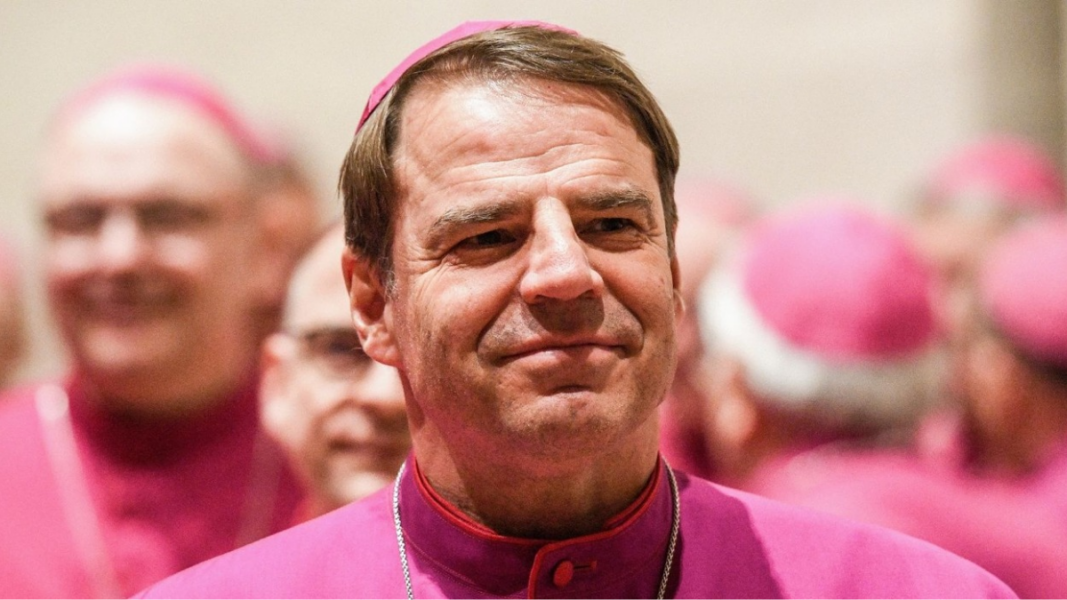
The Bishop of Passau (Germany), Monsignor Stefan Oster, had already made it clear that he would not apply in his diocese the main resolutions of the German Synodal Way nor the monitoring system planned to oversee its implementation. On that occasion, he defended that the future of the Church does not lie in structural reforms or doctrinal changes, but in an authentic spiritual renewal faithful to Catholic teaching.
The German Episcopal Conference recently approved in Würzburg the statutes of the new body, called to bring together bishops and laity to debate and adopt resolutions on the future of the Church in Germany. However, the project remains pending the definitive judgment of the Vatican, after months of dialogue and tensions.
Read also: German bishops will ask the Vatican to authorize lay preaching at Mass
Now Mons. Oster has conditioned his participation on the explicit approval of the Holy See. In an interview granted to Katholisch.de, the prelate makes it clear that communion with Rome and fidelity to Catholic anthropology are non-negotiable lines for him.
Communion with the universal Church as a condition
Oster, who abandoned the so-called Synodal Way at the time, does not rule out rejoining the process. But he sets a clear condition: “If we do it in agreement with the universal Church, I will participate.”
The bishop assures that he is awaiting Rome’s reaction. He recognizes that, after more than two years of conversations, there is a shared interest in avoiding a head-on clash. In his view, “no one wants to come out with a loss of credibility,” which makes it foreseeable that the Synodal Conference will eventually be established, albeit not without adjustments.
An anthropology in dispute
One of the most delicate points is the so-called “monitoring” [monitoring system] planned to oversee the application in the dioceses of the Synodal Way resolutions. Oster warns that many of those points “already presuppose a different anthropology.”
“I am Catholic and I defend Catholic anthropology,” he states clearly. For this reason, he rejects that it be monitored whether his diocese adopts measures “that have not been given or permitted by the universal Church.” The conflict, therefore, is not only jurisdictional, but doctrinal.
In the background is the debate on moral and ecclesiological issues that the Synodal Way has sought to reframe. From Rome, explicit warnings have been issued in recent years about the creation of national structures with competencies that may affect the proper authority of bishops or alter the hierarchical balance of the Church.
Synodality or parliamentary logic
Oster also questions the way in which some votes in the German process were conducted. According to his account, members of the Episcopal Conference itself confessed to him that, in public and nominal votes, they ended up supporting proposals under environmental pressure, even against their personal conviction.
Read also: Without solid consensus: this is how the German «Synodal Conference» was approved
For the Bishop of Passau, authentic synodality requires real listening in a protected space, without political calculations or the pursuit of majorities. He also recalls that the Pope has pointed out that synodality is not intended to change doctrine, but to live and transmit the faith better. In Germany, on the other hand, the modification of teaching has frequently occupied the center of the debate.
Episcopal unity and relationship with Rome
Asked about the new president of the German Episcopal Conference, Bishop Heiner Wilmer, Oster expresses confidence that he will know how to convey to Rome the resolutions adopted, noting that there was no full unanimity among the bishops.
In his own diocese, the prelate says he has openly debated the issue with the consultative bodies and has received majority support for maintaining a prudent stance toward certain developments in the synodal process.
Young people seeking liturgy and tradition
In contrast to the serious crisis facing the Church in Germany—with hundreds of thousands of annual departures—Oster observes a striking phenomenon: young people who discover or rediscover the Catholic faith, often through the internet.
These are, he explains, people who seek liturgy, tradition, and a clear identity in Christ. They consume content on digital platforms and do not always find an immediate fit in conventional parish structures.
For the bishop, the Church must open adequate spaces for welcome and accompaniment. If this movement is stable and not fleeting, it could become a true impetus for spiritual renewal.
Meanwhile, the German Synodal Conference remains pending Rome’s verdict. And for Stefan Oster, the dividing line remains clear: without communion with the universal Church and without fidelity to the received doctrine, there will be no participation.