


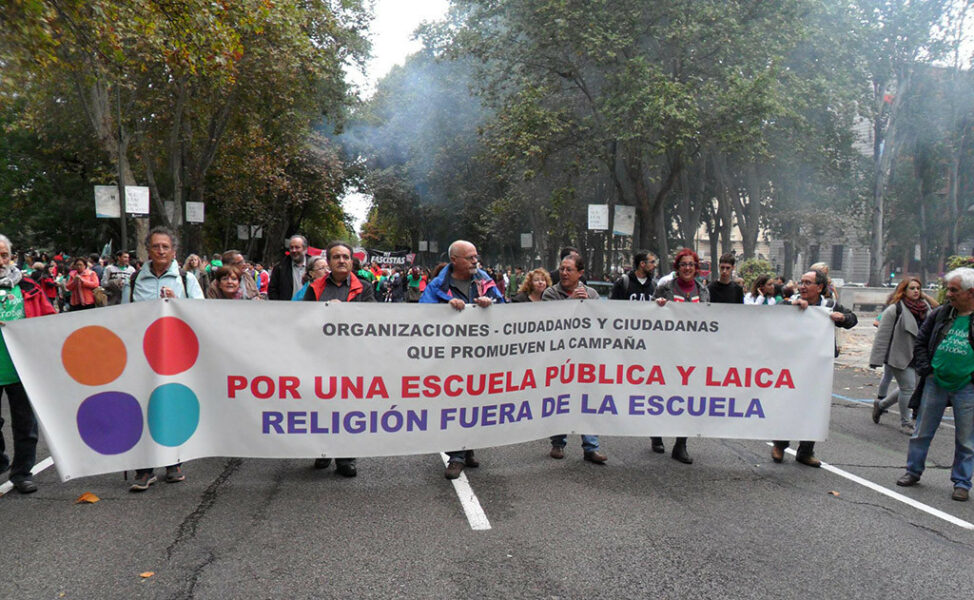
A total of 68 social, union, and political organizations have published a manifesto demanding the immediate removal of confessional Religion from education, advancing toward a fully secular school, and repealing the Agreements with the Holy See. The initiative is presented as a unitary campaign for 2026 under the slogan “Religion out of school” and accuses the Government of “immobilism.” Among the signatories are entities such as Europa Laica, CEAPA, STEs-i, the Federación de Enseñanza de CCOO, as well as Izquierda Unida and Podemos.
Context matters. The visit of Pope Leo XIV to Spain is confirmed from June 6 to 12, 2026, with the detailed program still pending official publication. In that framework, the manifesto functions as a first pressure move: it seeks to condition the political environment, set the interpretive framework, and force institutions to show distances from the Church just when the media spotlight will inevitably shift toward the presence of the Pontiff and the public meaning of Catholicism in Spain.
The promoters denounce the existence of Religion teachers appointed by the bishops and argue that the subject fulfills a “proselytizing” mission. Additionally, they link the defense of a secular school with a general critique of the concerted network, emphasizing that a majority of these centers have a Catholic ideology and alleging that there families would be more “conditioned” to choose Religion. The manifesto also insists on the idea of ideological “segregation” from early ages and on the need to eliminate any public funding that, in their view, sustains “indoctrination.”
What is decisive is that the discussion is not just administrative. It is cultural. Spain cannot be understood without Catholicism, and that is why the proposal to expel Religion from the curriculum is not neutrality: it is intellectual amputation. A person who is ignorant of Catholic doctrine cannot tour El Prado with real understanding, nor read the iconography of Spanish art, nor interpret the meaning of our cathedrals, altarpieces, and festivals, nor walk through the historic streets of the country understanding what they see. Nor can they seriously read the most important poetry in Spanish, traversed by biblical, theological, liturgical, and moral references, without staying on the surface.
That is why, in terms of basic education, the response should not be limited to “tolerating” Religion as a marginal elective. If what is intended is education and not mere utilitarian instruction, the teaching of Religion should be mandatory, at least in its doctrinal and cultural core, as a key to reading our history, our art, and our literature. The opposite does not produce free citizens: it produces illiterates of one’s own identity. And elevating that ignorance to educational policy is institutionalizing inculture and turning the school system into a factory of people who opine about Spain without understanding it.