


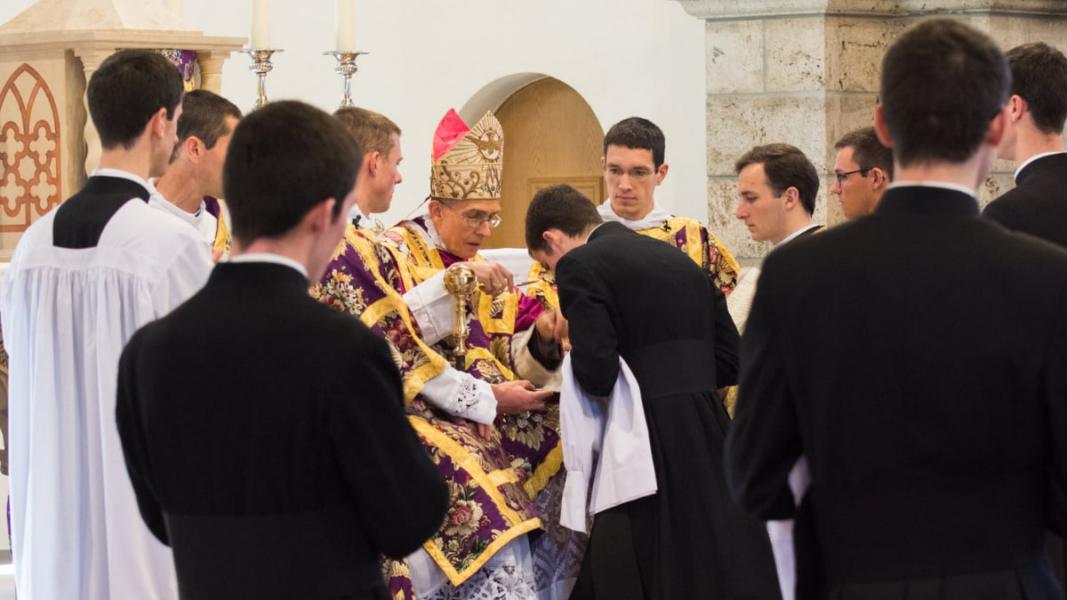
The philosopher and theologian Peter Kwasniewski, one of the most influential voices in contemporary traditional Catholic thought, has published a reflection following the announcement of the upcoming episcopal consecrations linked to the Priestly Fraternity of Saint Pius X (FSSPX), scheduled for July 1. In his text, Kwasniewski addresses the event without slogans or catchphrases, recognizing both the gravity of the moment and the doctrinal and ecclesial tensions that traverse the Church, and offering a nuanced assessment that avoids both automatic condemnation and uncritical idealization.
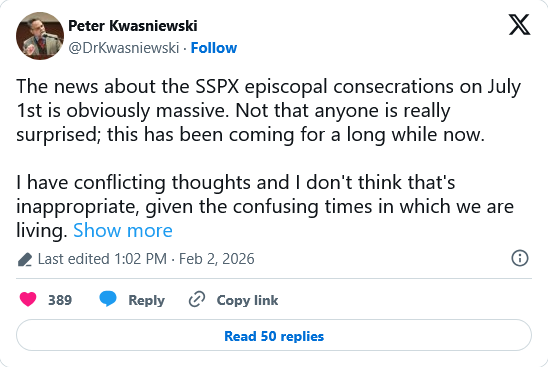
We leave below the full text of Dr. Kwasniewski:
The news about the FSSPX’s episcopal consecrations on July 1 is, obviously, massive. It’s not that it really surprises anyone; this has been coming for a long time.
I have contradictory ideas, and I don’t think it’s inappropriate, given the confusing times we live in. Anyone who expects me to condemn the FSSPX or to value it unconditionally will be disappointed. I have always been moderately pro-FSSPX, my stance on the matter is well known; but I have also always said that I believe it is objectively better to be in regular institutional communion with the Catholic hierarchy, which is why I have always attended and would attend Mass with an Ecclesia Dei institute, if I could choose.
Allow me to simply say: there is a great good at stake, as well as a great evil.
The greatest good is full and regular communion with the Church’s hierarchy. The Ecclesia Dei institutes have chosen this good as a fundamental principle and, as a result, often do not express themselves with the same force or clarity on current problems. Even so, they are manifestly doing the Lord’s work; they are restoring tradition stealthily and patiently around the world. I have seen the immense fruits. They are rebuilding the Church from the ground up, one apostolate at a time.
On the other hand, the great evil is the modernism that has infected the Church at all levels, to such an extent that it is now taken for granted; it has become an omnipresent, invisible, and odorless noxious gas. In the face of this trend, Archbishop Lefebvre positioned himself courageously in defense of the traditional Catholic faith («Between Rome and Rebellion», by Yves Chiron, is essential reading for those who wish to understand the depth of the crisis he faced, a crisis we still face), and his Fraternity continues to hold high that shining torch. I admire them for their witness, which they have acquired at a high price.
I pray daily for all the Ecclesia Dei institutes, all the diocesan priests who celebrate the traditional Mass, and the Priestly Fraternity of Saint Pius X. I wish them the best, in the charity of Christ. I would be deeply saddened by a world without any of them. I pray in particular for the healing of the numerous ruptures that wound modern Catholicism: not only the ruptures with canonical communion, which are regrettable, but, much worse, the terrible rupture with Catholic Tradition that explains why the Church is in such a lamentable state (and why the FSSPX exists).