


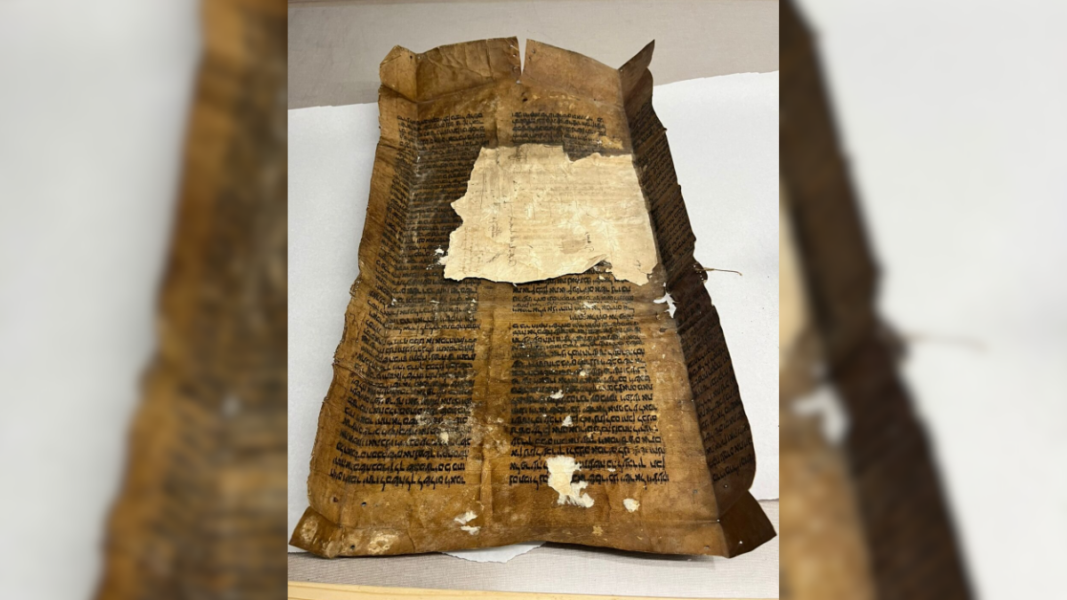
The Diocese of Calahorra and La Calzada-Logroño has reported the discovery of a manuscript of notable historical and religious value: a fragment of a Hebrew Torah dated between the 14th and 15th centuries. The discovery took place within the framework of the digitization project of the parish archives of Alfaro, promoted by the diocese to ensure the conservation and access to the documentary funds.
A Fragment Hidden in a 16th-Century Binding
According to the diocese, the discovery took place on September 19th last in the facilities of the Diocesan Archive of Logroño. During the review of photographs of the Book of Accounts of the Collegiate Church of San Miguel de Alfaro (1506–1547), the archivist Bruno Martínez Partidas noticed the presence of hidden Hebrew characters under the paper that reinforced the binding.
After reporting it to the director of the Archive, Jesús Merino Morga, the conservation protocol was activated and the specialized intervention of Códice Rioja was requested to safely separate the parchment and ensure its independent custody.
A Text from the Book of Exodus
The study and transcription of the manuscript, carried out by the specialist Manuel Hernández Sigüenza, confirmed that it is a fragment of a Torah scroll, equivalent to the Pentateuch in the Christian tradition. The passage corresponds to Exodus 4:18 – 7:17, which narrates Moses’ mission to free the people of Israel and the beginning of the plagues in the face of the pharaoh’s refusal.
Characteristics of the Manuscript and Historical Context
The parchment, made from calfskin and measuring 620 by 395 millimeters, features square Hebrew script without vowels, arranged in columns according to liturgical tradition. The presence of tagin —small strokes that crown certain letters— indicates that it was produced by a sofer, a professional scribe in charge of creating manuscripts intended for worship.
The specialists place its probable origin between the years 1350 and 1450, possibly from the Jewish quarters of Calahorra or Tudela, two of the main centers of Jewish cultural and religious activity in the region during the Late Middle Ages.
A Relevant Discovery for the History of Alfaro
The diocese emphasizes that this fragment constitutes a milestone for Riojan research. It is the first material testimony of a sacred book linked to the ancient synagogue of Alfaro, whose existence was documented in archives but lacked physical evidence of this nature until now. The fragment is only the second written proof that confirms the historical presence of said Jewish temple in the locality.
A Project Supported by Local Collaboration
The discovery is framed within the digitization project of the parish funds of Alfaro, initiated in June. The diocese highlighted the participation of the parish priest of San Miguel and Santa María del Burgo, Carlos Esteban Hernando, and numerous neighbors who have collaborated in the classification and digitization of more than 1,500 documents.
According to the Diocese of Calahorra and La Calzada-Logroño itself, this joint work has allowed the recovery of a significant fragment of the religious history of the region, which will now be preserved as a reference piece for future research.