


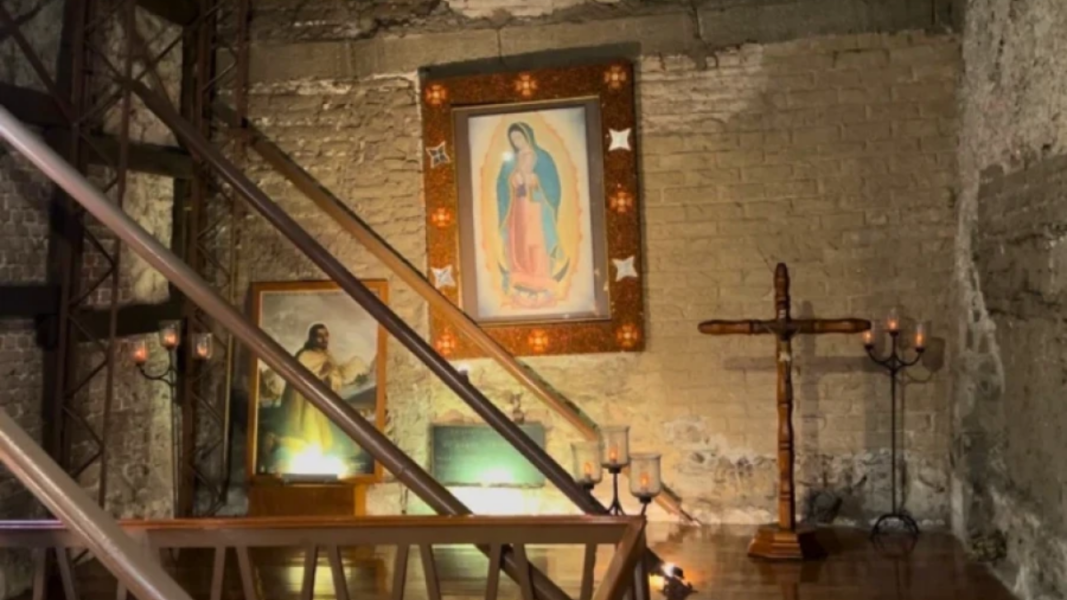
Few pilgrims know it, but on one side of the current Basilica of Guadalupe is preserved the first temple built to safeguard the miraculous image of the Virgin of Guadalupe. A discreet place, laden with history, where Saint Juan Diego lived and protected for years the tilma on which the image of the Mother of God was imprinted. ACI Prensa recovers its origin and meaning.
The beginning of everything: the small hermitage of Tepeyac
The story dates back to December 1531, when the Virgin appeared to Saint Juan Diego on the hill of Tepeyac and asked him to intercede with the first archbishop of Mexico, Fray Juan de Zumárraga, to build a temple there. After the apparitions and the verification of the facts, Zumárraga ordered the construction of a modest adobe hermitage to custody the tilma.
Saint Juan Diego settled next to that humble sanctuary for 17 years. He received pilgrims, personally recounted what had happened, and cared for the image with deep devotion. He lived there until his death in 1548, and was buried there as well. Although his house no longer exists, a cross marks the exact spot where it stood.
A temple for a marginalized people
Fr. José de Jesús Aguilar, a priest of the Archdiocese of Mexico, recalls that in the 16th century Tepeyac was a remote area of the city. Many indigenous people lived in those surroundings, far from the urban center and, in many cases, feeling forgotten and without rights.
That is why—notes the priest—the Virgin’s request to build her “sacred little house” in that place has a profound meaning: she wanted to approach precisely those who were on the social and geographical margins, showing that her love reached everyone, including the most forsaken.
Saint Juan Diego, first custodian and evangelizer
Fr. Aguilar emphasizes that Saint Juan Diego was the first great diffuser of Guadalupan devotion. His direct testimony, told firsthand, caused the news to spread quickly among the indigenous peoples. He recounted every detail: the weather, the singing of the birds, the exact location of each apparition, and even the face of the Virgin as he saw her. That closeness with the people—sharing language and culture—made the message take hold strongly.
The priest also explains that the Virgin addressed Saint Juan Diego with words that have accompanied the Mexican people for centuries: “Am I not here, who am your mother?”. These words, recorded in the Nican Mopohua, were spoken when the visionary was anguished by the illness of his uncle Juan Bernardino, whom the Virgin assured she had miraculously healed.
That maternal consolation, Fr. Aguilar recalls, remains relevant today for those who turn to her in moments of illness, fear, or uncertainty. It is a message that sustains hope: with the help of the Virgin, one can move forward.
From the first hermitage to the Old Parish of the Indians
Over time, devotion grew extraordinarily. The small adobe hermitage could no longer accommodate the pilgrims who arrived constantly. For this reason, in 1649 a new temple was built, today known as the Old Parish of the Indians.
Inside it, a wall from the first hermitage is still preserved: the place where the tilma remained on display for more than a hundred years, until it was transferred in April 1709 to the new Basilica.
This corner of Tepeyac—sometimes overlooked by those visiting the sanctuary—is a fundamental piece of Guadalupan history. There it all began: the presence of the Virgin, the fidelity of Saint Juan Diego, and the faith of an entire people who found in her consolation and hope.