


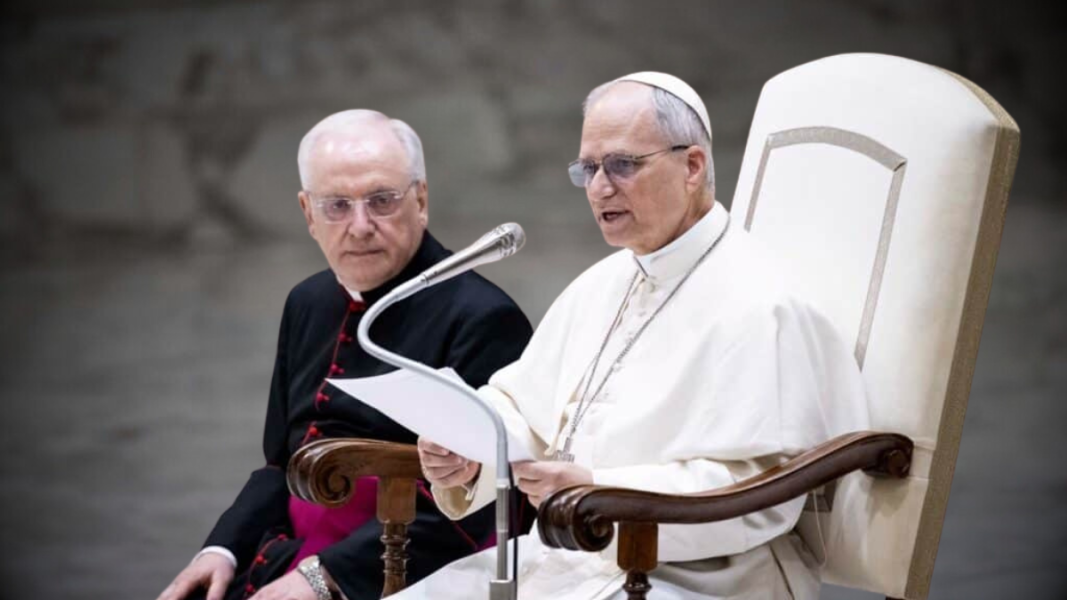
This Friday, October 10, Leo XIV received a delegation from Aid to the Church in Need (Ayuda a la Iglesia Necesitada, ACN) in the Apostolic Palace, as part of the Jubilee of Hope. In his speech, the Pontiff thanked the organization’s commitment to persecuted Christians and emphasized that religious freedom is “an essential and non-optional condition” for the life of peoples.
The Pope warned that the denial of this right leads to the disintegration of the social fabric: distrust replaces dialogue, suspicion replaces cooperation, and violence becomes the inevitable result. In this context, he recalled words from Francis: “there can be no peace without freedom of religion, freedom of thought, freedom of expression, and respect for the opinions of others”.
A mission in service to the persecuted
Leo XIV emphasized that ACN’s work is not abstract, but concrete: supporting isolated or pressured communities with the construction of chapels, the sustenance of religious sisters, the financing of radios and vehicles for the mission. He also thanked the aid to the dioceses of Peru, where he himself served as a missionary before arriving at the papacy, and where ACN continues to support pastoral works.
He also mentioned the impact of the Religious Freedom in the World Report, produced by the foundation for more than 25 years, which he described as a decisive tool for giving voice to the voiceless and making religious persecution visible around the world.
Religious freedom as a cornerstone
The Pontiff positioned religious freedom as “the cornerstone of any just society”, recalling the teaching of the Second Vatican Council in the declaration Dignitatis Humanae. He stressed that it is not a concession from the State, but a right inscribed in the very dignity of the person created in the image of God.
This emphasis can be interpreted as a reminder in the face of regimes that restrict faith and, at the same time, as an implicit rebuke to Western countries where, without open persecution, religious freedom is threatened by ideological laws or restrictions in the public sphere.
A message that challenges the West
While the Pope centered his words on the defense of persecuted Christians in Africa and Asia, his references to the disintegration of coexistence when freedom of conscience is limited also sound like a warning to Europe and the United States. There, the pressure from ideological currents against the Church’s magisterium translates into legal and social sanctions for those who defend the truth of marriage, life, or family.
In a world that oscillates between violence against Christians and the subtle silencing of faith in the West, Leo XIV’s words seek to position religious freedom as the thermometer of true social justice.
We leave below the full (and translated) message from Leo XIV:
In the name of the Father, and of the Son, and of the Holy Spirit.
Peace be with you!
Good morning to all and welcome.
Dear brothers and sisters:
I am pleased to greet you, dear members of Aid to the Church in Need International, as you gather in Rome during this Jubilee of Hope. Your visit comes at an opportune moment, for our world continues to witness growing hostility and violence against those who hold different convictions, including many Christians. In contrast, your mission proclaims that, as one family in Christ, we do not abandon our persecuted brothers and sisters. Rather, we remember them, stand by their side, and work to ensure their God-given freedoms. The words of Saint Paul remind us: “If one member suffers, all suffer together with it” (1 Cor 12:26). These words resonate in our hearts today, because the suffering of any member of the Body of Christ is shared by the whole Church. With this truth before us, I address you this morning.
Every human being carries in his heart a profound longing for truth, for meaning, and for communion with others and with God. This longing springs from the depths of our being. For this reason, the right to religious freedom is not optional, but essential. Rooted in the dignity of the human person, created in the image of God and endowed with reason and free will, religious freedom allows persons and communities to seek the truth, live it freely, and bear witness to it openly. For this reason, it is a cornerstone of every just society, as it safeguards the moral space in which conscience can be formed and exercised.
Religious freedom, therefore, is not merely a legal right or a privilege granted by governments; it is a fundamental condition that makes authentic reconciliation possible. When this freedom is denied, the human person is deprived of the capacity to respond freely to the call of truth. What follows is a slow disintegration of the ethical and spiritual bonds that sustain communities; trust gives way to fear, suspicion replaces dialogue, and oppression begets violence. Indeed, as my venerable predecessor observed, “there can be no peace without freedom of religion, freedom of thought, freedom of expression, and respect for the opinions of others” (Francis, Urbi et Orbi, April 20, 2025).
For this reason, the Catholic Church has always defended religious freedom for all peoples. The Second Vatican Council, in Dignitatis humanae, declared that this right must be recognized in the legal and institutional life of every nation (cf. December 7, 1965, 4). The defense of religious freedom, then, cannot remain abstract; it must be lived, protected, and promoted in the daily life of persons and communities.
From this conviction, your organization was born. Founded in 1947 as a response to the immense suffering left in the wake of the war, its mission from the beginning has been to foster forgiveness and reconciliation, and to accompany and give voice to the Church wherever it is needy, wherever it is threatened, wherever it suffers.
For more than twenty-five years, your Religious Freedom in the World Report has been a powerful instrument for raising awareness. This report does more than provide information; it bears witness, gives voice to the voiceless, and reveals the hidden suffering of many.
Your commitment also extends to supporting the Church’s mission around the world, reaching communities that are all too often isolated, marginalized, or under pressure. Wherever Aid to the Church in Need rebuilds a chapel, sustains a religious sister, or provides a radio station or vehicle, you strengthen the life of the Church, as well as the spiritual and moral fabric of society. And, as you surely know, your organization has helped many missions in Peru, including those of the Diocese of Chiclayo, where I had the privilege of serving.
Your aid, likewise, enables Christians—even small and vulnerable minorities—to be “peacemakers” (Mt 5:9) in their homelands. In countries like the Central African Republic, Burkina Faso, and Mozambique, the local Church—often sustained by your help—becomes a living sign of social harmony and fraternity, showing its neighbors that a different world is possible (cf. Angelus, August 3, 2025).
Dear friends, I thank each one of you for this work of solidarity. Do not grow weary in doing good (cf. Gal 6:9), because your service bears fruit in countless lives and gives glory to our Father in heaven. In conclusion, I invoke upon you and upon all those you serve the consolation of the Holy Spirit. May the Most Holy Virgin Mary, Mother of Hope, remain close to you and to all who suffer. With deep affection, I impart my Apostolic Blessing as a pledge of grace and peace in Jesus Christ, our Lord.