


In the early hours of Tuesday, July 7, 2026, the parish of Saints Cosme and Damián, in the San Rafael neighborhood of the Cuauhtémoc borough in Mexico City, was the scene of a theft that has sparked deep outrage among the faithful, artists, and defenders of cultural heritage. Canon José de Jesús Aguilar, the parish priest, reported the removal of three bronze sculptures and five commemorative plaques from the atrium, with an estimated value exceeding 150,000 pesos. Among the stolen pieces are a sculpture inspired by the work of Leonora Carrington, another influenced by the universe of Remedios Varo, life-size representations of angels, and plaques identifying these works, some linked to themes of animal care and the work of the searching mothers.
The sculptures were part of a community open-air gallery installed in the parish atrium, a space that combines faith, contemporary art, and social memory. The pieces were anchored with metal rods, cement, and foam; the perpetrators climbed over the perimeter fence, broke security chains, and tore them away, according to footage captured by nighttime surveillance cameras and shared by the priest on his social media. Father Aguilar issued a direct appeal: “If someone offers them to you or wants to sell them, know that they are stolen and contact santoscosmeydamian@yahoo.com.mx.”
After reviewing the recordings, a 26-year-old man was detained near Avenida San Cosme and Serapio Rendón Street. Nineteen plastic bags containing green and dry herb with characteristics of marijuana and five hand-rolled cigarettes were seized from the suspect. He was turned over to the Public Prosecutor’s Office; investigations continue to locate other possible accomplices and recover the artworks.
This case is not isolated. During May, June, and the first days of July 2026, various dioceses across the country have recorded a worrying increase in thefts, attempted burglaries, and especially sacrileges against Catholic churches and places of worship. These attacks not only affect material heritage—often metals such as bronze for resale—but in several cases also violate what is most sacred to the Catholic faith by desecrating the Blessed Sacrament.
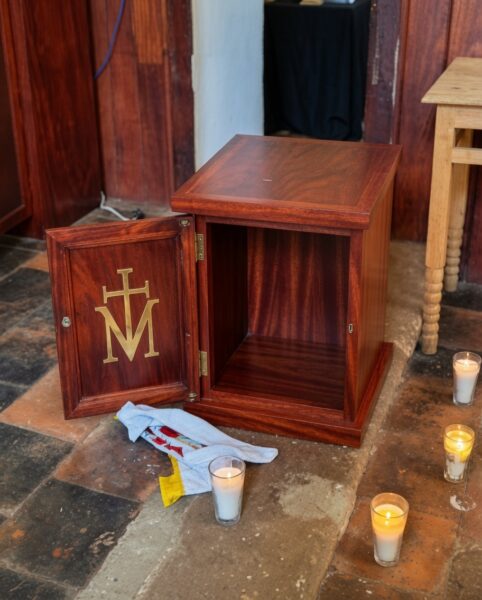
In the Diocese of Saltillo, Bishop Hilario González García has repeatedly expressed “deep pain, consternation, and sadness” over the wave of thefts and profanations. In May 2026, the San Francisco de Asís chapel in Colinas de San Francisco suffered a second robbery in a short period. The criminals forced entry and took the tabernacle, a monstrance with consecrated hosts, and sound equipment. The prelate described these acts as sacrileges that violate religious freedom and called on authorities to strengthen surveillance. The community held liturgical acts of reparation and atonement.
The most serious case occurred on June 12, 2026, at the Church of Our Lady of Sorrows, in the Montebello neighborhood of Saltillo, belonging to the parish of the Holy Child of Health. Unknown individuals removed the window protection, broke the glass, and entered the building. They stole the tabernacle, forced it open, and removed the ciboria and the pyx containing the reserved Eucharistic species. They also took speakers, extension cords, and tools.
In an official statement (circular 86/2026), the bishop declared the incident a violation of the sacred space and a sacrilege against the Eucharistic species. He recalled that, according to the Code of Canon Law, anyone who commits such an act, if Catholic, incurs excommunication. The diocese has insisted on prayer and reporting the crime.
The Diocese of Querétaro has reported at least four thefts in Catholic churches in the past month alone, bringing the total to eight cases so far this year. Although specific details vary, the pattern of stealing valuable objects and, in some cases, liturgical items has raised concern among parish communities and called on state authorities to strengthen protection of religious sites.
Other affected dioceses include those in Jalisco. On June 10, 2026, at the Chapel of Our Lady of San Juan de los Lagos in Lagos de Moreno, Jalisco, an individual attempted to steal a smaller bronze bell, valued at approximately 80,000 pesos. He managed to dismount it from a height of about 10 meters, but while descending with it he lost his balance and fell, struck by the heavy bronze structure. He sustained multiple injuries, including a leg fracture. Paramedics and authorities responded; the bell was recovered and secured. The individual was detained and placed at the disposal of the authorities for the corresponding investigations.
Although the theft was not completed and no desecration of the tabernacle was reported, the incident illustrates the vulnerability of churches even in urban areas of Jalisco and the risk faced by both criminals and the communities’ heritage.
Another recent incident in the West also involved desecration. In early July 2026, the community of Acaponeta, Nayarit, suffered the theft and removal of liturgical objects from the Chapel of St. Jude Thaddeus. According to local reports and regional social media posts, unknown individuals not only stole the collection box but also took the tabernacle. The act has been described as both theft and desecration, causing deep spiritual pain among the faithful, who see the removal of the tabernacle as a direct offense against the real presence of Christ in the Eucharist. No arrests or recovery of the stolen objects have been reported so far. The community has expressed its rejection and called for justice and respect for sacred spaces.
These cases reveal a troubling pattern that combines economic motives, the high value of metals and works of art, with acts that in several instances carry serious spiritual weight. The theft or desecration of the tabernacle and the Eucharist are not mere property crimes; they constitute grave offenses against the Body of Christ that entail excommunication.
These aggressions directly affect the security of Catholic communities, whose churches—and sometimes their own artistic and historical heritage—are violated. The Catholic Multimedia Center has documented in previous years that hundreds of churches suffer some type of attack annually; the trend appears to be continuing or worsening in specific regions, especially in places lacking constant surveillance.