


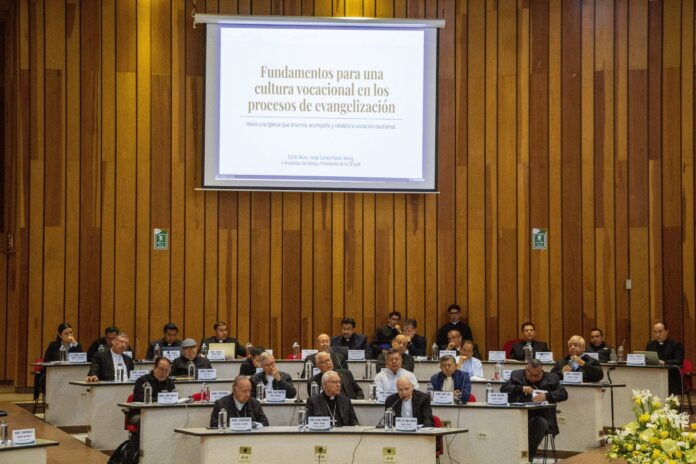
The bishops of Mexico are meeting this week at Casa Lago de la CEM for their 120th Plenary Assembly. In this important gathering, 114 prelates have agreed that the baptismal vocation is not a matter of consecrated minorities, but the axis that must permeate all pastoral action of the Church in Mexico. Under the motto “Towards a Church that announces, accompanies, and celebrates the baptismal vocation,” the bishops decided to promote a National Plan to renew vocational pastoral care that seeks to “vocalize” every dimension of evangelization.
The archbishop of Xalapa and president of the Episcopal Commission for Vocations and Ministries, Jorge Carlos Patrón Wong, was in charge of presenting the central document. “All pastoral care, at its root, is vocational,” he affirmed. For the prelate, the crisis that Mexico is experiencing is not only vocational, but anthropological and existential, “When man loses the sense of his vocation, he begins to experience his life as a burden and not as a mission.” Citing the challenges that especially affect young people—violence, narcoculture, individualism, and false promises of power—, Patrón Wong emphasized that the response does not lie in increasing the number of seminarians or religious, but in forming “missionary disciples of Jesus Christ, capable of living their lives as a response to God’s love”.
The proposed National Plan is articulated in five verbs: sow-kerygma, accompany-conversion, educate-discipleship, form-communion, and discern-mission. It is, the bishops explained, a transversal pastoral that permeates the family, catechesis, youth pastoral, and parish life. “We cannot evade this topic,” several prelates agreed when intervening from their diocesan realities. “We have to work on the lay vocation from the family, invest in vocational time, because if not, we won’t have results in the seminaries and even fewer lay vocations”.
Pedro de Jesús Mena Díaz, auxiliary bishop of Yucatán, insisted on the need to “vocalize all pastoral care”. For the Yucatecan prelate, catechesis must return to being a “nursery of vocations” and parents, the first catechists and responsible for education in the faith. “We have to promote the Christian vocation amid the currents of the world,” he pointed out, recognizing the distrust that some parents have towards ecclesial institutions.
A central element of the debate was the role of the laity. The bishops agreed that the baptismal vocation is universal and that the laity are not “collaborators” of the priests, but full co-responsibles in the building of the Kingdom. “The vocation is for all the baptized,” they repeated over and over. In a concrete exercise of synodality, the prelates experienced a “Conversation in the Spirit” where they shared diocesan experiences, listened to diverse realities, and discerned common paths. The day, which began with the Eucharist and Lauds presided over by Patrón Wong and concluded with Vespers led by Eduardo Muñoz Ochoa, bishop responsible for the Episcopal Dimension for Seminaries, was imbued with prayer and discernment.
At the end of this week of assembly, the customary message to the People of God is expected as a document that offers the conclusions of the conclave of Mexican bishops in the first semester of the year. The document, still in the process of final drafting, would synthesize the fruits of this collective discernment and seek to illuminate Mexican ecclesial life with an invitation for each baptized person to discover their vocation as a personal call from God and to live it with responsibility amid the complexities of the country.