


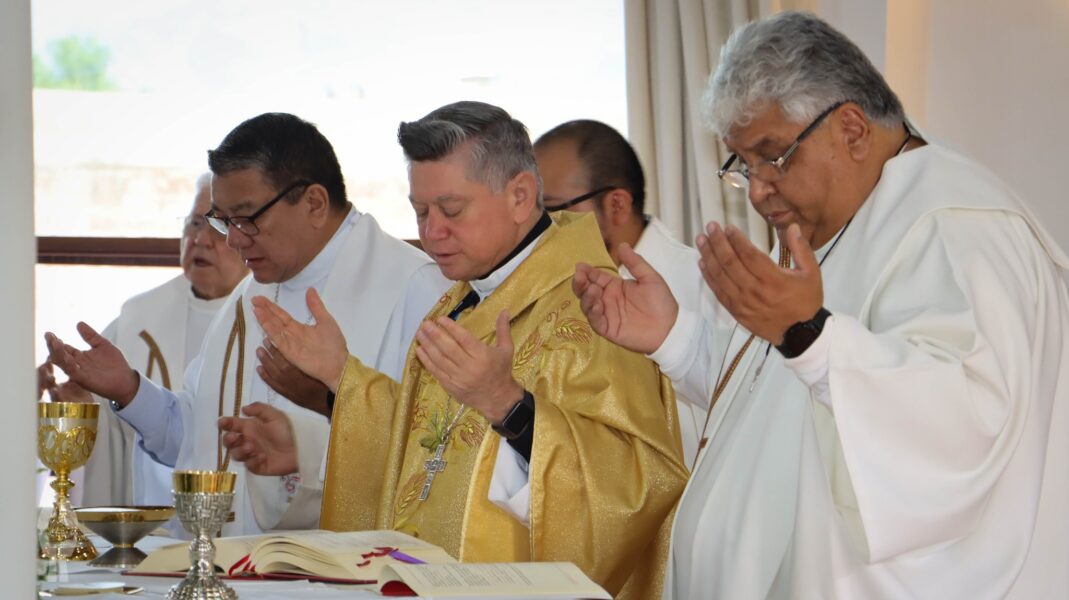
With the renewing power of the Easter season as a backdrop, the Bolivian Episcopal Conference (CEB) inaugurated this Tuesday its 118th Assembly in an atmosphere of deep episcopal fraternity and hope. More than two dozen bishops from across the country gathered to discern God’s passage in Bolivian reality, with the family as the central axis of reflection in the light of the apostolic exhortation Amoris Laetitia by Pope Francis and on the eve of the Ad Limina Visit they will make in November before Pope Leo XIV.
The inaugural day was marked by two high-caliber interventions that, together, trace the spiritual and prophetic course of the Church in Bolivia. On one hand, Mexican Archbishop Fermín Emilio Sosa Rodríguez, Apostolic Nuncio in Bolivia, delivered a message charged with missionary fire and confidence in the sovereign action of the Holy Spirit. On the other, the president of the CEB, Aurelio Pesoa, exposed with realism and courage the serious challenges facing Bolivian families, from the economic crisis and drug trafficking to educational and health precariousness.
In his homily, Nuncio Sosa Rodríguez, representative of Pope Leo XIV in the country, invited the bishops to a personal experience of “being born of the Spirit.” Taking as a basis the dialogue of Jesus with Nicodemus in the Gospel of John (chapter 3), proper to the second week of Easter, the Mexican archbishop emphasized: “It is difficult to understand the Spirit only from that material aspect. How is it possible for me to be reborn in my mother’s womb?” And he added clearly: “The Holy Spirit is the principal agent that produces a genuine and lasting transformation in people’s lives, as it is capable of arousing in us a change of attitudes and behavior.”
Fermín Emilio Sosa Rodríguez insisted that “being born of the Spirit depends properly on divine action, which transcends our own nature.” Quoting the same evangelical passage, he recalled that “the wind blows where it wills. You hear its voice, but you do not know where it comes from or where it goes. So it is with everyone who is born of the Spirit.”
For the nuncio, this image reveals the very essence of the Spirit: “It is sovereign, it is free, invisible, and, we can say, uncontrollable by human beings. Like the wind, its action transforms lives in an essential way, its effect is invisible, but it is real and has sovereignty in salvation.”
The nuncio’s message was an urgent call to renew missionary fervor. “Each one of us must have an experience of encounter with Jesus Christ, discovering the richness, the grace of feeling part of the mission, preserving in the heart the missionary fervor to proclaim his word with joy,” he affirmed. He linked this demand to the first reading from the Acts of the Apostles, where “a multitude of believers had one heart and one soul.” “That reality can only be the fruit of God’s Spirit,” he emphasized, contrasting it with “personal, partisan, group interests, as we are seeing at the world level”.
Addressing the national reality directly, Sosa Rodríguez was blunt, “Here in Bolivia lately attitudes and actions have been seen that truly make us reflect on our humanity, on the humanity of our people and where it is heading”. He asked the bishops for wisdom to “guide their people with that Spirit that comes from on high” and entrusted the assembly’s work to the protection of the Mother of the Redeemer.
The nuncio also mentioned that Pope Leo XIV has convened a consistory in June to deepen Evangelii Gaudium, reinforcing the urgency of a renewed missionary impulse throughout the Church.
For his part, the president of the Bolivian Episcopal Conference, Aurelio Pesoa, delivered the inauguration speech, in which he fraternally greeted all the bishops and especially thanked the presence of Archbishop Fermín Emilio Sosa Rodríguez and the representatives of the media, “helping us to make the apostolic communion with the Holy Father effective.” He also sent greetings to Cardinal Toribio Porco Ticona, honorary president of the CEB, absent for health reasons.
Pesoa centered his intervention on the assembly’s theme, the reality of the family in the light of Amoris Laetitia. He recalled that the apostolic letter of Pope Francis invites us to contemplate the Trinitarian God as a model of eternal love and to look to the Holy Family of Nazareth. “Marriage is the sacrament that consecrates human love, whose roots are found in human nature itself, a man and a woman, equal in dignity, different to be complementary, open to life, in communion and love forever until death do them part,” he affirmed, quoting Jesus in Matthew 19:6: “What God has joined together, let no one separate.”
However, he recognized the “not a few difficulties” that this ideal faces today: the cult of personal well-being, the fear of definitive commitments, selfishness as the “disease of love,” antinatalist positions, and gender ideologies. “The Pope calls us not to reject anyone, not to exclude anyone,” he said, and invited to more intense marriage catechesis.
In analyzing Bolivia’s specific situation, the CEB president did not mince words. “To these common difficulties must be added those of the situations we live in Bolivia, with a deep, inherited economic crisis, the fruit of an ideology-blinded economic system, united to widespread corruption, which has impoverished Bolivian families and plunged them into poverty”. He enumerated the dramatic consequences: family breakdowns, increase in intrafamily violence, feminicides, and resort to abortion as a “form of birth control.”
With special gravity, he referred to drug trafficking. Resuming verbatim the bishops’ 2016 pastoral letter titled Today I Set Before You Life and Death, Aurelio Pesoa warned that the situation “could be described today in the same way, but increased with concern for the growing violence, score-settling, and the appearance of organized drug cartels that negatively impact the country’s social peace.” Addressing those who profit from this scourge, he reclaimed them with the same words from the letter: “We ask you to be responsible before your children, the youth, and the construction of a safer and more fraternal society, renouncing that activity which is a crime and a grave violation of human dignity and ethical order.”
The bishops’ president also denounced problems in education and health. He criticized the “low quality of education” in public schools in rural and poor areas, where “they are not being given the tools to solve problems with creativity and comprehension capacity”. He thanked the government’s efforts but called for a national agreement between teachers, universities, and authorities.
In health, Pesoa was categorical: “More propaganda has been done than reality.” He demanded “universal access to quality and warm health care” that stops being “a luxury” and becomes “a fundamental human right”.
Finally, he recalled the first apostolic exhortation of Pope Leo XIV, Dilexi Te (“I have loved you”), which denounces “the dictatorship of an economy that kills” and the “culture of discard.” “One cannot be Church without serving the poor,” he affirmed, calling to live charity with the sick, the excluded from education, the deprived of liberty, and all the marginalized.
The message of the Apostolic Nuncio in Bolivia can be seen here: