


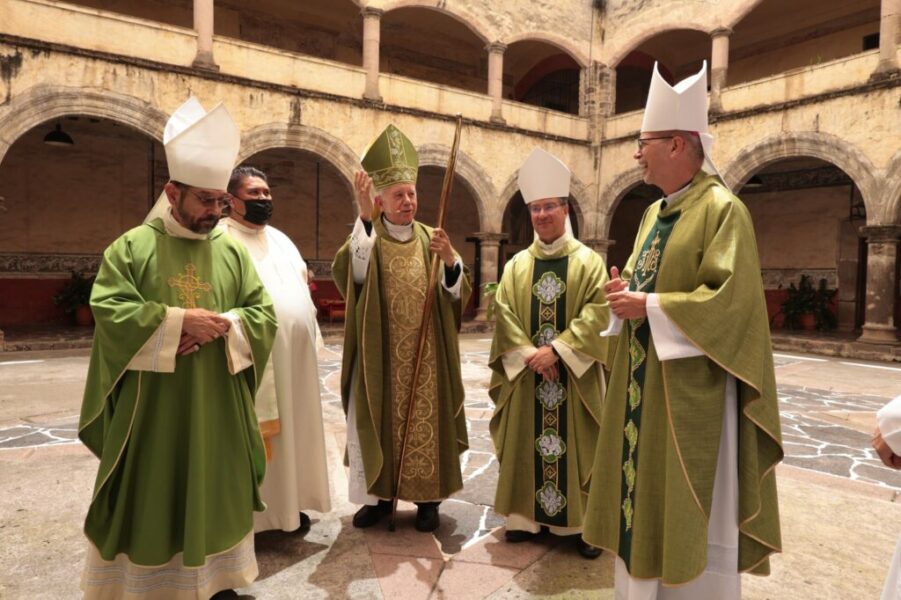
From August 30 to September 4, 2026, the Diocese of Cuernavaca hosted a “summit,” the Fraternal Meeting of Delegate Bishops from the Episcopal Conferences of Mexico, the United States, and Canada, in a space of prayer, listening, and discernment so that three neighboring Churches with distinct histories, cultures, and tensions could together examine the common challenges of North America. One week later, the president of the Mexican Episcopal Conference (CEM) and host bishop, Ramón Castro Castro, offered the most explicit assessment of what had taken place: the Spirit, he said, “breathed” and pointed out concrete paths. The most urgent is an integral migrant pastoral ministry, anchored in the Magisterium and not in yet another document.
The origin of the gathering, Castro explained in the interview, was not a geopolitical calculation. After assuming the presidency of the CEM, he asked how to bring the episcopal conferences closer together and find “common paths of work.” The proposal resonated with the vice-president of the United States Conference of Catholic Bishops (USCCB), Daniel Flores, Bishop of Brownsville, Texas; with the president of the Canadian Conference of Catholic Bishops (CCCB), Pierre Goudreault; and with two voices especially relevant to the migration issue, Óscar Cantú, president of the USCCB Subcommittee on Hispanic/Latino Affairs, and Eugenio Lira Rugarcía, Bishop of Matamoros-Reynosa and head of the Episcopal Dimension for the Pastoral Care of Human Mobility of the CEM.
The theological premise that Castro repeatedly emphasized is simple yet demanding: “One same baptism, one same ministry, one same Church,” embodied in distinct national realities. That unity does not erase social, political, and economic differences; it obliges them not to become borders between hearts. In the interview video, the Bishop of Cuernavaca insists that the initial goal was to get to know one another and to fraternize. The result, he affirms, exceeded that expectation: “It was not just a fraternal meeting.” He perceived “very concrete paths” and “invitations as pastors” to address the common realities of the three peoples, with “concrete fruits” that still need to mature.
The axis that concentrated attention was human mobility. Mexico is, at once, a country of origin, transit, and also destination. The United States and Canada are, above all, destinations, although their migration landscape has shifted toward a phase of greater restriction. Castro expressed it with a phrase that summarizes the pastoral tone of the meeting: “God is asking us to do something about migration.” The proposal he put forward is not a new declaration of principles, but joint work to build an integral migrant pastoral ministry in light of the Magisterium and of what each Church has already done. His self-critique is clear: one of the mistakes has been “not sufficiently socializing the Magisterium.” The work, therefore, will not end with the publication of a text, but with “making known and applying what the Church has already taught about migration.”
Hence the questions that, according to the president of the CEM, each conference must ask itself: “What am I doing for my brother?” What am I doing for integral migration? “How do I welcome?” How do I help ensure that transit respects the dignity of every person? The most political and delicate point is the distinction between a civil offense and a crime. Castro denounced that, in public discourse, the mere condition of being an undocumented migrant tends to be treated as a crime. “We have to work on this, because it is an injustice that what is not a criminal or penal act is being criminalized. It is being exaggerated and respect for human dignity is being violated.” In the face of commercial, diplomatic, and migratory tensions among the three countries, the ecclesial contribution he claims is not that of a power actor, but that of dialogue: “There is a field where we can contribute a great deal.”
That assessment—fraternity becoming an agenda, the Magisterium becoming practice, migration becoming a criterion of justice—finds its written support in the joint communiqué dated September 4 in Cuernavaca. The text, titled with the motto “Three Nations, One Church, One People Walking in Communion,” describes the meeting as more than a work session: fellowship, Eucharist, a welcome dinner, a visit to the Cathedral “corner by corner,” a meal at the Bishop of Cuernavaca’s residence, and a Conversation in the Spirit, in the style of the synodal path, before addressing substantive matters. The encounters with parishes, towns, and ancient convents of Morelos were not mere tourist ornament; they formed “part of the heart of the meeting” because communion, the bishops say, “is not woven only in meeting rooms.”
The communiqué organizes the national voices. Mexico offered the panorama of a country of contrasts with inequality, violence, migration, and a popular and Guadalupian faith that still makes the Church credible. The United States, through Flores and Cantú, recalled that charity implies social justice and recounted the hospitality of border Churches when Central American children and families arrived: sometimes the authorities themselves brought mothers and children to the parishes “because there was no one to feed them.”
It then described the subsequent hardening: the border “almost completely” closed, even for those fleeing war; mass deportation programs; community fear of family separation; and the paradox of charitable action that, in some cases, has had to defend itself in court when what was service to the poor is presented as complicity. As signs of hope, they cite the campaign “You Are Not Alone” and the National Pastoral Plan for Hispanic/Latino Ministry.
Canada offered another perspective: a highly diverse yet secularized society, with one of the highest proportions of foreign-born population and the foundational weight of the First Nations, Inuit, and Métis peoples. Goudreault listed four priorities—synodality, ecumenical dialogue, discernment regarding artificial intelligence, healing and reconciliation with Indigenous peoples—and acknowledged that, after years of record growth, Canada’s migration landscape has also become more restricted. Even so, in many dioceses migrant families and clergy from other nations are renewing parishes: “the migrant also becomes a missionary.” Hence the new National Service for Human Mobility, conceived as a diocesan network, formation, and a culture of welcome.
A second axis, less visible in the interview but central in the communiqué, is the guardianship of the human in the age of artificial intelligence, based on the encyclical Magnifica Humanitas by Pope Leo XIV. The bishops take up a classic anthropological key—“the mystery of man is clarified only in the mystery of the Incarnate Word”—and a contemporary warning: responsibility for AI cannot be delegated; decisions that define dignity, utility, or discard cannot be left in the hands of an algorithm. In the face of transhumanism, the “more than human” is attained by grace. The quotation the communiqué applies to migration is lapidary: the way a society treats migrants and the most vulnerable “shows whether its idea of justice is guided by fear or by fraternity” (Magnifica Humanitas, 81).
There is also a package of initiatives that are not yet ecclesial law. The delegates identified common proposals—such as the exchange of priests, evangelization missions, pastoral coordination regarding human mobility—that will be presented to the Permanent Councils of each conference for discernment and eventual approval. The horizon they sketch is gradual and prudent: a “region of episcopal fraternity in North America,” a stable bond of communion among the three conferences, in union with Pope Leo XIV, that could foster a continental conference and more effective collaboration. That aspiration is articulated with the recent Message to the People of God Pilgrimaging in the Americas, prepared together with CELAM: “we are one single Church in the Americas.”
The closing homily, on the memorial of Saint Gregory the Great, condensed the spiritual meaning of the week with the scene from Luke 5: the boat, the empty nets, and the command “Put out into the deep.” Castro warned that the Churches know their realities and have structures, programs, and resources, “and yet we must acknowledge before the Lord that some nets remain empty.” A Church can have magnificent analyses and lose the Gospel; great principles and forget the concrete face. That is why migration is not only a matter of borders, but of faces. And one single boat is not enough: “Mexico cannot walk alone, nor the United States, nor Canada.” The Church, he emphasized, does not belong to any conference or its pastors; “the Church belongs to Christ.”
The meeting closed at the Basilica of Guadalupe, after joining the Intercontinental Guadalupian Novena. The communiqué leaves a thesis and a reservation. The thesis: three nations, one Church, one people that wants to walk in communion. The reservation, implicit in the interview and in the text itself: the agreements will only bear fruit if they cease to be papers and become concrete welcome, coordination, and defense of dignity. In a moment of tension among the States, the bishops do not seek to replace governments. They seek something more modest and more difficult: that political borders do not become borders between hearts and that the pastoral question “What am I doing for my brother?” does not dissolve into statistics.
The joint communiqué can be read here.