


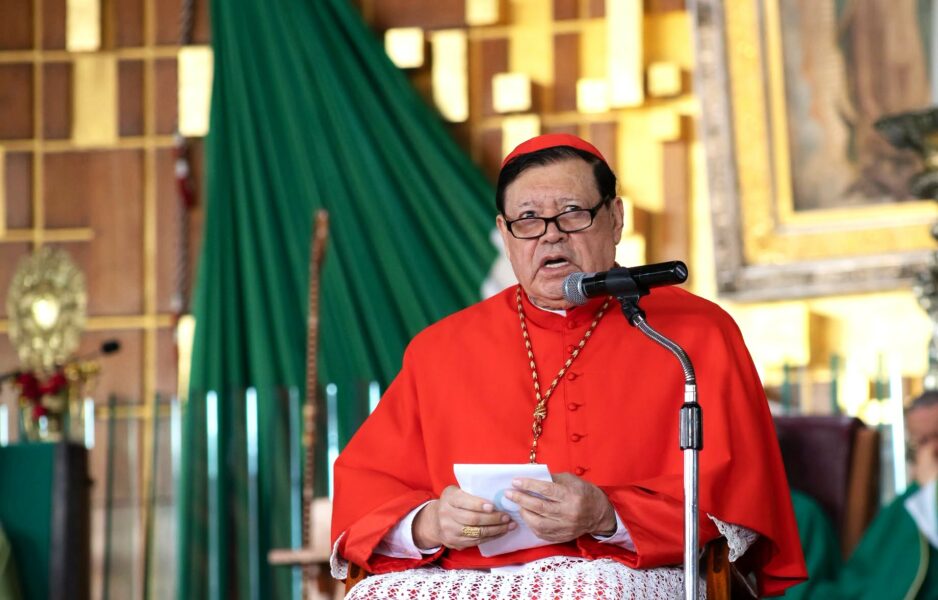
The full Chapter and Emeritus Archbishop Norberto Rivera Carrera marked this October 11 the celebrations for the 50th anniversary of the dedication of the church and the beginning of the Guadalupan Jubilee Year.
The Illustrious and National Basilica of Santa María de Guadalupe was the setting this Sunday, October 11, 2026, for the capitular Mass with the Venerable Chapter in full, presided over by the auxiliary bishop of Mexico, Luis Manuel Pérez Raygoza. The Eucharistic celebration, held in the circular hall that has housed the tilma of Saint Juan Diego for half a century, was attended by the emeritus archbishop of Mexico, Cardinal Norberto Rivera Carrera, who delivered the homily.
The prelate, 84 years old, was seen leaning on a cane and was assisted by Canons Luis Felipe García Álvarez and Jorge Antonio Palencia Ramírez de Arellano. His presence at the altar of the Basilica, on a date that prepares for the anniversary of October 12, 1976, the day of the dedication of the new sanctuary and the transfer of the Sacred Image from the old church, took on a character of ecclesial recognition. The Mass was part of the program of events prior to the official start on October 12 of the Guadalupan Jubilee Year granted by Pope Leo XIV.
Rivera Carrera centered his preaching on the day’s readings, Isaiah 25:6-10a and the Gospel of Matthew 22:1-14 about the wedding banquet, and placed them in dialogue with the jubilee context and with reality. “The Lord of the Universe will prepare on this mountain a feast of rich food for all peoples. He will remove on this mountain the shroud that is cast over all peoples… The Lord God will wipe away the tears from all faces,” the cardinal recalled, evoking the prophet’s promise.
Faced with that hope, the emeritus archbishop drew a direct contrast with the present: “We, in the midst of the culture of death, impunity, and uncertainty that we are living, God consoles us, enlightens us, enlightens our future.” He stressed that “others also present us with a new era and announce changes and progress that never arrive because they have neither foundation nor events to sustain them.” Human promises, he noted, “are empty speeches and promises that are not fulfilled,” while “God’s promises do have a fundamental source, since they are grounded in concrete and precise events.”
The cardinal insisted that the Guadalupan event—“the Lord of Heaven, the Lady of Heaven, Holy Mary of Guadalupe, came to our land to bring us her Son Jesus Christ”—and Christ’s redemption are facts that “have already happened and continue to be realized.” He recalled that the presence of Our Lady of Guadalupe has been “our national banner” and that thousands of pilgrims come to the sanctuary “above all to give thanks” or to ask for her intercession.
Referring to the two thousand years of the redemption that are approaching, he emphasized that “the greatest banquet in our human history” will be celebrated and that the Eucharist is the place where “his death and resurrection” are made present. He criticized the culture of immediacy and disposability: “We live in a culture of immediacy, haste, and disposability… we are prey to fast food and junk food… thus we pollute our land, our seas, and even the air we breathe.” In response, he invited people to long for eternal life not as something “boring,” but as the banquet of joy and abundance that Jesus describes. “God desires that all people be saved and come to the knowledge of the truth,” he concluded.
The dedication of October 12, 1976 responded to an urgent need. The old basilica (today the Expiatory Temple of Christ the King), whose main construction dates from 1695-1709, showed serious structural damage due to differential subsidence of the ground in Mexico City. A 1968 diagnosis confirmed the risk. After a provisional solution, the so-called ephemeral Basilica, it was decided to build a new permanent church. The cornerstone was laid on December 12, 1974 under Cardinal Miguel Darío Miranda. The project, directed by architects Pedro Ramírez Vázquez, José Luis Benlliure, Alejandro Schoenhofer, Friar Gabriel Chávez de la Mora, and Javier García Lascuráin, produced a circular building 100 meters in diameter, with a clear span of 63 meters without intermediate columns, so that the image of the Virgin can be seen from almost any point. The roof, of reinforced concrete covered with copper sheets, has acquired the characteristic greenish tone. The complex can accommodate around 10,000 people in the main nave. On October 12, 1976, in the presence of thousands of faithful, the sanctuary was dedicated and the tilma was solemnly transferred. Pope Paul VI sent a message in which he described the dedication not as a finishing line, but as a “starting point.”
Half a century later, the church continues to receive millions of pilgrims each year. The Guadalupan Jubilee Year that will officially open tomorrow, October 12, with the Mass of the Roses and the opening of the Holy Door, extends until October 12, 2027. The faithful who visit the “Sacred Little House” with devotion, participate in a liturgical act, or dedicate time to prayer may gain a plenary indulgence, under the usual conditions. The date also coincides with the 131st anniversary of the Pontifical Coronation of 1895. The broader horizon is that of the 500 years of the apparitions (2031) and the two thousand years of the redemption. The homily of Rivera Carrera placed the 50 years of the new Basilica within that historical and theological continuity.
The presence of the emeritus archbishop of Mexico at this capitular Mass constitutes a gesture of recognition to the archbishop who governed the Primatial Archdiocese of Mexico from 1995 to 2017. During his pastoral pontificate, Guadalupan devotion was decisively promoted and one of the most significant processes in recent Mexican ecclesial history was completed: the canonization of Saint Juan Diego Cuauhtlatoatzin, the seer of the Virgin. On July 30, 2002, in the same Basilica of Guadalupe, Pope John Paul II proclaimed the indigenous man a saint. Rivera Carrera, the main promoter of the cause and author of works that documented the historicity and fame of sanctity of Juan Diego, accompanied the Pontiff and spoke words of gratitude on behalf of the Mexican Church. That the Chapter and the auxiliary bishop invited the emeritus cardinal to deliver the homily on the eve of the fiftieth anniversary of the dedication of the church that houses the tilma of Juan Diego is, in that sense, an act of memory and continuity.
In a national context marked by impunity, violence, and political promises that do not materialize, the words of Cardinal Rivera Carrera turned the gaze back to the banquet that, according to Christian faith, God has prepared and continues to prepare. The Basilica, at 50 years since its dedication and on the threshold of the Jubilee Year granted by Leo XIV, once again presents itself as the place where that banquet is announced and anticipated in the Eucharist, while the Church moves toward the 500 years of the Guadalupan event and the two thousand years of the redemption.