


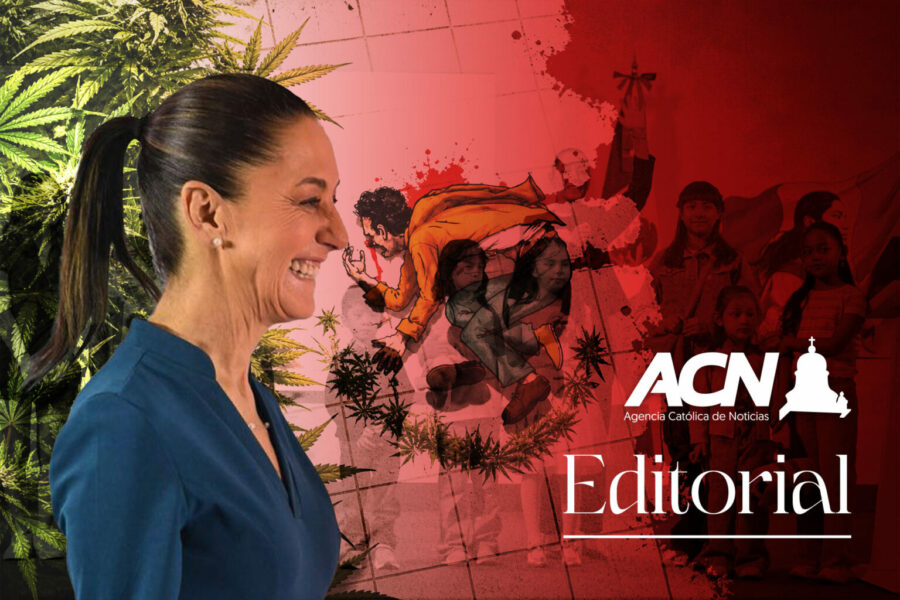
On April 30, 2026, during the morning press conference at Palacio Nacional, the Children’s Day celebration turned into a spectacle that reflects the regime’s crisis, but even more so, channeling the impotence that it can only control through the manipulation of the most vulnerable, children and girls.
Perhaps the proud parents and mothers gave their consent for their children, along with the president “with an a,” to pretend an excessive happiness with the Secretary of Public Education as the jester. While the children’s band played “Vamos a brincar” and “Chin-chin el que se mueva,” the vocalist, visibly uncomfortable, had to correct them: “better to one side because like that they’re not really getting into it,” “come over here better,” “go up a little bit.”
The little ones weren’t jumping, weren’t singing, weren’t smiling. Most looked at the floor, moved timidly, or remained motionless, showing discomfort and displeasure. It was so evident that the president herself acknowledged it out loud: “The last question because I can see that the girls and boys are getting bored.” And yet, the show continued. The group photo was taken, the “six-seven” was done, and the image of a happy party was projected.
But that unreal scene was meant to hide the narco Mexico. While the president and her Secretary of Public Education, who has been pointed out for months for alleged links with fiscal huachicol and with Sergio Carmona, one of his main operators, they smiled, danced, and jumped as if the country’s reality were that of a happy world. Just 24 hours earlier, they had received the devastating blow against the governor of Sinaloa, a senator of the Republic, and several state officials accused of conspiring with the Sinaloa cartel to traffic drugs, bribe, and manipulate elections. It was, without a doubt, one of the most delicate morning press conferences of the presidency. Instead of facing the scandal with institutional seriousness, they chose to disguise apparent normality with children forced to act.
This use of childhood is not a mistake; it is a way to hide and pretend. It is the logical consequence of the desperate urgency to project stability and happiness in a government accused time and again of protecting narco-governors and narco-politicians. When reality speaks of persistent poverty, structural violence, and complicities with organized crime, the only way out is to resort to the most emotional and manipulable currency, children. They are exhibited as trophies of a supposed prosperity that doesn’t reach millions of homes. They are forced to simulate the joy that the regime needs to sell. And it is done in the same space where the people are supposed to be informed.
Throughout history, regimes that later proved to be among the darkest and most sinister that humanity has known, have resorted exactly to this same tactic. They have placed children in posters, parades, and public acts to legitimize themselves, to humanize themselves, to make people believe that their project was one of a radiant future and innocent hope. Children became propaganda bargaining chips: their pure image served to whitewash the impure. Over time, those images remained as testimony of cynicism, of decadence, and of the fact that children are the ideal resource to justify deception and consummate manipulation.
While a party was being faked at Palacio Nacional, thousands of Mexican children, girls, and adolescents continued to be victims of violence or remained missing. In 2025 alone, 10,707 reports of minors’ disappearances were recorded, 29 cases daily, and at the beginning of 2026, nearly 3,000 were still unlocated. Thousands more face extreme poverty, educational lag, hunger, and direct exposure to organized crime. That is the true face of Mexican childhood.
In this way, pursuing false ideals, Mexican childhood “runs the risk of encountering bitterness and humiliation, hostility and hatred, absorbing the dissatisfaction and emptiness of what impregnates the surrounding environment, as St. John Paul II pointed out in the 1996 World Day of Peace, when addressing the delicate situation of childhood in the world, and whose words seem to have indisputable relevance in this decadent reality.
Today, the viral clip of the April 30 morning press conference runs the same risk of becoming the document of a blatant instrumentalization in which Mexico’s children are just that, puppets of a narco-regime, the same one that a president defends, resorting to the pathetic manipulation of childhood.
And whoever causes one of these little ones who believe in me to stumble, it would be better for him to have a millstone hung around his neck and to be drowned in the depths of the sea…