


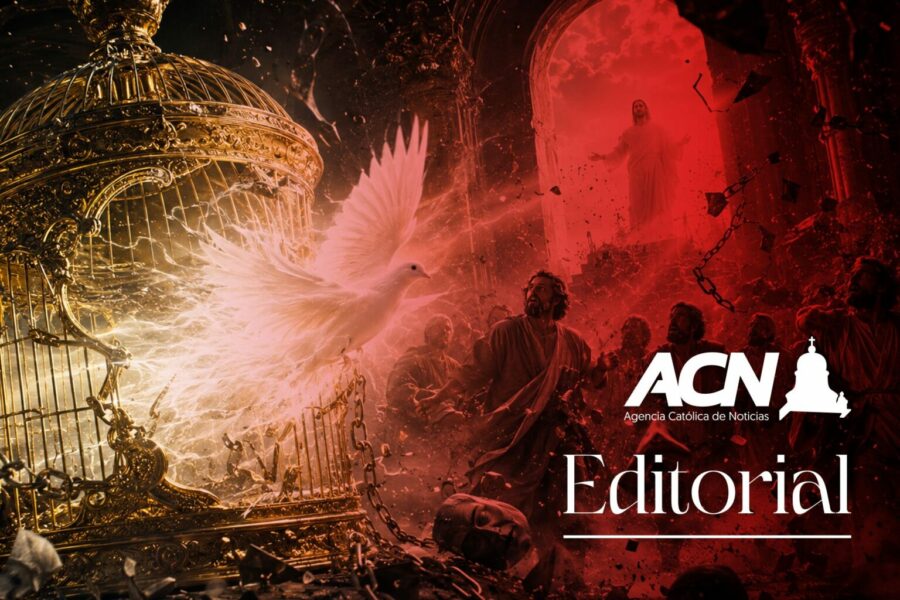
Each year, the feast of Pentecost bursts into the liturgical calendar like a hurricane wind that no one can tame. We remember the moment when the Holy Spirit descended upon the apostles in the form of tongues of fire, granted them the gift of speaking in any language, and transformed a handful of frightened men into bold witnesses of the Risen One.
That day the Church was born, not as a comfortable institution, but as a community sent into the world with a clear and non-negotiable vocation: holiness, which soon made those in power feel uneasy. It is not an optional goal or a pious ideal for a select few. The Church exists to be holy because her Spouse is holy, and it is the Spirit who makes her capable of that radicality.
Yet today the Holy Spirit remains, for many of the faithful and not a few pastors, the Great Unknown. We invoke Him in prayers, mention Him in documents, affirm Him in the Creed, but we act as if His presence were a hindrance or a negotiable resource. Entire sectors of the Church have fallen into the temptation of manipulating the third Person of the Blessed Trinity for their own convenience, attempting to control Him according to their interests. They do so from two equally destructive extremes.
On one side, certain progressive trends have turned “synodality” into a supposed “fresh wind of the Spirit.” Under that banner, a babel of emotions, opinions, and sentimentalisms has been promoted that have little to do with the seven gifts of the Holy Spirit. Instead of wisdom and understanding, confusion is imposed; instead of fortitude and piety, endless assemblies prevail where truth is diluted in emotional consensus. The result is a dizzy Church and a human swell that no longer knows how to distinguish between the newness of the Spirit and the newness of cultural fashion. The pentecostal fire has been reduced to a stifling, sultry breeze that neither burns nor purifies.
At the opposite extreme, the most rigid conservatism has turned Christianity into a club for the privileged of the rite. They take refuge in pure ritualism, in liturgical languages that many no longer understand, and in a mechanical repetition of forms that stifles life. With that attitude they have driven de facto schisms without daring to declare them, creating ghettos where faith becomes a proud and exclusionary relic. Here too the Spirit has no place; He is reduced to a guarantor of frozen traditions, a mere seal of approval for those who already feel superior simply for attending the correct Mass or reciting the exact formulas.
Both extremes share the same pride: they believe they can tame the Spirit and appease Him according to their tastes. And while they do so, the most self-sufficient clergy and laity have in fact banished the gifts of the Spirit from the ordinary life of the Church. Clerical self-sufficiency, in particular, has been devastating; an attitude of control, of technical management of the sacred, has taken hold, extinguishing the fire and leaving only the smoke of incense that conceals corruption beneath purple zucchettos, ornate mitres, or festive chasubles.
The Holy Spirit moves a Church without fear, yet deeply attached to living tradition. Tradition is not a museum that mothballs the faith, but a foundation that revitalizes it. Only from that firm root can the Church understand the diverse languages of our time and bring the Truth to those who live in obstinacy, sunk in falsehoods that masquerade as salvation but only produce confusion, discouragement, and sadness.
We have tried to lock the Holy Spirit in a golden cage of our own making, feeding Him with the birdseed of our sin. Today more than ever we need the Spirit to burst in, to overthrow ideologies, and to restore to us the boldness of the apostles to proclaim one fundamental truth: That the Risen One is the Way, the Truth, and the Life.