


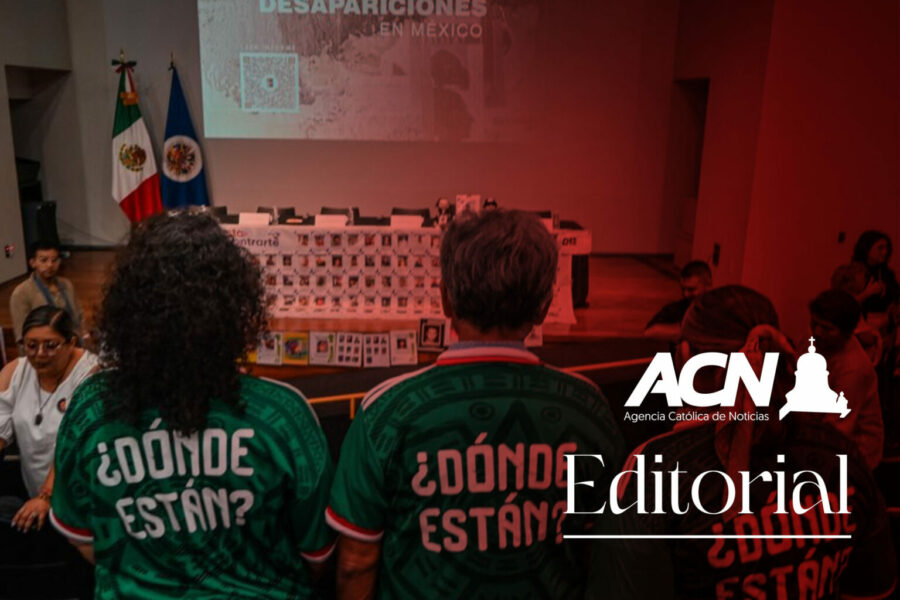
While the issue of narcopoliticians has dealt a severe blow to the regime, another front has revealed a tremendous and harsh reality. The harsh and devastating report of the Inter-American Commission on Human Rights that lays bare, with rigor and without euphemisms, the magnitude of the worst humanitarian crisis Mexico is experiencing in terms of human rights.
Approved on February 9, 2026, the document makes clear that the disappearance of persons is not a problem of the past nor an isolated issue, but a phenomenon that is widespread, structural, and ongoing. According to the official record, there are more than 128,000 missing and unlocated persons. Independent estimates raise to more than 70,000 the unidentified bodies that remain in State custody. The figures reflect a tragedy that has shattered entire families, exposed deep flaws in the justice and search systems, and continues to claim lives in silence.
The report describes in stark terms how disappearances are concentrated in regions such as Jalisco, the State of Mexico, Tamaulipas, and the Pacific Corridor, where organized crime frequently operates in close collusion with state agents. It affects indiscriminately children and young people recruited, women and girls victims of gender-based violence and trafficking, migrants, people of sexual diversity, human rights defenders, and journalists.
It is not a matter of exceptional cases, entire families have been decimated and those who dare to seek their loved ones face mortal risks. Although the Mexican State has reluctantly recognized the existence of the crisis and the forensic emergency, the document underscores that, despite the institutions and regulations created since 2018, serious challenges persist in prevention, access to justice, and memory policies. Investigations are slow, complaints are dismissed, judicialization is minimal, and impunity is reproduced in a structural manner.
In this scenario, the Presidency of the Republic has responded with explicit and calculated denialism. The president has publicly declared that she does not agree with some of the central statements of the Inter-American Commission’s report, while at the same time insisting to highlight the “advances” of the federal government and to promote greater coordination with the Commission itself.
In place of acknowledging the structural gravity of the crisis, facts are minimized and blame is placed on the past, as if disappearances were an inherited problem sufficiently addressed. This attitude not only ignores the pain of thousands of families, but also perpetuates deep distrust between society and the authorities. While dialogue tables and reforms are announced, bodies are accumulated in morgues, clandestine graves continue to proliferate, and searchers continue to risk their lives without effective State protection.
The Inter-American Commission, with decades of experience accompanying the Mexican situation, reminds us that disappearances have ceased to be exclusively political and have become a massive and indiscriminate scourge. From the case of Ayotzinapa to the public hearings with relatives, the report gathers heartbreaking testimonies and evidence that the State transfers to the victims themselves the responsibility to search and prove. The result of an institutional weakness that allows organized crime to act with total freedom is impunity.
It is necessary to remember the deep dignity of those who have been disappeared. They are, in a real and theological sense, the body of Christ wounded and tortured by human injustice. Each disappeared life reveals the face itself of the Lord crucified by the idols of power, money, and violence. God is the first who goes out to search for them, and the collectives of families become the body of Christ resurrected searching for the crucified. Treating them as mere figures or as an administrative problem is to profane that sacred dignity, searching for them with truth and justice is an act of mercy that restores the humanity of the entire society.
The families of the more than 128,000 disappeared do not ask for speeches or statistics; they demand truth and justice. The report of the Inter-American Commission is an uncomfortable mirror. Ignoring it does not resolve the crisis; only deepens the wound and the shame. It is time that denialism gives way to real action, dignified reparation, and political will to face the truth.
Repeating lies does not make the absent disappear, only covers up that Mexico, at the Latin American level, is one of the most corrupt countries where high levels of violence persist, an abysmal distrust in the authorities and a structural impunity that is exhausting the Rule of Law.