


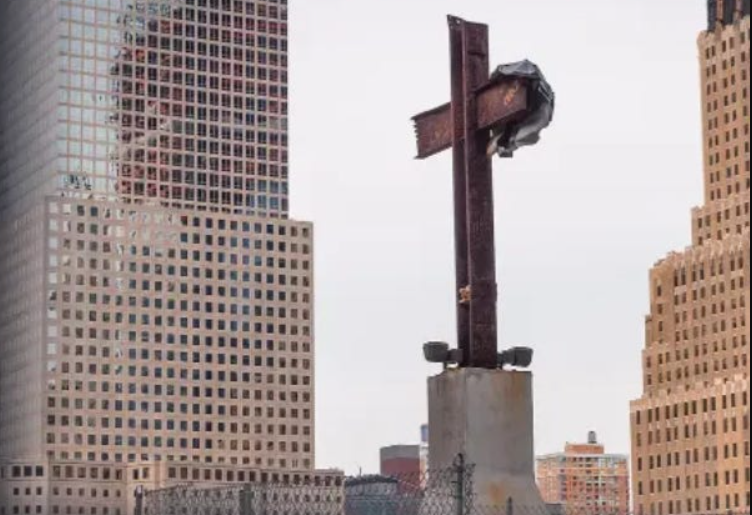
Twenty-five years after the attacks of September 11, 2001, the world remains marked by the images of the Twin Towers collapsing and by the global war on terrorism that was unleashed afterward. For the Catholic Church in Mexico, those events were not merely a distant occurrence, but a moral and spiritual shock. The Mexican Episcopate interpreted 9/11 and the subsequent spiral of war.
A statement signed by Luis Morales Reyes, then president of the CEM, expressed “deep sorrow and solidarity with the American people” and called on all dioceses in the country to celebrate Masses for the victims. The text described the attacks as “an affront to human dignity” and warned that violence could never be a path to justice. This message set the official stance: spiritual closeness to the victims and categorical condemnation of terrorism.
In the Archdiocese of Mexico, Cardinal Norberto Rivera Carrera reinforced that line in public statements and homilies reproduced in the national press. At the Basilica of Guadalupe on September 12, he called for a day of prayer and stated that the attacks were a reminder of the fragility of world peace. His voice insisted that the response should be spiritual and communal, not military. However, international reality soon tilted toward war: the United States launched the invasion of Afghanistan in October 2001 and later that of Iraq in 2003. The Mexican ecclesiastical hierarchy, in subsequent messages, was critical of the spiral of war, warning that violence begets more violence.
Other local bishops also spoke out. Florencio Olvera Ochoa, then bishop of Tabasco and later of Cuernavaca, declared in regional interviews that the attack should be read as a call to strengthen the culture of peace and international cooperation. Other voices complemented the national picture: the Mexican Catholic hierarchy agreed that terrorism was an absolute evil, but also that the response should be the building of peace, not war.
The now-defunct weekly Desde la Fe of the Archdiocese of Mexico devoted editorials in the weeks following 9/11. In them, terrorism was explicitly condemned, the vulnerability of human coexistence was reflected upon, and prayer was called for. Their opinions showed how the Church sought to give spiritual meaning to an event that transcended politics and international security. The insistence on Christian fraternity and solidarity with the victims became the axis of its discourse.
In the international context, the words of John Paul II resonated in Mexico. The Pope described September 11 as “a dark day in the history of humanity” and called for rejecting the paths of violence. The Church had to be an actor that called for peace, even when governments chose war.
The war on terrorism, initiated by the United States, was followed with concern by the Mexican Episcopate. They warned of the risks of a disproportionate military response. In their messages, it was emphasized that justice could not be confused with revenge and that peace had to be built through dialogue and international cooperation. The Church aligned itself with the Vatican’s stance: condemnation of terrorism, but rejection of war as a solution.
Over the years, this position was maintained. On subsequent anniversaries, Mexican bishops recalled 9/11 as an event that revealed humanity’s vulnerability and the need to strengthen the culture of peace. The memory became a reference point for speaking about violence, terrorism, and war in other contexts, such as drug trafficking in Mexico. The Church used the experience to insist that violence can never be justified and that the response must always be the building of peace.
Twenty-five years after the attacks, the consequences remain present. The war on terrorism transformed international politics, generated prolonged conflicts in Afghanistan and Iraq, and left millions of victims. From the faith of the Church in Mexico, 9/11 was a turning point that forced a stance on global violence and the need to build peace in a world marked by war.
In retrospect, the Mexican Episcopate did not limit itself to expressing solidarity with the United States. Its messages were also a warning: violence begets more violence and justice cannot be confused with revenge. Those words remain relevant in a world that still faces terrorism, wars, and violence. The position was clear: condemnation of terrorism, solidarity with the victims, and a call to peace, and it constituted an important testimony of how faith interpreted one of the darkest moments in recent history.
The messages of solidarity to the people of the United States and to the United States Conference of Catholic Bishops, as well as the message of the Conference of the Mexican Episcopate on violence and war, all from 2001, can be read below: