


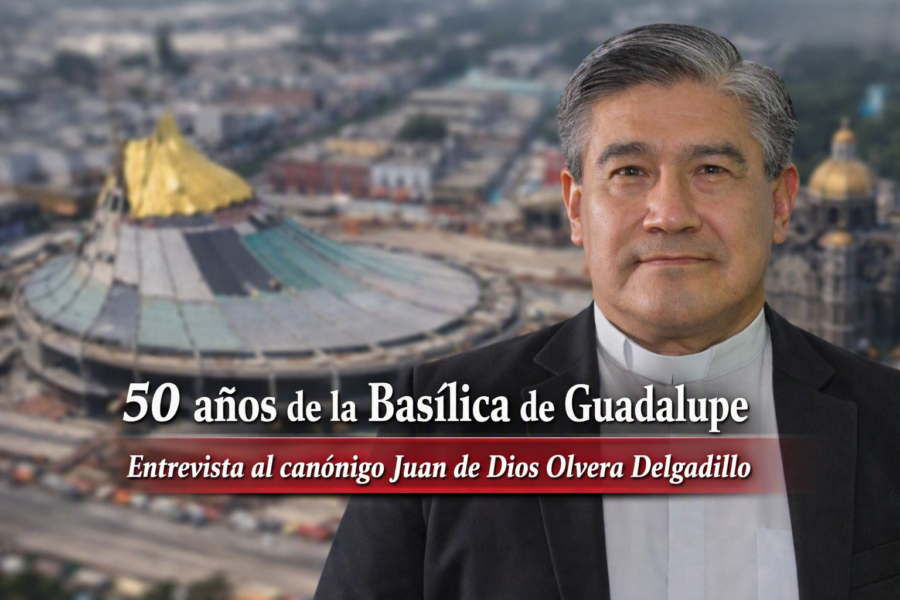
The architecture of the Basilica of Guadalupe in 1976 reflected a fundamental purpose: It was not only the architectural space that would serve to “rescue” a place of worship in clear deterioration due to subsidence, but it also had to be functional, spacious, and pedagogical.
The main creators of the architectural plan saw in that project the opportunity to build a Basilica with elements suited to the new liturgical times of the Second Vatican Council and with a structure bearing biblical implications that would link the history of Salvation, from the Old and New Testaments, with Tepeyac, a hill near the ancient conquered city in 1521, where a prodigy occurred that, in that year 1976, marked its 445th anniversary.
From a distance, that pedagogy seems to erode as a consequence of what time always provokes in history: oblivion. For the believer and the contemporary observer, attending the “Little House of Tepeyac” could mean more than just a visit to a temple so familiar, known, and beloved that protects the “Virgencita,” but recovering its initial pedagogy is now a moral duty of memory in this fiftieth anniversary.
In an interview, Canon Juan de Dios Olvera Delgadillo, shares his reflections “from within,” those of a priest who has served his ministry at the Basilica of Guadalupe. His biography and career are well known. Forty years ago, he was ordained a priest for the Archdiocese of Mexico in 1986; he holds a doctorate in dogmatic theology from the Pontifical Gregorian University. Called to collaborate in the Holy See as an official of the Pontifical Commission for Latin America from 1989 to 1994, he participated in the IV General Conference of the Latin American Episcopate (1992). In charge of the Permanent Formation of the Clergy from 1995 to 2002, he collaborated in one of the fundamental positions in the government of Cardinal Norberto Rivera Carrera as chancellor of the Archdiocese of Mexico from 2004 to 2011, combining his curial duties and parish responsibilities from 2000 to 2017. Since 1996, he has served as a professor of Dogmatic Theology at the Pontifical University of Mexico and as a member of the Mexican Academy of Theology. In 2016, Pope Francis appointed him Missionary of Mercy and in October 2017, Cardinal Rivera integrated him into the Venerable Chapter of the Illustrious and National Basilica of Guadalupe. He founded the Priestly Friendship group, aimed at the spiritual and doctrinal formation of diocesan and religious priests. He has published theological works, including Christological Methodology and Pastoral Reflection (CELAM, 1993). Currently, Father Juan de Dios Olvera collaborates with the Catholic News Agency through his Sunday column Veritas Salutaris.
The full interview can be viewed here: