


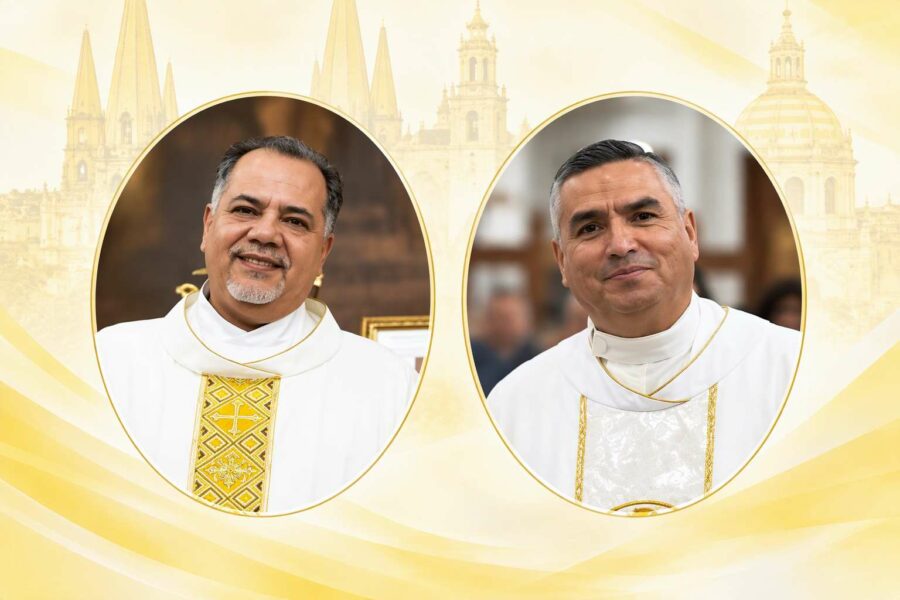
On November 4, the feast of Saint Charles Borromeo, the Mexican Episcopal Conference announced the appointment by Pope Leo XIV of two auxiliary bishops for the Archdiocese of Guadalajara. The positions were entrusted to priests Ramón Duarte Miranda and Héctor Michel Figueroa, appointments that immediately strengthen the pastoral structure of one of the country’s most important ecclesiastical jurisdictions.
Both priests, trained in the Archdiocese of Jalisco, have developed a pastoral career marked by responsibilities in governance, formation, and the accompaniment of parish communities. Their appointment is especially significant given the speed with which the Holy See has filled the vacancies created by the recent episcopal promotions of Ramón Salazar Estrada and Héctor López Alvarado, who only weeks ago were named residential bishops of the dioceses of Mazatlán and Puerto Escondido, respectively. In similar contexts, the replacement of auxiliary bishops usually requires months or even years of discernment and consultation. However, the response has been particularly swift, underscoring the importance the Holy See places on the proper pastoral accompaniment of the Church in Guadalajara.
The new auxiliary bishop Ramón Duarte Miranda was born on May 6, 1969, in Las Pilas, in the municipality of Encarnación de Díaz, Jalisco, and was ordained a priest on May 30, 1996. He completed his ecclesiastical studies at the Seminary of Guadalajara and later earned a licentiate in Psychology from the Universidad del Valle de Atemajac, a formation that complemented an intense pastoral and administrative activity.
Over nearly three decades of priestly ministry, he has held numerous responsibilities within the Archdiocese of Guadalajara and the Mexican Episcopal Conference. He served as executive secretary of the Commission for the Ongoing Formation of the Clergy, collaborated in the organization of the 48th International Eucharistic Congress held in Guadalajara in 2004, and carried out various national assignments related to the pastoral and administrative life of the Church in Mexico. From 2013 to 2021, he served as executive secretary of the Episcopal Commission for Intra-Ecclesial Solidarity of the Mexican Episcopal Conference, a responsibility that allowed him to become closely acquainted with the ecclesial reality of numerous dioceses across the country. Until now, he served as pastor of San Joaquín and episcopal vicar of the Vicariate of San Andrés.
For his part, Héctor Michel Figueroa, born in Guadalajara on February 19, 1970, and ordained a priest on May 18, 1997, has developed an eminently pastoral trajectory. Also trained at the Seminary of Guadalajara, he began his ministry as a parochial vicar in Ocotlán and later carried out various tasks in the areas of priestly formation and parish care.
His experience is closely tied to direct work with communities. He served as a formator at the Auxiliary Seminary of Totatiche, pastor of Divina Providencia in Tonalá, and representative of his deanery on the Presbyteral Council. Since 2011, he has led the parish of San Miguel Arcángel in Cocula, where he consolidated a recognized pastoral ministry. He also served as dean and, since 2022, as episcopal vicar, roles that gave him broad experience in the territorial coordination of the archdiocesan evangelizing mission.
The appointments also carry a particularly relevant ecclesial significance. The decision to grant two new auxiliaries to Cardinal José Francisco Robles Ortega, Archbishop of Guadalajara, constitutes an unequivocal sign of confidence on the part of the Holy See in his pastoral leadership. This is especially significant because the cardinal had already submitted the resignation required by the Code of Canon Law upon reaching the age of 75.
Far from limiting the archdiocesan governance structure while awaiting the succession in the metropolitan see, the Pope has chosen to strengthen it. The simultaneous appointment of two new auxiliaries indicates that Rome considers it necessary to keep the pastoral leadership of Guadalajara fully operational and to continue supporting the evangelizing work carried out under the leadership of Cardinal Robles Ortega.
In this sense, the appointments announced on the liturgical memorial of Saint Charles Borromeo, an emblematic figure of the reforming episcopate and close to the needs of the Christian people, represent much more than a simple filling of vacancies. They constitute a commitment to pastoral continuity, a recognition of the strategic importance of Guadalajara within the Mexican Church, and a concrete expression of the Holy See’s support for an archdiocese called to continue playing a leading role in the ecclesial life of the country.
From this blog, we wish the new auxiliary bishops a fruitful ministry. Congratulations!