


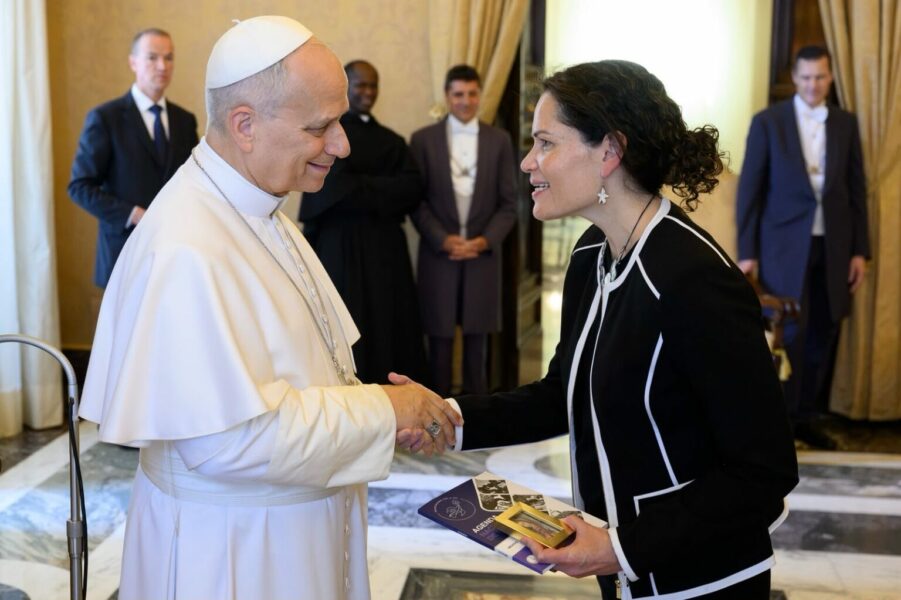
Pope Leo XIV received Ana Paula Hernández Romano, coordinator of the National Dialogue for Peace, at the Vatican, where she presented him with Mexico’s National Peace Agenda, a document built with more than 14,000 citizen voices. The meeting took place within the framework of an international dialogue on drugs and the criminal recruitment of youth, during which the pontiff emphasized the need to rebuild the community fabric as a comprehensive response to violence.
The meeting between Pope Leo XIV and Ana Paula Hernández Romano became a symbolic moment of great significance for Mexico. Hernández Romano, leading the National Dialogue for Peace, shared with the pontiff Mexico’s experience in community rebuilding in the face of youth violence and addiction. She explained that the risks faced by adolescents and young people cannot be reduced to individual decisions, but are shaped by social, family, and institutional conditions. The lack of community, the abandonment of public spaces, job insecurity, and the absence of policies that prioritize new generations are factors that fuel vulnerability.
Pope Leo XIV, upon receiving the National Peace Agenda, blessed it as a sign of support for those working for reconciliation in Mexico: families searching for their missing loved ones, women fighting for safe communities, pastoral agents accompanying pain, and young people who refuse to give up on their future. In his remarks during the meeting “Faith-Based Response to Drugs and the Criminal Recruitment of Youth: A Dialogue from Latin America and the Caribbean to the World,” the pontiff insisted that “there is no better prevention against drugs than a good family” and called for efforts to focus on care, presence, and the rebuilding of the community fabric. He evoked the figure of the Good Samaritan to urge the Church not to pass by suffering, but to stop, tend to wounds, and become a home for the marginalized.
The meeting was promoted by CELAM, the Pontifical Commission for Latin America, and the OAS, and was held in Rome from August 25 to 27, 2026. Experiences of prevention and accompaniment from Latin America, Africa, Asia, and Europe were shared. The “Conversations in the Spirit” methodology helped identify common challenges and responses based on faith and shared responsibility. Hernández Romano emphasized that building peace is a “long-distance race” that requires the responsible participation of the Church, governments, families, universities, and businesses.
The National Peace Agenda, delivered to the Pope, is the result of a process that began after the assassination of Jesuits Javier Campos and Joaquín Mora in the Sierra Tarahumara in 2022. It was developed from 1,004 community conversations in 20 states, 50 forums on justice and security in 32 entities, and a National Dialogue in Puebla with more than 1,300 participants and 550 organizations. The document outlines three fundamental pillars: social fabric, justice, and security. It acknowledges the crisis of violence in Mexico, with more than 92 homicides per day and thousands of disappearances, and proposes a shift from a culture of violence to a culture of care. Among its objectives are strengthening families, rebuilding community trust, combating violence against women, restoring institutional integrity, promoting decent work, and protecting the environment. The proposed roadmap includes mental health programs, peace education, victim support, restorative justice, and active citizen participation in institutional oversight.
Pope Leo XIV’s gesture of blessing the National Peace Agenda was interpreted as a spiritual and political endorsement of Mexican society in its effort to “organize hope.” The meeting not only highlighted the urgency of addressing the community roots of youth violence, but also placed Mexico at the center of a global dialogue on how faith and shared responsibility can offer alternatives to addiction and organized crime. In the words of Hernández Romano, peace cannot be delegated—it is the task of all sectors, a collective construction that seeks to enable young people to imagine a future that is “desirable, livable, and shared.”
This meeting marks a milestone in the relationship between Mexico and the Vatican, as the delivery of the National Peace Agenda to Pope Leo XIV symbolizes the convergence of the citizen voice and the moral authority of the Church, at a time when the country faces one of the worst violence crises in its contemporary history.
The National Peace Agenda can be consulted here.