


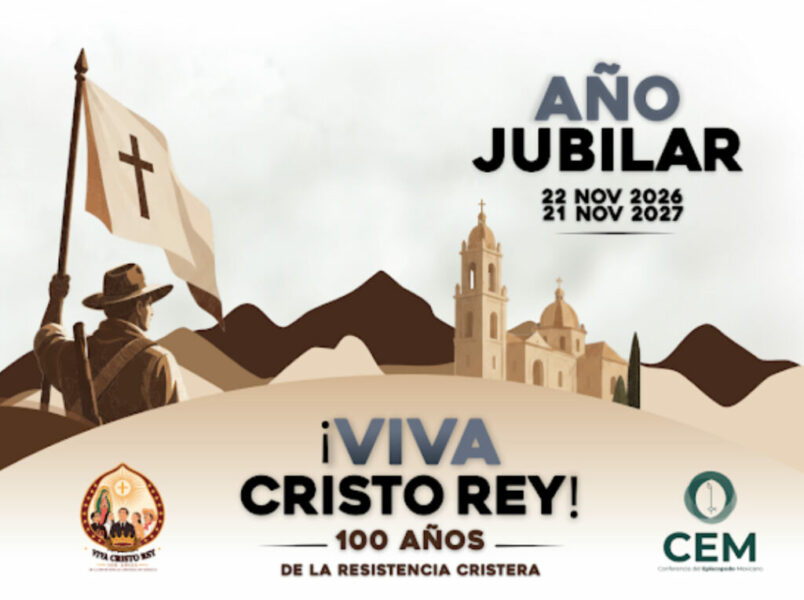
One hundred years after the beginning of the Cristero resistance, the Mexican bishops propose reading that painful historical episode through the lens of truth, freedom of conscience, reconciliation, and the commitment of a faith ready to become service
One hundred years after the beginning of the Cristero resistance, the bishops of Mexico have addressed the country with a pastoral letter that seeks to recover one of the most painful, complex, and controversial episodes in national history without turning it into an instrument of revenge, polarization, or the legitimization of violence. Under the title ¡Viva Cristo Rey! His faith, our memory; his witness, our mission, the document proposes a historical, theological, spiritual, legal, and pastoral reading of those events, but above all, it formulates a question addressed to believers of our time: What does it mean today to keep alive a faith for which others were willing to give their lives?
The letter does not celebrate war or present armed resistance as a model of Christian action for the present. Its starting point is different: to remember the fidelity of a people who, in the midst of persecution, continued to pray in their homes, baptize their children, protect their priests, celebrate the sacraments clandestinely, and defend freedom of conscience against a State that sought to administer religious convictions as if they were a concession of power.
From the outset, the bishops establish an essential distinction between the armed conflict, with its errors, excesses, responsibilities, and wounds, and the witness of those who died without renouncing their faith. The martyrs, the document emphasizes, are not remembered because they killed for Christ, but because they died for Him and, in many cases, forgave their executioners. It is not about recovering a war cry, but the spiritual strength of a conscience that refused to be subdued.
The episcopate proposes a threefold exercise of historical memory, appreciation of martyrdom, and Christian commitment to life, human dignity, and peace. Throughout the letter, a transversal conviction emerges: memory is authentically Christian only when it leads to conversion, helps heal wounds, prevents the repetition of injustices, and is transformed into mission.
This purpose requires beginning with “a brief account of the religious conflict”, the title of the first chapter and the point of entry for understanding that the confrontation did not arise suddenly in 1926. Its antecedents go back to the formation of the Mexican State after Independence, when two national projects began to clash. One recognized Catholicism as the foundation of the social order; the other sought to limit the institutional influence of the Church in order to consolidate a liberal, sovereign, and progressively secular State.
The Constitution of 1857 and the Reform Laws represented a decisive moment in that process. They established the separation between Church and State, limited ecclesiastical property, and modified the presence of the religious institution in education and civil life. For their promoters, these were indispensable measures to modernize the country; for the Church and many Catholics, they represented a hostile intervention in areas they considered essential to their identity and mission.
The letter acknowledges, however, that secularization did not occur immediately nor did it eliminate the deep roots of Catholicism in national life. Faith continued to be present in customs, families, education, festivals, and community forms of organization. In that context, social Catholicism gained strength, inspired in large part by the 1891 encyclical Rerum novarum.
Workers’ organizations, youth and women’s associations, savings banks for peasants, night schools, mutual aid centers, media outlets, and projects of political participation emerged. Catholics did not limit themselves to claiming the Church’s position; they built social networks and used civic instruments such as voting, the press, association, and public mobilization.
The Mexican Revolution revived an anticlericalism that, in some places and moments, took on violent expressions. There were attacks on churches, images, and religious ministers. Some revolutionary leaders identified the Catholic hierarchy with the political and economic structures of the old regime, particularly after the support that certain members of the now-defunct National Catholic Party gave to the government of the usurper Victoriano Huerta.
The Constitution of 1917 hardened the restrictions, denied legal personality to the Churches, limited the political rights of ministers of worship, prohibited certain forms of confessional education, outlawed religious orders, nationalized ecclesiastical property, and allowed state legislatures to determine the number of priests authorized in each entity.
These provisions were not applied immediately with the same intensity throughout the country, but they created the legal framework that would enable the subsequent persecution. After a period of relative détente during Obregón’s government, the tension reached its critical point under the presidency of Plutarco Elías Calles.
On June 14, 1926, the penal reform known as the Calles Law was issued, published on July 2 and effective from July 31 of that same year. The legislation turned constitutional restrictions into criminal offenses accompanied by precise sanctions. It limited the exercise of religious ministry, subjected various public expressions of faith to control, prohibited certain forms of confessional teaching, and penalized the wearing of religious habits outside of churches.
What was then put at risk was not only the legal position of the Church, but the possibility for people to live, teach, and publicly express their religious convictions.
The initial response was not armed. The National League for the Defense of Religious Freedom promoted petitions, protests, and an economic boycott. A request backed by around two million signatures called for the modification of the anti-religious legislation, without obtaining a favorable response.
In that context, the bishops adopted the principle of the Non possumus, “we cannot,” through which they expressed that they could not subject the exercise of the ecclesial mission to provisions considered contrary to conscience and the rights of the Church. The Episcopal Committee decided to suspend public worship beginning July 31, 1926. The measure was announced in a collective pastoral letter dated July 25.
The suspension of worship was not conceived as an ecclesiastical closure of the churches nor as a censure against the faithful, but as a legal, pastoral, and theological protest against the application of legislation considered unjust. Initially, the churches remained open for private prayer and penitential acts, although later the authorities carried out inventories and closed several buildings.
The impact on the population was profound. The bells fell silent, the public celebration of the sacraments was interrupted, and numerous priests were expelled, persecuted, hidden, or concentrated in the cities. But religious practice did not disappear. Homes, fields, caves, and other improvised spaces became places of prayer and celebration.
The laity organized community acts, protected priests, transmitted doctrine, sustained networks of solidarity, and, in situations of need, assumed extraordinary responsibilities. The so-called “white masses” were celebrated—gatherings of prayer and the Word without Eucharistic consecration due to the absence of priests.
The persecution produced a grave ecclesial crisis, but at the same time revealed the capacity of the believing people to take responsibility for their faith. Women and men assumed tasks that usually depended on parish structures. Faith ceased to be linked exclusively to the church and found refuge in families and communities.
The peaceful protest turned, for some groups, into armed insurrection. In August 1926, uprisings occurred in Zacatecas and Jalisco, and the movement spread mainly through rural regions of central and western Mexico. Its members were called “Cristeros” and adopted as expressions of identity the cries “¡Viva Cristo Rey!”, “¡Viva la Virgen de Guadalupe!” and “¡Viva México!”.
The letter does not hide that the confrontation took on the characteristics of a civil war nor that the Government responded with severe repression. Nor does it present the Cristero movement as a homogeneous force. There were differences among the combatants, the civilian leaders, the bishops, and those who defended the continuation of peaceful means.
The Holy See did not approve the armed uprising, but neither did it issue a formal condemnation against those who participated in it. Through the encyclical Iniquis afflictisque, Pius XI denounced the persecution of the Church in Mexico and exhorted the faithful to resist peacefully through prayer. The ecclesial position, therefore, cannot be reduced to an approval of war nor to indifference in the face of persecution.
The letter also highlights the participation of women, who sustained clandestine religious networks, distributed information, provided formation, transported resources, and preserved family and community life. Very few priests took up arms directly; the majority remained spiritually attending to the population, hid in private homes, or sought refuge elsewhere.
The conflict lasted until 1929, when negotiations known as “the arrangements” allowed public worship to resume. These were verbal agreements between representatives of the Government and the Catholic hierarchy, with international mediation. However, they did not eliminate the constitutional provisions that had given rise to the confrontation.
For many Cristeros, the arrangements represented a defeat and even a betrayal, especially because some combatants were assassinated after laying down their arms. The letter maintains that the bishops’ intention was not to abandon them, but to put an end to a war that was destroying populations, communities, and families.
Tensions continued in the following decade and led to what is known as the Second Cristiada, between 1934 and 1941. The relationship between the Church and the State only stabilized gradually through a modus vivendi, a practical coexistence that did not eliminate the constitutional restrictions but allowed the open confrontation to be reduced.
The historical account concludes with an invitation to look at those years with a spirit of reconciliation, critical lucidity, and rejection of any triumphalist or polarizing discourse. Remembering the persecution does not mean reopening wounds, but understanding how a fundamental right was denied and preventing a similar imposition from happening again.
From that historical foundation, the letter moves into its second movement, “martyrdom: configuration with Christ and permanent vocation of the disciple”. Here lies the theological core of the document. Martyrdom is not presented as a feat born of human self-sufficiency, as a voluntary search for death, or as an expression of fanaticism. It is the possible culmination of a life configured with Jesus Christ and sustained by grace.
Christ is the faithful witness of the Father and the source of all martyrdom. His surrender on the cross does not constitute an exaltation of pain, but the extreme manifestation of a love that remained faithful. Consequently, the martyr is not one who despises life, but one who has recognized in Christ a good that cannot be renounced, not even under threat of death.
The letter situates martyrdom within the Paschal mystery. The death of the witness does not represent a definitive defeat, because it can only be understood from the resurrection. The martyr participates in Christ’s victory over sin and death, not because suffering has value in itself, but because his existence is incorporated into Christ’s loving surrender.
The Holy Spirit is presented as the inner force of witness. It not only sustains those who face martyrdom of blood, but every believer called to persevere in the truth, defend human dignity, forgive, fulfill their vocation, and exercise charity.
At this point, the document broadens the understanding of martyrdom. Alongside the supreme witness of one who gives their life, there exists a daily fidelity by which the Christian dies to selfishness, lies, injustice, and indifference. Between martyrdom of blood and daily witness there is a spiritual continuity; both proceed from a life configured with Christ.
The vocation to witness belongs to the entire Church. Families live it through the fidelity of love and the transmission of faith; priests, through pastoral charity; consecrated persons, through their dedication to the Kingdom; and the laity, by making the Gospel present in culture, education, work, society, and the building of the common good.
In the face of secularization, individualism, violence, family fragmentation, and the culture of discard, the disciple is called to give witness without seeking conflict and without renouncing truth or charity. The martyrs do not invite us to desire persecution, but to live with interior freedom, humility, and hope.
The letter asks that the memory of the martyrs be kept free from ideological appropriations. The Church does not venerate them because they embody a military victory or because they legitimize a political cause. It recognizes them because in them it identifies the action of grace and Christian virtues lived to the point of heroism. In cases formally recognized as martyrdom, the Church holds that they accepted death out of hatred for the faith.
The true victory of the martyrs did not consist in defeating their persecutors, but in allowing the love of Christ to conquer hatred in their own lives. Therefore, their memory must strengthen evangelization, ecclesial communion, and service.
The chapter leads to two complementary images: the Eucharistic Church and the Samaritan Church. The first receives the given body of Christ and learns to transform its own existence into an offering. The second makes faith credible through care for the poor, victims, migrants, the sick, those suffering from addictions, and excluded persons.
The letter expressly mentions the wounds that run through Mexico: violence, disappearances, poverty, forced migration, human trafficking, addictions, the weakening of the family, and various forms of exclusion. A martyrial memory that is not transformed into mercy, accompaniment, and defense of human dignity remains incomplete.
The reflection continues with “the values lived by our martyrs”, the title of the third chapter and a spiritual inventory of the virtues that the episcopate identifies in priests and laity. The starting point is that martyrdom is not reached by chance. It is a gift from God, but also the culmination of a way of life built through decisions, convictions, and practices sustained over time.
The first value is unbreakable faith in Christ. The cry “¡Viva Cristo Rey!” is not interpreted by the letter as a partisan slogan, but as the public confession that no human power can take the place of God or claim absolute dominion over conscience. For the martyrs, Christ was not an abstract idea, but the real center of existence.
The second value is deep devotion to the Eucharist and the sacraments. Priests and laity risked their lives to celebrate Mass, receive Communion, go to confession, and preserve the consecrated species. This dimension reveals that the confrontation was not exclusively political: it affected the sacramental core of Catholic life.
Added to this was fidelity to God, to conscience, and to the desire for peace. The letter acknowledges that many believers resorted to civil disobedience in the face of provisions considered unjust, but clarifies that the defense of conscience did not necessarily imply a will to war. Many sought to recover the indispensable space to live their faith with freedom.
Pastoral and apostolic zeal was manifested in priests who continued to celebrate, confess, and accompany communities, as well as in laity who organized catechesis, Eucharistic networks, and assistance services. It was not enough to survive; it was necessary to prevent the Christian proclamation from being interrupted.
Hope in eternal life made it possible to face death without succumbing to despair. That hope explains the serenity manifested in numerous testimonies and, especially, the capacity to forgive. It was not a reckless attitude nor a contempt for life, but the conviction that death did not have the last word.
The defense of religious freedom appears as a surrender for the right of every person to believe, teach, and practice their faith without coercion. The martyrs did not die to preserve a concession reserved for the clergy, but for a freedom linked to the dignity of every person.
The document also highlights love for the family, collaboration between faithful and pastors, fidelity to the Church, serene courage, detachment from goods, and trust in Providence. The persecution did not annul family responsibilities. In many cases, it led to defending the right of children and communities to receive and transmit the faith.
Among all the values, forgiveness and mercy stand out. Many martyrs expressly forgave those who condemned or executed them. That attitude makes it possible to differentiate Christian witness from the logic of resentment; resisting an injustice does not authorize denying the dignity of the one who commits it nor reproducing their violence.
Devotion to the Virgin of Guadalupe linked religious fidelity with a profound expression of Mexican Catholic identity. To this devotion was added humility. The martyrs did not consider themselves self-sufficient heroes, but persons in need of God’s mercy.
Their example formulates an uncomfortable question for today’s believers: Does the same coherence exist today to live as they were willing to die? Being faithful when there is a cost, loving in the midst of rejection, forgiving when it hurts, and proclaiming Christ with one’s life constitute the possible updating of their legacy.
The letter then delves into “the heart of the conflict: the right to freedom of faith and conscience”. The fourth chapter shifts the focus to the underlying legal and political issue: the State’s claim to treat religious freedom as a revocable concession, not as a right inherent to the person.
Religious freedom is defined as the cornerstone of human rights. It implies that no one should be forced to act against their conscience or prevented from living according to it, both in private and in public. The State does not grant this freedom; it is obliged to recognize and guarantee it because it proceeds from human dignity.
The letter distinguishes three stages in the relationship between religious freedom and Mexican legislation: an anticlerical secular State between 1855 and 1911, a secular State with an anti-religious orientation between 1917 and 1992, and a State formally oriented toward religious freedom since 1992, although still with restrictions and pending issues.
Article 130 of the 1917 Constitution denied legal personality to the Churches and established severe limitations on ministers of worship. State legislatures could set the number of priests; ministers had restricted political rights and the capacity to speak on public matters; religious education, confessional publications, and the possession of goods were also limited.
The Calles Law turned that system of constitutional restrictions into a penal regime. It did not limit itself to defining the institutional separation between Church and State, but criminalized certain religious behaviors and subjected the exercise of conscience to political control.
The letter recalls that the resistance initially followed civic and peaceful channels: petitions, legal appeals, mobilizations, boycotts, and social organization. Only after those avenues were rejected or proved ineffective did a portion of Catholics conclude that armed resistance had to be resorted to.
This historical explanation does not amount to declaring that every decision made by the insurgents was morally justified; it does, however, allow us to understand that the rebellion did not arise spontaneously nor can it be reduced to a reaction against modernity. It occurred in a context in which broad sectors considered the institutional paths for defending their rights to be closed.
The document proposes moving toward a positive secularity, distinct from secularism. Secularity means that the State does not identify with a confession, does not impose a belief, and treats believing and non-believing citizens impartially. Secularism, on the other hand, seeks to reduce religion to public irrelevance and confine it to the interior of churches.
A democratic secularity must recognize that religious freedom includes worship, teaching, association, public expression, charitable works, social participation, and the right of parents to educate their children according to their convictions. It must also allow cooperation between civil authorities and religious communities when both contribute to the common good.
The warning remains relevant: it is not enough to tolerate worship if conscience is distrusted; it is not enough to allow the church if believers are to be excluded from the public square. The neutrality of the State cannot be confused with hostility toward religious expressions.
After the historical, theological, spiritual, and legal journey, the letter presents “the tasks, teachings, and commitments inherited”, with which the fifth chapter transforms memory into a pastoral and social program.
The first task consists in recognizing the role of women. Mothers, grandmothers, and collaborators sustained homes, taught prayers, organized networks of help, protected the persecuted, and preserved religious practice. The continuity of the faith depended to a great extent on women who prevented persecution from interrupting its transmission to new generations.
The second task consists in recovering the meaning of the word martyr as witness. What is decisive is not the violence suffered nor the manner of death, but what the life and surrender proclaimed. For them, faith was not a private opinion that could be abandoned in the face of danger, but a truth capable of guiding the entire existence.
The third task is to strengthen an organized and co-responsible Church. The resistance demonstrated that the Church is not reduced to the hierarchy or to pastoral structures. The laity assumed responsibilities in formation, the press, communication, assistance, legal defense, and civic mobilization.
The layperson appears not as a passive recipient of ecclesial action, but as a subject responsible for the mission. That experience today calls for mature participation in the family, culture, work, economy, politics, and community building.
The fourth task is to advance from fratricide to the building of peace. The persecution was real, but it ended in a war among Mexicans. Memory cannot be reduced to an absolute division between good and bad. It is necessary to recognize causes, responsibilities, errors, and excesses without morally equating all decisions, but also without using truth as a pretext for hatred.
Mexico needs a reconciling Church in the face of violence, insecurity, public distrust, and the weakening of the social fabric. Rebuilding relationships, accompanying victims, promoting justice, and working for peace are current ways of honoring the martyrs.
The fifth task consists in turning memory into mission. A memory that does not produce witness runs the risk of becoming devotion without consequences. A faith that is not transmitted weakens; a laity that renounces its responsibility becomes a spectator, and a commemoration incapable of reconciling ends up reproducing the divisions it sought to overcome.
The letter directs concrete teachings to children, adolescents, young people, adults, priests, and consecrated persons. To the new generations, it presents the example of those who learned in their homes that faith could demand courage. To adults, it recalls the value of social organization, communication, and solidarity. To priests and consecrated persons, it proposes pastoral creativity, perseverance, and closeness to communities.
Finally, it formulates ethical, communal, social, and ecclesial commitments. Among them are defending religious freedom and freedom of conscience, rejecting armed violence as a means of vindication, living the faith with coherence, strengthening the community fabric, accompanying the poor, promoting civic participation, recognizing the leadership of women and young people, studying history without ideological manipulation, and building a culture of reconciliation.
The laity, priests, religious, and bishops receive different but complementary responsibilities. The laity must participate in society and defend freedoms by legal and peaceful means; priests must accompany their communities with generosity; consecrated life must serve the most vulnerable with creativity; and bishops must harmonize institutional dialogue, pastoral guidance, prophetic denunciation, and the search for concord.
In its conclusion, the letter summarizes the proposed itinerary: remember to give thanks, give thanks to be converted, be converted to be reconciled, be reconciled to serve, and serve to evangelize. Mexican reality, marked by violence, poverty, corruption, disappearances, family fragility, and various forms of exclusion, demands a witness that does not remain enclosed in memory nor limited to the interior of churches.
The martyrs must not be transformed into immovable banners nor used to justify new confrontations. Their legacy calls for a Church that defends the truth without hatred, denounces injustice without losing charity, accompanies victims, and proclaims hope through service.
The letter entrusts this path to the Virgin Mary, invoked as Queen of Martyrs, and recognizes in Saint Mary of Guadalupe the maternal presence that has sustained the faith of the Mexican people in times of trial. Marian devotion does not conclude in a religious emotion, but in the evangelical invitation to listen to Christ and fulfill His word.
The pastoral letter, after a prolonged period without a collective document of the Mexican episcopate of this nature, can become an indisputable reference for understanding martyrdom as a testimony of faith and hope. Celebrating the “Cristeros” does not mean wrapping ourselves in a flag of belligerence nor promoting a new “taking up of arms.” It means remembering that, according to the demands of each era, the Christian is called to be light of the world and salt of the earth, proclaiming the Gospel and denouncing whatever wounds human dignity, subjects conscience, denies freedom, covers up injustice, or destroys peace.
The pastoral letter can be read here:
carta pastoral obispos México Centenario resistencia cristera