


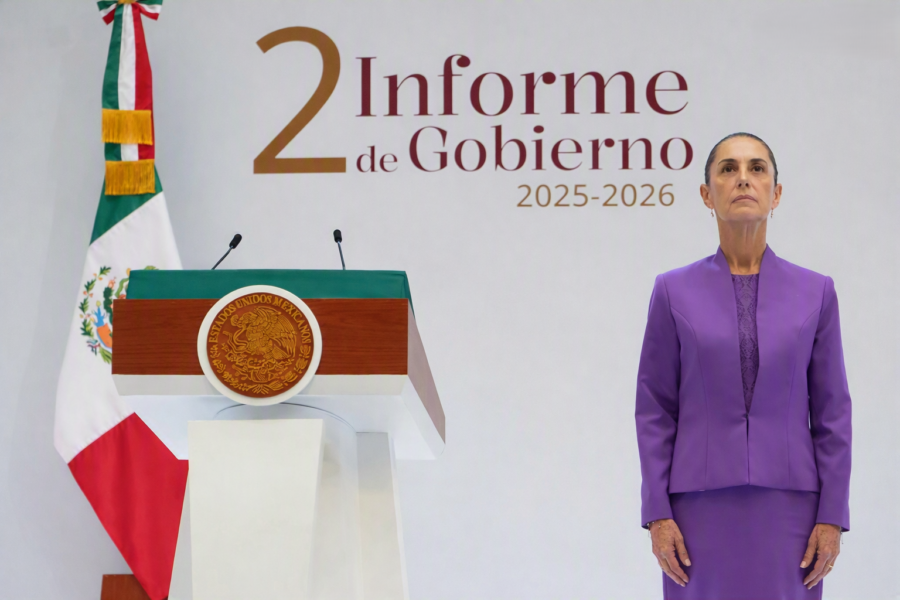
The Observatory of Catholic Citizenship and Social Analysis, in its report number 71, offers a severe and deeply critical reading of Claudia Sheinbaum’s Second Government Report. Its analysis is based on an ethical principle that is not accessory, but foundational: “Fidelity to man demands fidelity to the truth, which is the only guarantee of freedom”, recalling that the examination of public life cannot be separated from the moral responsibility of naming reality without makeup or propaganda. The question that articulates the document is direct: Is it true that Mexico is doing well, as the President claimed? And the answer, supported by public data, is a resounding no.
The presidential report is presented in a context that the Observatory describes as critical and deteriorating. The Mexican economy is not growing, GDP has remained stagnant since 2018 and the population has increased by more than ten million people. The report summarizes it clearly: “There is no more wealth, but there are more people, so social inequality may increase.” This statement is not rhetoric; it is supported by figures from INEGI, Banco de México and IMSS, which show the loss of 204 thousand formal jobs in June 2026 and the disappearance of more than 25 thousand companies in 2025. The country, far from moving toward a welfare model, is sliding toward an informal economy that precarizes millions of families.
The Observatory emphasizes that the economic crisis is aggravated by political uncertainty. The United States’ refusal to ratify the USMCA, which contributes 55% of the national GDP, is interpreted as a symptom of international distrust toward Mexico. The document points out that the treaty “will be subject to annual reviews, causing private investments to lose certainty”, and that the supposed record foreign investment claimed by the government is actually reinvestment, not new capital. The Mexican economy, according to the analysis, is sustained on manipulated figures and triumphalist speeches that do not correspond to reality.
Institutional deterioration is another central axis of the report. The Observatory states that the institutions responsible for guaranteeing democracy such as the National Electoral Institute, the Electoral Tribunal of the Federal Judiciary or the Attorney General’s Office, have been captured by partisan interests, weakening constitutional checks and balances and favoring a model of power concentration. The document describes this process as “an Authoritarian and Despotic State, prelude to a Left-Wing Populist Dictatorship”, supported by the Armed Forces and an assistance-based corporatism that ensures political loyalties through social programs. This statement is based on the observation that the presidential report does not call for national unity, but rather reinforces polarization and consolidates the partisan base.
Regarding security, the report claims a 51% reduction in intentional homicides and thousands of arrests and seizures. However, the Observatory warns that these figures hide the increase in missing persons and the reclassification of crimes to artificially decrease homicides. The document points out that the government has begun to dismantle drug laboratories, “nearly three thousand” according to the text, contradicting the previous narrative that denied their existence. This contradiction, the Observatory states, reveals the systematic manipulation of data to sustain an image of success in security that does not correspond to the daily experience of millions of Mexicans.
The Observatory’s political analysis is especially incisive. The document denounces the alliance between government actors and organized crime leaders, pointing out that this relationship has generated tensions with the United States and has facilitated the expansion of criminal networks linked to fentanyl trafficking. The report mentions specific cases, such as the alleged involvement of politicians in fuel theft schemes that would have generated losses of 600 billion pesos, describing it as “the greatest theft and historic fraud of Mexican resources.” These accusations, based on journalistic and judicial investigations, point to structural corruption that compromises national sovereignty more than any external pressure.
The Observatory maintains that the Second Government Report is, in reality, the starting signal for MORENA’s electoral campaign toward 2027. The President’s national tour, presented as dissemination of achievements, is interpreted as an early act of proselytism. The document recalls that the electoral process formally begins on September 10, but that candidate selection should not begin until 2027. MORENA, the report states, has initiated this process in a veiled manner, using public resources and the presidential platform to consolidate its political project.
The Observatory’s report concludes with a warning and a call. The warning is that the country is at a dangerous crossroads, where the manipulation of figures, institutional deterioration and the alliance with organized crime can lead to a profound crisis. The call is for citizens to inform themselves with reliable sources, demand truth and transparency, and remember that Mexico is not the property of any party. The document expresses it with a phrase that synthesizes its concern, many Mexicans “hear without listening, let lies pass or simply do not care about their country until the problem reaches their pockets or affects their own security.”
The full report can be read here
Ciudadania Catolica y Analisis Social 71