


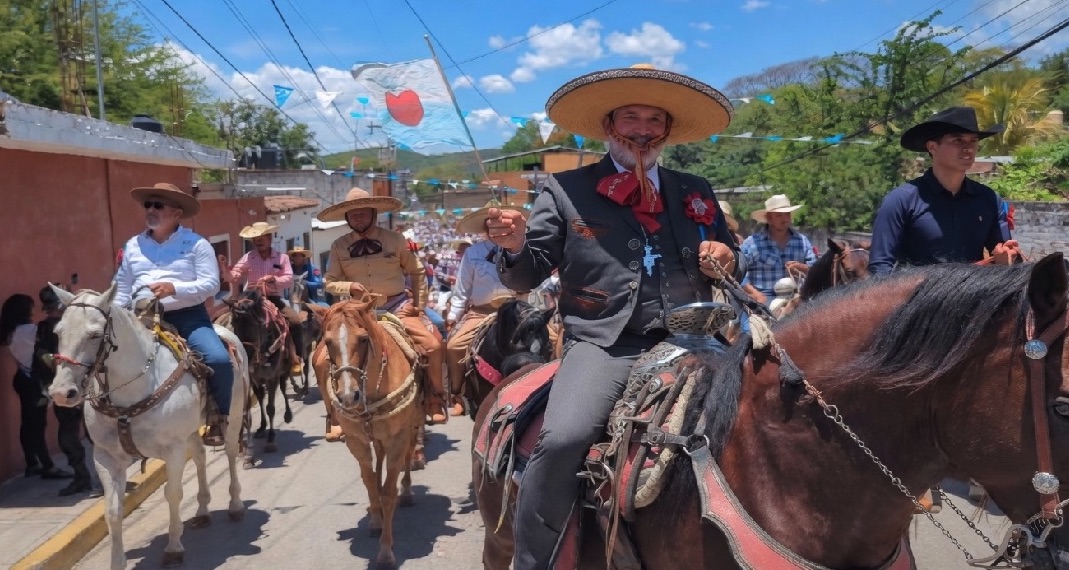
With the prominent presence at the charrería event, the bishop of the Diocese of Chilpancingo-Chilapa, the Franciscan José de Jesús González Hernández, took part in the horseback procession and charreada held on Sunday, June 14, 2026 in Huitzuco de los Figueroa, Guerrero, in honor of the Immaculate Heart of Mary, the devotion to which the diocese has been consecrated since its canonical erection in 1863 (163 years). The event, the second of its kind in Huitzuco, combined popular faith, charrería tradition, and an explicit call to diocesan fraternity to heal society.
During the celebration, the bishop recalled how a moment of diocesan festivity transcends the private and is lived with the people. For the second consecutive year, Huitzuco hosted the popular feast, following the religious acts on Saturday, June 13 in Iguala. The image of the Virgin traveled through communities, and on Sunday the horseback procession brought together hundreds of faithful, charros, and families.
At 10:00 a.m., the procession set out from Colonia El Bonete, along Vicente Guerrero Street. More than a hundred riders and amazons, dressed in traditional charro attire, rode through the streets toward Plaza Trinidad Uriza, also known as the Trinidad Uriza bullring, adapted as a charro ring. Groups from Huitzuco—the local “monteños”—Chilpancingo, Tixtla, Mochitlán, Zumpango, Iguala, as well as representatives from Morelos, the Costa Grande, and Toluca participated. The escaramuzas from various regions and the children’s group “Caballito de Palo” from Huitzuco added color and elegance. Traditional skills were demonstrated: horse reining, rope tricks, the paso de la muerte, and ranch-style bull riding.
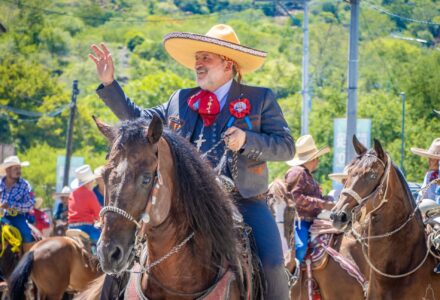
At the charro ring, José de Jesús González Hernández took the floor with visible joy. “The dream became reality,” he said. “We are at a very Mexican celebration; it is our sport…”. He recalled that the diocese “164 years ago was erected… and was consecrated to the Immaculate Heart of Mary” thanks to the fact that the Diocese of Chilpancingo-Chilapa was canonically erected by the bull Grave nimis of Pope Pius IX on March 16, 1863.
The central theme of his message, displayed on banners, was: “United in diocesan fraternity, to heal our society”. He invited healing through joy: “Ahead of us came the music and the young people, with this fresh joy, dancing, dancing… very happy. They truly are contagious.” He emphasized that the emotions of the celebration “will serve as rest, as relief” and asked for prayers for those who could not enjoy it. He blessed the event and asked for peace and timely rain for the region.
The parish priest of Santiago Apóstol de Huitzuco, Fr. Oscar Mauricio Prudenciano González, warmly welcomed everyone: “Gentlemen riders, gentlemen on horseback, thank you for coming… Monseñor, welcome, this is your parish, your home.” He thanked the bishop, the municipal president, and the authorities for making the event possible “precisely in honor of our Most Holy Mother, the Immaculate Heart of Mary.”
The municipal president, Eder Nájera Nájera, highlighted the unprecedented nature of the day: “It is the first time a horseback procession of this kind has taken place; it is the first time we are joined by charros from Zumpango, Chilpancingo, Toluca, Morelos, and nearby municipalities.” He stressed that supporting the Church “is supporting fraternity, unity” and that its principles contribute to healthy coexistence in Guerrero. He welcomed the bishop and all attendees.
The event was widely documented on social media, with live streams, videos, and photographs published that garnered a significant number of views. The column of riders, the escaramuzas, families, and young people dancing to the band’s rhythm were all visible. Comments highlighted the “white balance”—the absence of incidents—the security, peaceful coexistence, and the bishop’s gesture of embracing the spirit of charrería. Phrases such as “The Virgin unites us” and “How beautiful to see our Church so close to the people” were recurrent.
In a state like Guerrero, marked by wounds of violence and fragmentation, the event took on a profound pastoral meaning. The bishop’s invitation to “heal our society” through diocesan fraternity was embodied in the shared horseback procession, in the charreada that unites generations, and in institutional support without incidents. Charrería became a vehicle for evangelization and social cohesion. The Franciscan bishop, with his active presence at the charrería event, reminded us that the Church embraces local cultures, purifies them, and elevates them toward the Gospel.
https://www.youtube.com/shorts/VnZPFJ4EEbI