


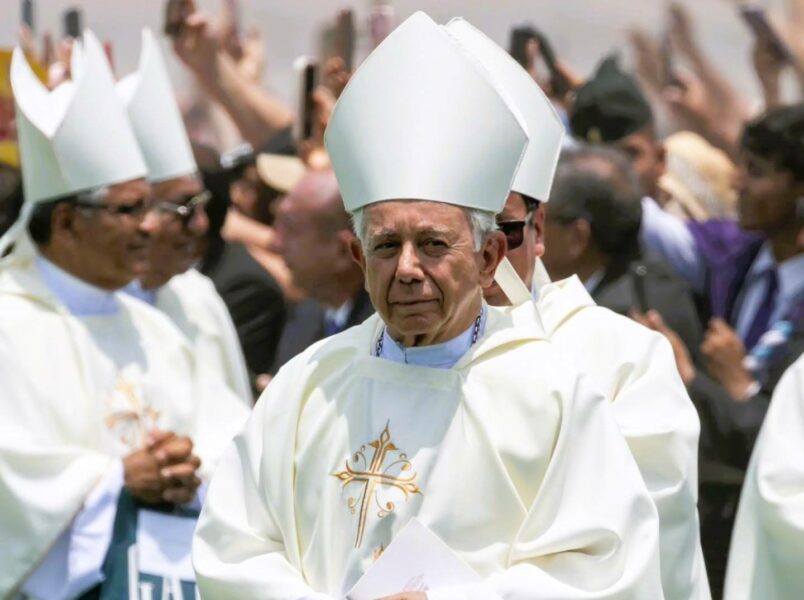
The message that the president of the Mexican Episcopal Conference, Ramón Castro Castro, addressed to the country’s bishops on the occasion of the CXXI Plenary Assembly constitutes one of the most severe, direct, and socially committed pastoral statements issued by the Mexican Catholic Church in recent years. Under the evangelical motto “I was blind and now I see” (Jn 9,25), the bishop of Cuernavaca articulated a profound reflection on the national reality that transcends the limits of an internal ecclesial discourse to become a critical reading of Mexico’s current state, marked by violence, corruption, political polarization, institutional fragility, and the progressive weakening of the rule of law.
The document’s relevance lies not only in the clarity of its diagnoses but also in the decision to place the Church in a prophetic position before Mexico’s wounds. From the opening lines, the message avoids any triumphalist temptation and proposes a realistic view of the country. Castro Castro reminds the bishops that the memory of the Mexican martyrs only makes sense if it illuminates the present and compels us to ask what is being done today with the truth, justice, and freedom for which so many believers gave their lives. The evocation of those testimonies immediately leads to a moral demand: to recognize the people’s hopes, but also to denounce what threatens their dignity.
The bishop thus proposes a pastoral methodology inspired by three figures from the Gospel of Saint John, the Samaritan woman, the man born blind, and Lazarus. Yet behind the catechetical proposal emerges a profound social reflection. The Church is invited to listen to a people’s thirst, to open its eyes to the truth of events, and to collaborate actively in removing the obstacles that prevent a dignified life for millions of Mexicans. This perspective turns evangelization into a task inseparable from human promotion, inclusion, and the defense of the most vulnerable.
One of the most significant aspects of the message is the recognition that Mexico lives in a complex situation that cannot be reduced to figures or official narratives. The president of the CEM acknowledges that there are social advances that deserve recognition, mentions the benefit that various families have found in social programs, and admits that the increase in the minimum wage has allowed many workers to improve their incomes. He also recognizes the honest work of public servants committed to the common good. However, he affirms that precisely because the Church seeks the good of society, it is obliged to point out what requires correction and transformation.
From that moment on, the message takes on a particularly forceful tone. The searching mothers, the victims of extortion, the communities subjugated by criminal groups, the young people forcibly recruited, the sick without timely access to medication, and the families forced to go into debt to receive medical care appear as concrete faces of a national crisis that continues to lack sufficient responses. For Castro Castro, insecurity is not a statistical abstraction but a reality with names, stories, and human consequences that demand effective public actions and a close pastoral presence.
However, the most relevant social and political core of the document emerges when the bishop addresses the issue of institutional deterioration, warning that Mexico faces a worrying weakening of democratic checks and balances and of the guarantees necessary to preserve the independence of justice. The erosion of oversight mechanisms, the systematic disqualification of criticism, and the loss of impartiality in institutions constitute, according to his analysis, alarming signs of a deterioration in public life.
The denunciation reaches one of its most delicate points when it states that the law loses legitimacy when it is applied harshly to adversaries and leniently to allies. This observation is not directed at any specific political force, but at a dynamic that can take hold in any system of power. When compliance with the norm ceases to be universal and becomes selective, warns the president of the CEM, citizen trust begins to crumble and the rule of law enters a phase of progressive weakening.
Corruption occupies a central place in this reflection. Castro Castro does not limit the phenomenon to the misappropriation of resources or the acceptance of bribes. He presents a broader definition that includes the use of public office to favor private interests, the manipulation of administrative procedures, the concealment of information, and cover-ups within political or bureaucratic groups. Particularly serious is his denunciation of nepotism and conflicts of interest, practices that, he points out, destroy equal opportunity and send society the message that personal connections matter more than ability, merit, or legality.
The moral force of the argument lies in linking corruption to its human consequences. Every diverted or misused resource represents medicines that do not reach hospitals, schools without maintenance, poorly equipped police officers, and deficient public services for those who need them most. In this way, the phenomenon ceases to be an administrative problem and becomes an ethical and social issue that directly affects the daily lives of millions of people.
The message insists that no institution can preserve its authority by hiding its problems. On the contrary, only truth, transparency, and accountability allow citizen trust to be recovered. Hence, the president of the CEM makes an explicit call to cleanse public life, eradicate corrupt practices, and restore to institutions their vocation of service. It is not, he clarifies, about promoting political persecutions or fueling revenge, but about ensuring that no one is above the law.
Another aspect of enormous relevance is the concern expressed about the influence of organized crime on democratic life. Castro Castro warns of the risk that criminal groups may intimidate communities, condition electoral processes, or determine who can govern certain territories. Where the vote is cast under fear, he affirms, democratic freedom is gravely compromised. Democracy requires independent institutions, trustworthy authorities, and citizens capable of participating without pressure or threats.
The defense of national sovereignty is also addressed from a novel perspective. The bishop maintains that sovereignty is not threatened solely by foreign interventions, but also by the capacity of criminal groups to impose rules, infiltrate government structures, and control entire regions of the country. Consequently, strengthening sovereignty implies combating impunity, investigating possible links between crime and authorities, and ensuring that institutions respond effectively to citizens.
Particular attention is given to the denunciation of the polarization that runs through Mexican public life. For the president of the CEM, one of the country’s deepest wounds lies in the growing tendency to turn the adversary into an enemy. When public discourse ceases to build bridges and begins to divide society between the good and the traitors, between patriots and enemies, conditions are created that ultimately justify aggression and normalize permanent confrontation.
This reflection is deeply relevant today. Castro Castro explicitly rejects any claim to monopolize the representation of the people and recalls that no political cause justifies the destruction of the dignity of those who think differently. Democratic coexistence requires recognizing plurality, accepting the diversity of opinions, and protecting freedom of expression even when it proves uncomfortable for those in power.
In this context, the message expresses concern about threats against journalists, human rights defenders, searchers for the disappeared, and social leaders. The freedom of those who denounce injustices or accompany victims constitutes, according to the bishop, a fundamental indicator of the democratic health of a nation. When a society silences critical voices, it ultimately weakens its own freedoms.
The Church, however, does not limit itself to pointing out problems. One of the most significant contributions of the document lies in the proposal of concrete paths toward national reconciliation. Castro Castro maintains that the ecclesial community possesses a particularly valuable resource in times of polarization: the capacity to generate spaces of encounter, listening, and dialogue. Parishes, movements, and communities can become places where people with different views learn to listen to each other, share common concerns, and rebuild deteriorated social bonds.
This proposal acquires special relevance in an era marked by fragmentation and distrust. In the face of the logic of permanent confrontation, the Church offers a pedagogy of encounter based on the dignity of each person, the shared search for truth, and the construction of the common good. It does not propose abandoning convictions, but learning to defend them without hatred and to dialogue without turning differences into reasons for exclusion.
Equally important is its insistence on the formation of responsible citizens. Christian initiation cannot, according to the bishop, be reduced to sacramental preparation. It must form people capable of discerning manipulation, resisting hate speech, committing to justice, and actively participating in public life. From this perspective, evangelization also becomes a school of citizenship and social responsibility.
The Guadalupana dimension of the message offers the spiritual horizon of this proposal. By evoking Saint Juan Diego and the apparitions at Tepeyac, Castro Castro presents the Virgin of Guadalupe as a model of closeness to those who suffer. The cry of Mexico’s children, he affirms, resonates today in the searching mothers, in the sick without adequate care, in the extorted families, and in the communities that wish to live without fear. Invoking Guadalupe demands assuming a concrete commitment to those who endure these realities.
The reference takes on even greater importance because the message places the reflection within the itinerary leading to the fifth centenary of the Guadalupano Event in 2031. The path toward that commemoration does not appear as a nostalgic celebration of the past, but as an opportunity to renew the Church’s evangelizing and social commitment. The Intercontinental Guadalupana Novena and the preparation for the five hundred years of the apparitions are presented as an invitation to rediscover Guadalupe’s capacity to generate reconciliation, hope, and unity among peoples.
A particularly significant fact is that this message was sent to the bishops gathered in assembly while Ramón Castro Castro was absent from the in-person sessions due to the invitation extended by the Peruvian episcopate to accompany Pope Leo during his pastoral visit to that country. His physical absence, however, did not diminish the weight of words intended to guide the deliberations of the Mexican prelates and offer criteria for discernment in the face of national challenges.
Taken as a whole, the document transcends the ordinary scope of an episcopal assembly. More than a simple inaugural address, it constitutes a moral X-ray of Mexican reality. Its pages bring together pastoral concern for victims, the defense of democratic institutions, the denunciation of corruption, the demand for transparency, the critique of polarization, and the search for paths of reconciliation inspired by the Gospel and the Guadalupana tradition.
In the end, Ramón Castro Castro’s letter becomes more than an exhortation addressed to the bishops. It is a serene yet firm denunciation of the historical moment Mexico is experiencing; a pastoral reflection that warns of the risks posed by the weakening of the rule of law; a call to recover trust in institutions through truth, transparency, and justice; and an invitation for the Church to contribute to rebuilding the social fabric through encounter, hope, and human dignity. In a nation marked by violence, corruption, and divisions, the message asserts that the defense of legality and of the human person is not only a political task, but also an irrenounceable moral imperative for all those who aspire to build a more just, freer, and more fraternal Mexico.
The full message can be read here:
Mensaje_inaugural_CXXI_Asamblea