


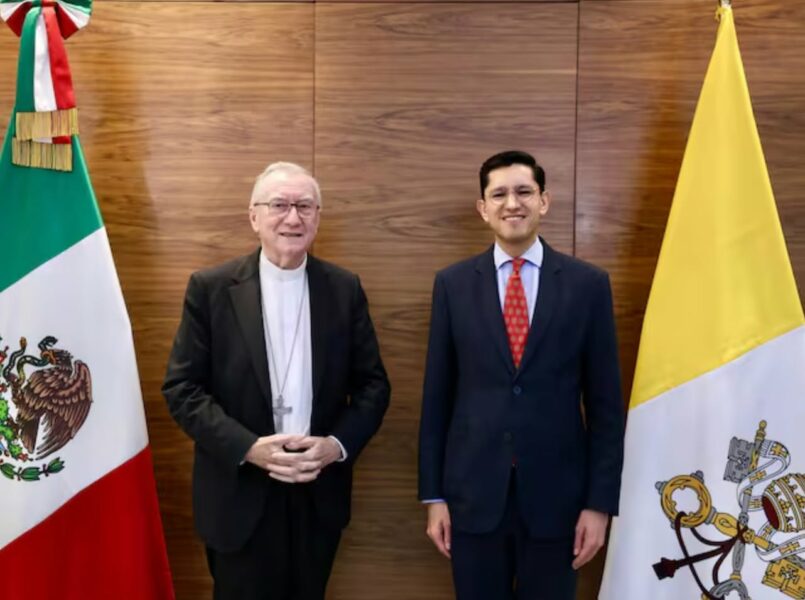
From August 4 to 6, 2026, Cardinal Pietro Parolin, Secretary of State of the Holy See, made an official visit to Mexico on the eve of the 34th anniversary of the re-establishment of diplomatic relations, which took place on September 21, 1992. The agenda combined institutional meetings, a Eucharist at the Basilica of Guadalupe, and a dialogue with actors from the National Dialogue for Peace. Its apparent objectives were to strengthen Church-State ties, share reflections on violence, migration, human dignity, religious freedom, and the ethics of artificial intelligence, and reaffirm the ecclesial commitment to peace. The results, however, reveal both significant gestures and risks of political instrumentalization.
The political axis was the August 5 meeting at the National Palace with the President of the Republic. According to what was reported by the president herself, the first encyclical of Leo XIV, Magnifica Humanitas, on the ethical development of artificial intelligence guided by human dignity, justice, and shared responsibility, as well as the papal calls for peace, fraternity, and closeness to the vulnerable, were addressed. She took the opportunity to reiterate the formal invitation to the Pope to visit Mexico, a desire she has promoted since she was a candidate, when Pope Francis was still reigning. The meeting, framed in “cooperation” and “dialogue,” projected an image of harmony and institutional alignment.
More eloquent was Parolin’s homily at the Basilica of Guadalupe. Before the Virgin, he presented Tepeyac as a school of prayer for the pacification of peoples and reconciliation. With particular force, he referred to the searching mothers: he compared their perseverance to that of the Canaanite woman in the Gospel, who insists before the Lord for her daughter. “Her example resonates with special force here in Mexico, where so many mothers continue to search with firmness and faith for their disappeared children. Nothing can prevent them from doing everything possible to help their children, and we can all help them with our prayer,” he affirmed. The cardinal did not avoid the pain of families marked by violence nor the call to accompany the victims. That same afternoon, at the meeting with the National Dialogue for Peace, where searching mothers, academics, police officers, businesspeople, and representatives from several states participated, he emphasized that “peace begins with empathy for the pain of the other” and that it is an “artisanal work” of every day.
The communiqué from the Mexican Episcopal Conference clearly captured these emphases. It thanked the visit, highlighted the strengthening of the relationship based on respect for the autonomy of both institutions and the commitment to the common good. It reaffirmed the work of the National Dialogue for Peace and, before the Virgin, the call to accompany the victims and the searching mothers “sharing their pain and walking with them in the search for truth, justice, and peace.” It also reiterated the desire for Leo XIV to visit the country and offer a word of reconciliation that prepares the celebration of the 500th anniversary of the Guadalupana apparitions.
However, the questions are also unavoidable. Is a papal visit advisable at this time? Politicians have always sought to associate themselves with the benefits of religious legitimization. And the current regime is no exception. A visit in the short term could be used to project moral legitimacy and dilute criticism in the face of the persistent crisis of violence, disappearances, and the breakdown of the social fabric. Recent Mexican history teaches that political powers often seek religious endorsement when it suits them, especially when electoral moments arrive, without this necessarily translating into structural changes in favor of the crises society suffers.
All the faithful of the Church undoubtedly desire the presence in Mexico of the Successor of Peter. That longing is legitimate and deep, but there is a horizon of greater significance: the 500 years of the apparitions of Our Lady of Guadalupe, which will be fulfilled in 2031. From 2027, only four years will remain until that celebration of faith. That political and ecclesial time will, with high probability, correspond to other actors. The Church must not rush nor allow the expectation of a papal visit to become diplomatic currency or a shield of legitimization, especially when in this country appears the specter of an autocratic-liberal regime that feigns normality, while threatening even the most elementary and essential rights of peace and coexistence.
Parolin’s visit left a valuable message: peace is artisanal, born of empathy with the pain of others, and requires concrete accompaniment of the mothers who search. That is the criterion that should guide any future meeting of the Pope with Mexico. Protocol photographs and speeches on the ethics of artificial intelligence are not enough if the cry of the searching mothers continues without an effective response. The Church, under the mantle of the Virgin of Guadalupe, is called to maintain its prophetic autonomy, not to allow itself to be instrumentalized, and to walk with the victims, not behind the powers of the moment. Only in this way will a possible pontifical visit be a sign of hope and not of the opportunism that has characterized the political class, clinging, by any means, to the papal cassock.