


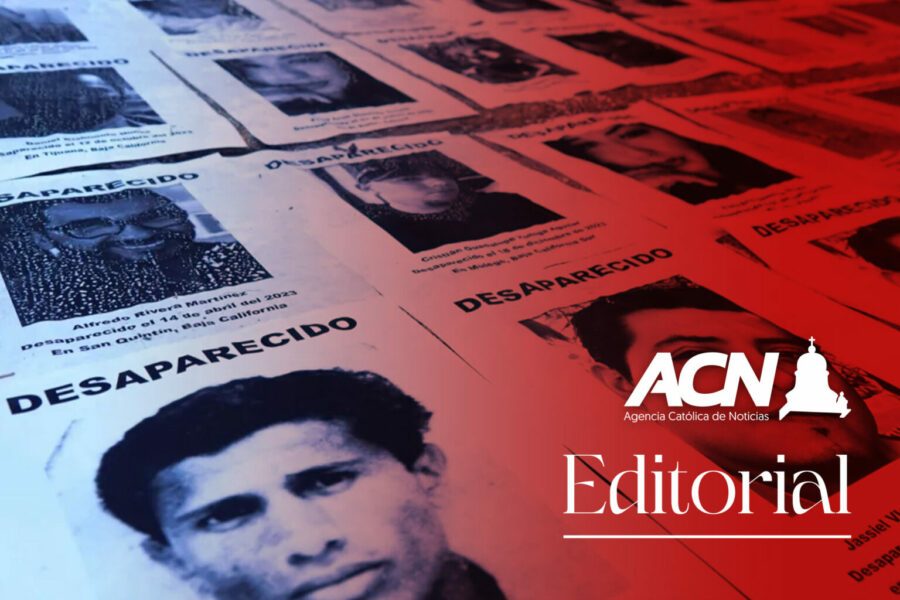
Human rights organizations and groups of relatives, led by Amnesty International, have called on the General Assembly of the UN to create an “extraordinary mechanism” in response to the crisis of disappearances in Mexico, a crime that persists because impunity fuels it and because part of society has learned to live with absence.
However, there is an angle that rarely occupies the center of public debate: the spiritual consequences for those who make another person disappear against their will. The Christian tradition calls certain sins “cries that reach heaven.” The first is the blood of Abel. “What have you done? The voice of your brother’s blood cries out to me from the ground,” says Genesis.
Making someone disappear is not only depriving them of freedom; it is preventing mourning, stealing their name, denying them a grave, and condemning a family to an unending wait. Whoever commits or covers up that act does not merely wound their neighbor; they mutilate themselves. Conscience, if it is not completely extinguished, becomes a court without respite. Cain found no peace in exile; his punishment was to wander marked. The contemporary perpetrator of disappearances may buy silence, protection, or social oblivion; they cannot buy the stillness of the soul.
That inner wound has a precise logic. Repeated evil numbs moral sensitivity until the voice of reproach ceases to be heard. Then the perpetrator has not only made another person disappear; they have begun to disappear as an ethical subject. They live on secrecy, fear the truth, and lock themselves in a solitude that no complicity can compensate. Even if they evade human justice, they remain a prisoner of what they know.
Christian faith does not romanticize that ruin; voluntary homicide and cooperation in it are grave sins. Nor does it reduce it to a verdict of irreversible condemnation. It affirms, with equal seriousness, that conversion is possible, but not cheap; it demands truth, reparation, and the recognition that no strategy of terror, whether state or criminal, escapes God’s gaze.
Faced with that abyss, the Catholic Church has come to recognize, sometimes late, sometimes with historical lights and shadows, that it cannot limit itself to lamenting. In Latin America, parishes and religious communities have served as spaces of welcome when the State failed. In Colombia, the episcopate has committed to collaborating in the search for remains, precisely because many parishes administer cemeteries and know territories where the conflict sowed mass graves. In Mexico, the Episcopal Conference has called on churches to open their doors to searching families, welcome them in celebrations, name the disappeared in prayer, facilitate “peace mailboxes” for anonymous information and accompany them permanently. Religious congregations have adapted their charism and turned community houses into shelters for those who travel the country digging in the earth. In northern dioceses, parish priests have made listening a concrete ministry; they do not replace the prosecutor’s office, but they prevent the pain from remaining orphaned of community.
Here lies a pastoral core that deserves emphasis. Naming the disappeared in the liturgy is not a minor pious gesture; it restores, at least symbolically, the dignity that the crime sought to erase. Receiving a searching mother in the atrium affirms that the Church does not fear the cry of those who demand truth. Offering a safe space for an anonymous tip is betting, with realism and prudence, that the conscience of some witness has not yet been entirely extinguished. Pope Francis expressed it with a phrase that does not expire. Disappearance generates “the permanent presence of an absence.” And he added another, equally severe, a society cannot smile at the future while having its dead hidden.
That does not absolve the Church’s past omissions nor turn every parish into a tribunal. It does, however, turn the temple into what it should never have ceased to be: a house for the wounded. The current challenge is not only to denounce disappearance as a crime against humanity, but to sustain a presence that does not grow weary when the cameras turn off.
That is why a new pastoral approach to pain is required—one that consoles without anesthetizing, welcomes without instrumentalizing, and reclaims the memory of thousands who are not here. To console is to accompany the wait without selling cheap miracles. To welcome is to open the door, the chair, and the ear. To reclaim memory is to speak the names, demand the search, defend the right to burial, and not allow oblivion to disguise itself as pacification, because Abel’s cry continues to rise. The question is not whether God hears it. The question is whether we are still willing to respond, because forced disappearances have profound spiritual consequences.