


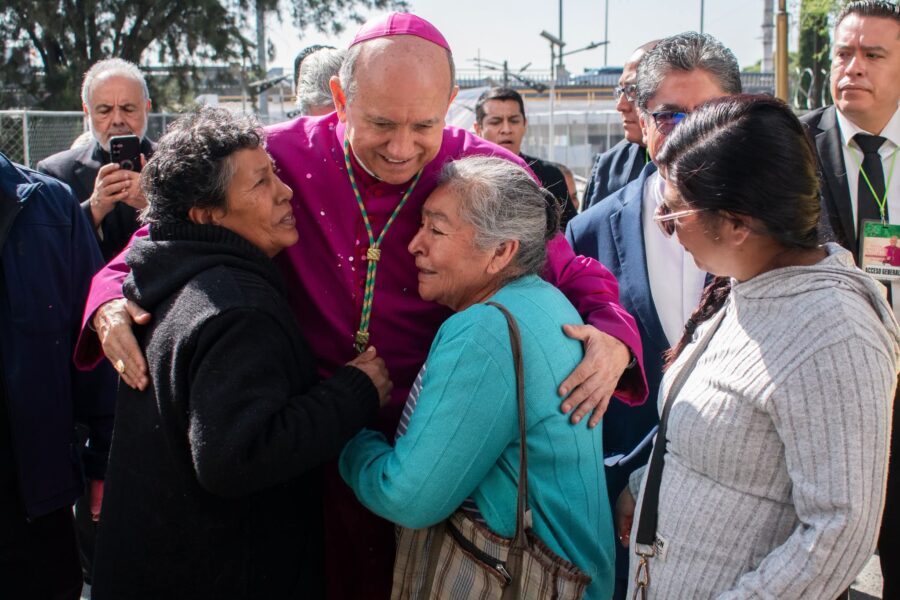
The Diocese of Ecatepec closed nearly two years of vacant see and opened a new pastoral stage with the canonical installation of José Guadalupe Torres Campos as its third bishop. The day, which began at the Sanctuary of the Fifth Apparition in Tulpetlac and culminated at the Cathedral of the Sacred Heart of Jesus, combined the color of popular faith, sawdust carpets made by neighbors from the indigenous communities, balloons, flags, banners and cheers, with a profound liturgical reflection on the meaning of episcopal ministry in a territory marked by population density, the wounds of violence and the need to rebuild the social fabric.
Torres Campos, a native of León, Guanajuato, and until then bishop of Ciudad Juárez, had been appointed on May 13, 2026 by Leo XIV. He arrived in the diocese after eleven years of service on the northern border, where his ministry was characterized by attention to migrants, victims of violence and social accompaniment. The see of Ecatepec had remained vacant since July 2024, when his predecessor, Óscar Roberto Domínguez Couttolenc, was transferred to the Archdiocese of Tulancingo. The diocesan administrator, Father Luis Martínez Flores, had maintained pastoral continuity until this day.
The morning began with a visit to the Sanctuary of the Fifth Apparition in Santa María Tulpetlac, a place of deep Guadalupian significance. There, the new bishop was received by civil authorities, including Pedro Mena Alarcón, in charge of religious affairs for the State of Mexico, and later by the municipal president of Ecatepec, Azucena Cisneros Coss. The walk along Vicente Villada Street and Ecatepec Avenue became a living procession; hundreds of faithful accompanied the prelate amid ovations, while the sawdust carpets marked the path toward the cathedral. Cisneros Coss took the opportunity to propose a joint peace agenda focused on youth, the recovery of community spaces, accompaniment for victims, the strengthening of values and institutional presence in the most vulnerable neighborhoods, always respecting the secular state. “Today we open a new stage of dialogue, accompaniment and peacebuilding,” the mayor emphasized.
The eucharistic celebration of installation, presided over by the apostolic nuncio in Mexico, Joseph Spiteri, brought together numerous bishops from the ecclesiastical province of Tlalnepantla and other regions of the country, the diocesan presbyterate, religious sisters and brothers, seminarians, civil authorities—including Senator Higinio Martínez Miranda and the mayor of Tlalnepantla, Raciel Pérez Cruz—and a multitude of faithful who filled the church.
The Eucharist, during which the new bishop made his profession of faith, was presided over by Archbishop José Antonio Fernández Hurtado. Bishops, diocesan priests and faithful packed the cathedral, and in his homily, delivered on the feast of Saint Mary Magdalene, Nuncio Spiteri offered a dense and pastoral reflection that oriented the beginning of the new ministry. He began by expressing the joy of receiving a “shepherd according to the heart” of God and thanked the patience of the people and the diocesan administrator during the waiting period. He recalled that bishops, successors of the apostles, are called to be “good stewards of the grace of God,” according to Saint Peter’s exhortation, and that for this they need three fundamental elements: constant prayer that springs from the heart, reciprocal and effective love that “buries” or forgives a great number of sins, and fraternal service that shares the gifts received for the common good.
Spiteri insisted that the true strength of ministry is born from a personal relationship with the Lord, especially in His Sacred Heart, the daily source of nourishment for communion and service. He quoted Pope Leo XIV’s words to the bishops: to guide the Church one must allow oneself to be profoundly renewed by the Good Shepherd, so as to conform fully to His heart and His mystery of love.
The nuncio devoted ample space to the figure of Mary Magdalene. He highlighted her fidelity beside the cross, her persevering search for the Lord even in pain, and her mission to be “apostle of the apostles” by announcing the Resurrection. “The mission of the apostles is this: to announce the resurrection, to proclaim the risen Christ to the whole community,” he affirmed, adding that this same mission belongs to all missionary disciples: to offer credible witness in order to build a culture of life and not of death.
Particularly significant was Spiteri’s insistence on the angels’ question to Magdalene: “Woman, why are you weeping?” and on her anguished reply: “They have taken my Lord, and I do not know where they have laid him.” The nuncio interpreted that anguish as that of every true disciple and, in a special way, of those called to priesthood and episcopacy. “At times on our spiritual journey we too can feel a little lost… and we ask ourselves: where is the Lord?” It is not a matter of seeking a dead body, but the Risen One who lives among us. That is why it is necessary to have the courage to ask that question, to weep for wanting to find Him, and to recognize the Lord who calls us by name.
From there, Spiteri made the decisive pastoral leap: “Because we firmly believe that Jesus the Lord identifies with every neighbor, with every person, we are also called to seek Him in our brothers and sisters, especially the most needy”. He listed those who have drifted away, the elderly, the sick, victims of violence, young people who seem lost. “We do not know where the Lord is, we do not know where these brothers and sisters are… but we are called to go out in search of them, to find them in the Lord and to offer them the tenderness of the risen Christ.”
The nuncio underlined the urgency of communion and of a “peace that disarms the heart,” born of a disarmed heart capable of disarming others. He called in a particular way on priests to strengthen priestly fraternity, not to leave anyone without support, and to offer an example of unity around the bishop. He greeted the numerous brother bishops present and recalled the new bishop’s visit to the Sanctuary of the Fifth Apparition, where Our Lady healed Juan Bernardino. “She will undoubtedly remain at your side to help you on your way,” he said to Bishop Torres Campos.
At the conclusion of the Eucharist, José Guadalupe Torres Campos delivered his first message to the diocese. With a serene voice and warm tone, he greeted the nuncio as the representative of Pope Leo XIV, the cardinals, archbishops and bishops, priests and deacons, consecrated life, the civil authorities present—including the governor of the State of Mexico through her representative—the municipal president Azucena Cisneros and other dignitaries, and above all the people of God.
He expressed his gratitude to God and to the Holy Father for the trust placed in him. He confessed that from the day of his appointment he had begun to pray for the diocese, even though he did not yet know its faces or its stories. “Today that prayer begins to take on a concrete face,” he said. “From this day forward, my episcopal ministry will gradually be filled with persons, families, communities, joys, sufferings, hopes and challenges”.
He presented his episcopal motto, taken from the wedding at Cana: “Do whatever he tells you.” “These words have illuminated my ministry since the day I was called to the episcopate, and today I wish to place them once again at the center of this new mission. Mary always leads to her Son.” He expressed the desire that this be the spirit of the Church of Ecatepec: to listen to the Lord, to seek the risen Lord in everyone, to allow oneself to be guided by His word and to make His will the sure path.
With clarity and humility he defined the style of his episcopate: “I come with the sincere desire to listen before speaking, to know before deciding and to love before asking. I want to be for you a close bishop who walks among his people, a shepherd who is not afraid to approach the wounds of persons, a father who strives to ensure that no one feels alone, forgotten or excluded from the love of God and the life of the Church.”
To the priests he addressed especially warm words. He acknowledged their daily, often silent dedication, and expressed his desire to know them personally, not only in their places of service, but in their joys, concerns, dreams and challenges. “We will walk together, we will listen to one another, we will discern together what the Holy Spirit is asking of our diocesan Church. I deeply believe in priestly fraternity, because a united presbyterate makes the communion of Christ visible and strengthens the hope of the people.”
To consecrated life he expressed gratitude for the silent and fruitful witness of their charisms. He called the seminarians “hope of tomorrow and joy of the present,” inviting them to care for their time of formation and to allow the Lord to shape their hearts according to that of the Good Shepherd. To the civil authorities he offered willingness to work together, each from his or her own sphere, for the common good, the dignity of the person, the building of peace and the strengthening of the social fabric, noted the bishop, who was accompanied by his family and who also had heartfelt words of gratitude for the Church of the Diocese of Ciudad Juárez.
The Diocese of Ecatepec, erected in 1995, covers one of the most densely populated areas of the country. It serves nearly one and a half million Catholics in about one hundred parishes. Its recent history has been marked by the need to accompany complex realities of poverty, violence, internal migration and the weakness of community fabric. The new bishop arrives with the experience of having pastored in contexts of border and high social conflict, which generates expectations of a ministry attentive to the peripheries.
The presence of civil authorities and the open dialogue on a peace agenda evidence the possibility of respectful collaboration between Church and civil society. Both the nuncio and the new bishop insisted that true peace is born of disarmed hearts and the concrete search for the Lord in those who suffer. The figure of Mary Magdalene, recalled on the liturgical feast, became a key to interpretation: a woman who seeks, who weeps, who announces and who does not abandon.
At the end of the day, Torres Campos shared in the popular celebration; greetings, photographs and informal conversations prolonged the meaning of what had been celebrated at the altar. The Diocese of Ecatepec now has a shepherd. The challenge now is for that shepherd and his people to walk together, listening to what the Lord tells them, seeking the Risen One in the most wounded and building, step by step, a culture of life and communion, especially in an area burdened by poverty and exploited by political parties.
The day of July 22 was not only a juridical and liturgical act of installation. It was the beginning of a journey that, according to the words heard that day, seeks to be close, fraternal, prayerful and missionary. In a diocese that had waited almost two years, the arrival of José Guadalupe Torres Campos is lived as an answer to many prayers and as an invitation not to stop asking, with Magdalene: “Where is the Lord?”, so as to find Him always anew in our brother.