


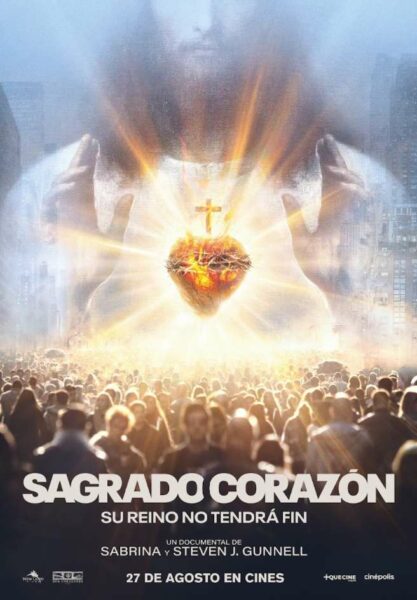
The upcoming August 27 will arrive at 150 Cinépolis theaters across the country the French docudrama Sacred Heart. His Kingdom shall have no end, a 2024 production that has generated a peculiar phenomenon in its country of origin: half a million viewers in less than six weeks and a prolonged run in theaters, despite attempts at advertising and screening blockades that, far from silencing it, fueled public curiosity. The film, distributed in Mexico by Dos Corazones Films, founded by Pablo José Barroso, makes the country the first in Latin America to screen it; it will later be shown in Central America and Chile. Barroso obtained the rights after being contacted by the French distributor and did not hesitate to accept them. “Look, the truth is, for the Sacred Heart I’ll do anything, but let me see the film. When I saw it, I said: it’s a very timely message that would be of great benefit to Mexico,” he told the site VC Noticias.
In France the film faced obstacles that illustrate the tensions between secularism and religious freedom. The advertising agency of the national railway system and the Paris transport authority banned posters in stations and train cars. Cultural authorities in one department recommended against screening it. In Marseille, the city council canceled a private screening at the Château de la Buzine just one hour before it was to begin, citing the separation of Church and State. “In France, even though there should be freedom of expression and religious freedom, they blocked it. People themselves flocked to the cinema to see what they were talking about because they hadn’t allowed it to be advertised in the metro,” Barroso noted. The result was an unusual success for a work with religious themes, which was later shown in Poland, the United States, and several Eastern European countries. Among the French audience were Muslims, Jews, Christians of various denominations, and Catholics, which the producer interprets as a sign of the universality of the message.
Directed by the filmmaking couple Sabrina and Steven J. Gunnell, the film combines historical recreations of the apparitions of Jesus Christ to Saint Margaret Mary Alacoque between 1673 and 1675 at the Visitation monastery in Paray-le-Monial with contemporary testimonies from people who claim to have experienced profound transformations after encountering this devotion. Steven, who was part of the French boy-band Alliage before dedicating himself to Catholic music and cinema, and Sabrina, an actress who plays the Virgin Mary in the film, bring a personal and committed perspective.
Their production company KREA-Film Makers has made documentaries for the Catholic channel KTO, including Let Me Live, the trilogy Eternam and One Flesh, as well as the testimonial book Objective: God. The format is a docudrama of approximately an hour and a half, beginning with the mystical revelations, incorporating scenes of the Last Supper and the Sermon on the Mount, and closing with contemporary voices recounting transformative encounters.
The heart of the story is the theological mystery the Gunnells explore with sensitivity: how the infinite, the divine Heart of Jesus, can fit into the finite, the heart of flesh shared with humanity. The revelations to Margaret Mary are marked by fire. Jesus asks for her heart, she offers it, and He unites it to His own to return it to her as a burning flame. “I will never cease to help you, as long as you always keep your nothingness and your weakness immersed in My strength,” He tells her.
The film also addresses the twelve promises that tradition attributes to these revelations and that the film presents as still valid. Jesus promises to grant to those who consecrate themselves to His Heart all the graces necessary according to each person’s state of life; to bring peace to families; to console them in all their tribulations; to be their safe refuge during life and especially at the hour of death; to pour abundant blessings on all their endeavors; to be for sinners the source and infinite ocean of mercy; to make lukewarm souls become fervent; to quickly raise fervent souls to great perfection; to bless the homes where the image of His Heart is exposed and honored; to give priests the gift of moving the most hardened hearts; to write in His Heart, never to be erased, the names of those who spread this devotion; and, in His excessive mercy, to grant to those who receive Communion on the first Fridays of nine consecutive months the grace of final perseverance, so that they do not die in disgrace or without the sacraments, His divine Heart being their safe refuge in that final moment. In the film, these promises do not appear as an abstract catalog, but as a thread connecting the 17th-century visions with the stories of people today who claim to have found in them family peace, comfort in suffering, and renewed confidence.
The Mexican premiere takes place in a context of particular resonance. The country has been consecrated to the Sacred Heart for approximately a century, during the years of the Cristero persecution. “This year it is renewed,” he told the site VC Noticias. The date of August 27 coincides with the memorial of Saint Monica and the 28th with that of Saint Augustine, whose spiritual journey the producer links to the film’s message. For many Mexican communities, the promises of peace in families, comfort in tribulations, and blessing of homes do not sound like distant formulas, but like possible responses to everyday realities of insecurity, family breakdown, and the need for hope. The film does not claim to resolve these dramas, but offers a space for contemplation and an invitation to trust in a presence that, according to the testimonies, does not abandon.
Dos Corazones Films, with two decades of experience in religious cinema that includes titles such as Guadalupe, Karol, Cristiada and The Great Miracle, invites communities to arrange additional screenings. If the film is not showing at a nearby Cinépolis, you can contact the chain or through the site www.doscorazonesfilms.org, where it is also possible to pre-purchase tickets or request a screening room. The arrival of Sacred Heart. His Kingdom shall have no end is not just a film premiere. It coincides with the renewal of a consecration born in times of trial and is part of a moment in which the ardor of this devotion continues to provoke both attraction and rejection. The film offers Mexican viewers the opportunity to reconnect with that flame which, according to tradition and the testimonies it gathers, never goes out, and to ask themselves whether the promises Jesus made to Margaret Mary still have something to say in the present.
With information from VC Noticias