


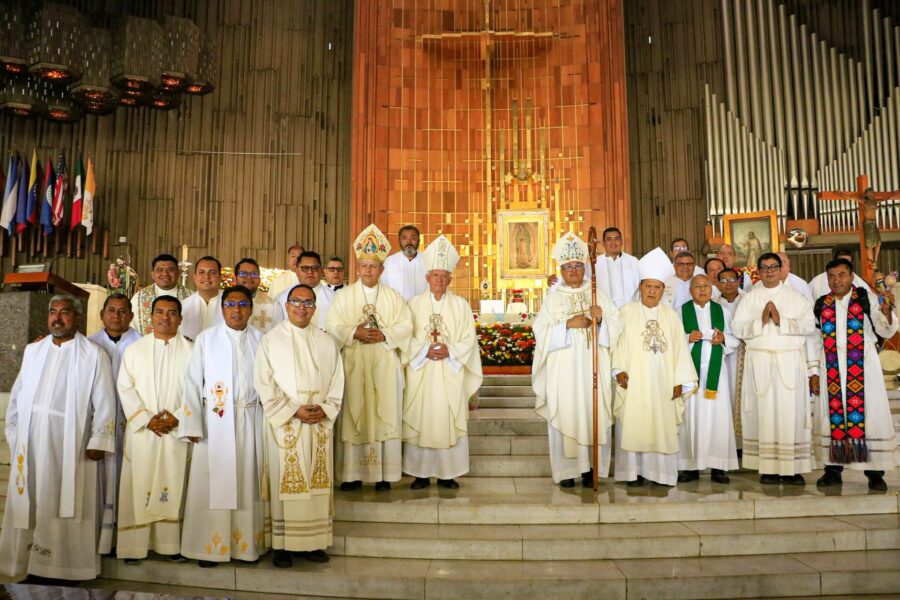
The bishops of the Ecclesiastical Province of Chiapas, formed by the Archdiocese of Tuxtla Gutiérrez and the Dioceses of San Cristóbal de las Casas and Tapachula, made a pilgrimage on May 31, 2026 to the Basilica of Guadalupe to present before the image of the Morenita Virgin a message that summarizes the pain and hope of their land. Under the title “From Tepeyac: a cry of faith, justice, and hope for our people”, the four shepherds made it clear that they had not come only to ask, but to renew the commitment of a Church that walks alongside the joys and sorrows of its people.
In the document, signed at the Basilica on the last day of May 2026, they describe five open wounds that tear at the social fabric of Chiapas. The first and most visible is that of violence and insecurity. They point out that territorial control exercised by criminal groups has fractured social peace, imposed a culture of death manifested in extortion and loss of freedom, and caused the forced displacement of families who have seen their belongings taken or, in some cases, the lives of their members. Although they acknowledge that cases of displacement have decreased, they warn that many people continue to bear the consequences of this persistent violence.
Added to this reality is the drama of forced disappearance. The bishops embrace with special tenderness the families and the searching mothers, whose daily pain extends beyond the kidnapping itself. They compare their perseverance to that of the Mater Dolorosa at the foot of the Cross and denounce the silence and complicity of some authorities in the face of the cruelty of the perpetrators.
Another deep wound is ancestral and structural poverty. Chiapas, they say, remains the most visible face of poverty in Mexico, not because of a lack of natural resources, but because of a system of historical exclusion that keeps its peoples in abandonment, with precarious access to health services, dignified education, and real opportunities for integral development. This poverty, they warn, fuels and perpetuates the other forms of violence.
The message also highlights the migratory drama that runs through the province. Thousands of migrant and refugee brothers and sisters pass through their territories in search of a better life, while many young Chiapans are forced to leave their communities due to lack of security and livelihood, becoming easy prey for networks of human trafficking, labor exploitation, and sexual exploitation.
The fifth wound they identify is the damage to our Common Home. The biological wealth of Chiapas is being plundered through the contamination of rivers, the indiscriminate exploitation of minerals, and the deforestation of jungles. These acts, described as ecological sins, mortgage the future of coming generations for the profit of a few.
In the light of the Gospel and hand in hand with Saint Mary of Guadalupe, the bishops offer three perspectives that allow for discerning a different path. The first recognizes the dignity of Indigenous peoples, validated by the mestiza Virgin who spoke in Nahuatl and who today invites us to value the systems of organization and respect for life that these communities safeguard. The second views the “Sacred Little House” not as a building of stone, but as a national project where no one is left out, recalling that peace is the fruit of justice and that there can be no peace while bread continues to be stolen from the table of the poor. The third perspective affirms that the earth is a gift from God and not a commodity; citing Laudato Si’, they insist that everything is connected and that destroying creation to obtain fleeting wealth constitutes an act of arrogance against the inheritance that God entrusted to humanity.
From this perspective, the bishops issue concrete appeals to different actors. To the youth, whom they call sentinels of tomorrow, they urge not to be seduced by the false promises of organized crime and to become artisans of peace who use their creativity to heal Chiapas. To communities and parishes, they ask that they function as field hospitals, strengthening the pastoral ministry of listening to accompany victims of violence and disappearance, promoting the solidarity economy, and actively defending Mother Earth against any project of death.
To the authorities at the three levels of government, they remind them that power exists to serve and not to be served, and they urge them to guarantee security and justice, combat impunity, and settle the historical debt with actions that respect the dignity of the peoples, beyond welfare programs that do not address the roots of misery. To those who generate violence, they plead, in the name of God, that they stop and cease staining their hands with the blood of their brothers and sisters, reminding them that divine judgment is inevitable, but that mercy remains open to those who decide to repent and repair the harm caused.
The message concludes with a tone of firm hope. Upon returning to their dioceses, the bishops do so with hearts strengthened by the certainty that the Virgin continues to say to her people, as she did to Juan Diego: “Am I not here, who am your mother?”. They invite everyone to be missionaries of reconciliation and cite the document of the Mexican Episcopal Conference that defines the building of peace as a permanent task that requires constancy in doing good and responsible civic participation to transform structures of sin into structures of solidarity and justice.
Chiapas, they affirm, is called to be a garden of life, a space of encounter, and a common home where freedom can be breathed. Hope, they conclude, is invincible because it is grounded in Christ Jesus, the Lord of Life, and only in Him does the human heart find peace, and only with Him is it possible to walk together the paths of justice, integral development, and communion.
The message was signed at the Basilica of Santa María de Guadalupe on May 31, 2026 by the Archbishop of Tuxtla Gutiérrez, José Francisco González González; the Bishop of San Cristóbal de las Casas, Rodrigo Aguilar Martínez; the Bishop of Tapachula, Luis Manuel López Alfaro; and the Auxiliary Bishop of Tuxtla Gutiérrez, José Luis Mendoza Corzo.