


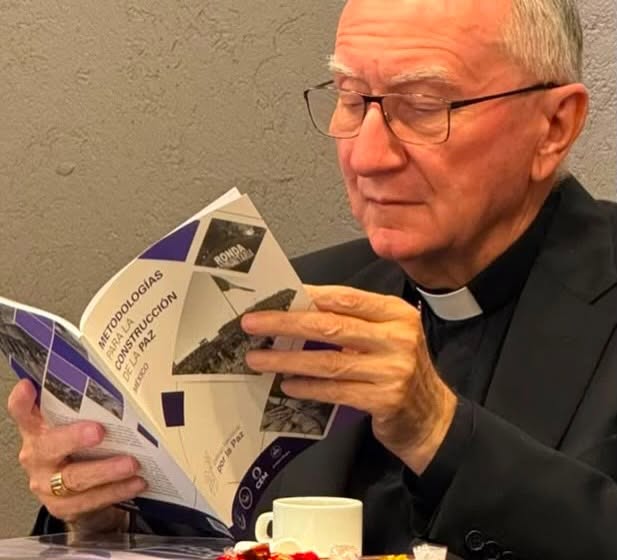
The Mexican Episcopal Conference (CEM) issued an official statement on August 6, 2026, in which it deeply thanks the visit of Cardinal Pietro Parolin, Secretary of State of the Holy See, and reaffirms the Church’s commitment in Mexico to peace, hope, and the common good. The document, signed by the president of the CEM, Ramón Castro Castro, Bishop of Cuernavaca, and the secretary general, Héctor M. Pérez Villarreal, Auxiliary Bishop of Mexico, offers an institutional reading of the three-day stay of the cardinal in the country (August 4–6) and projects its meaning toward the future of the Church and society.
The text highlights that the visit allowed for “strengthening the bonds of collaboration between the Church and Mexican authorities” and sharing a joint reflection on the realities facing the Mexican people: violence, migration, threats to human dignity and religious freedom, as well as the ethical principles that should guide the use of artificial intelligence. On the eve of the 35th anniversary of the reestablishment of diplomatic relations between Mexico and the Holy See (1992), the CEM describes the meeting as an opportunity to “strengthen and update the Church-State relationship, based on respect for the autonomy of both institutions and with a renewed willingness to collaborate in everything that contributes to the common good.”
One of the central themes that Cardinal Parolin was able to observe, according to the statement, was the Mexican Church’s commitment to building peace, particularly through the coordinated efforts of the National Dialogue for Peace. In that meeting, the Secretary of State recalled that “peace is a craft that begins with empathy for the pain of the other.” Before the Virgin of Guadalupe, “a mother who welcomes and consoles,” Parolin encouraged those present to accompany the victims of violence and the searching mothers, “sharing their pain and walking alongside them in the search for truth, justice, and peace.”
The document does not stop at the immediate assessment. His presence, the CEM affirms, “was an occasion for us bishops in Mexico to reiterate to him our longing for His Holiness, Pope Leo XIV, to visit our country and experience the affection we hold for him, as well as to share with us a word that encourages us to walk paths of reconciliation and peace that prepare for the celebration of the 500th anniversary of the apparitions of Our Most Holy Mother of Guadalupe.” This explicit mention links the visit of the Vatican’s second-in-command with the jubilee horizon of 2031, when five centuries of the Tepeyac apparitions will be completed. It is not a generic request, but a longing already articulated with the pastoral and spiritual preparation for an event foundational to Mexican Catholic identity.
The CEM thanks Cardinal Parolin for “his closeness, his words, and his willingness to engage in dialogue.” His time in Mexico, the text concludes, encourages the Church to continue working “together with all sectors of society, for a Mexico that is peaceful, reconciled, supportive, and open to hope.” With its eyes on the future and under the protection of Saint Mary of Guadalupe, the bishops reaffirm that they continue walking together “as a Church on pilgrimage in Mexico.”
The CEM’s statement thus offers a precise and hopeful synthesis. On the one hand, it values institutional dialogue and the recognition of the craft of peace that the Church promotes amid violence. On the other, it lifts its gaze toward 2031 and presents the possible visit of Leo XIV not as an isolated event, but as a word of encouragement that can help walk the paths of reconciliation necessary to worthily celebrate the half-millennium of Guadalupe. In a country that continues to seek truth, justice, and peace, the voice of the Mexican episcopate turns Cardinal Parolin’s stop into a sign of continuity and an open horizon.