


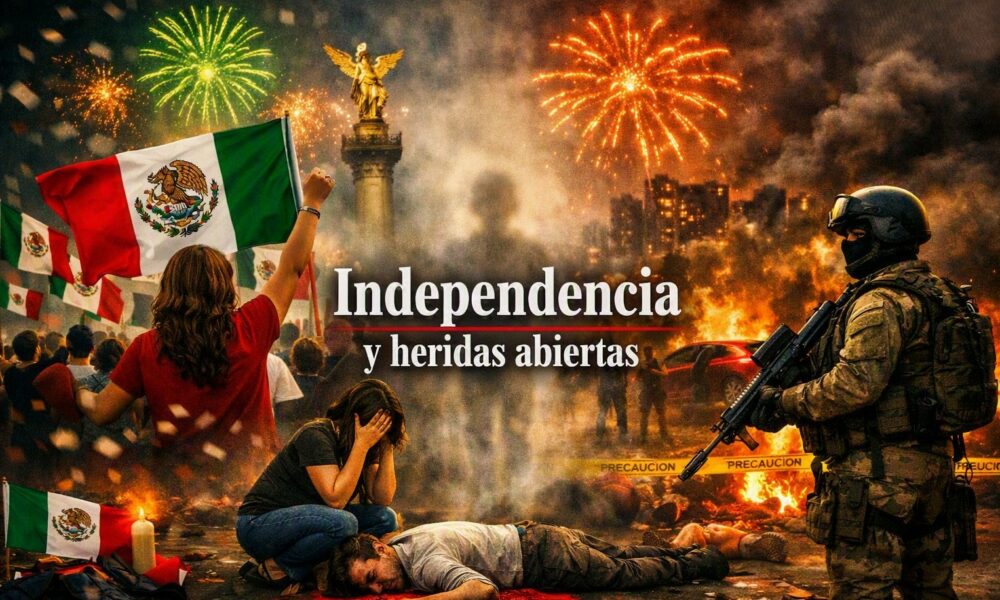
In the framework of the patriotic celebrations, the Mexican Episcopal Conference released a message titled Called to Freedom, on the occasion of the 216th anniversary of the beginning of Independence. The text, signed by Bishop Ramón Castro Castro and Auxiliary Bishop Héctor M. Pérez Villarreal, seeks to offer a reflection that goes beyond historical commemoration to address the present situation of a country that, as the bishops note, “continues to bleed” due to violence, inequality, and impunity.
The document expresses gratitude toward the homeland, acknowledging Mexico’s human and cultural richness, but also its open wounds. The bishops emphasize that celebrating Independence does not mean turning a blind eye to current problems, but rather remembering where we come from in order to find the courage to continue building. Mexico is not an abstraction, but faces, families, communities, migrants, young people, and elders who carry hope and memory, the message states.
It delves into the soul of the Mexican people by evoking the figure of the Virgin of Guadalupe, a symbol that accompanied the beginning of the independence movement and that, two centuries later, continues to be the heart and soul of the nation. The bishops recall that the Virgin asked at Tepeyac for a “sacred little house” to show her love and protection for the most vulnerable, and they link that request to the preparations for the Fifth Guadalupan Centenary in 2031. Guadalupan identity is presented as a unifying element that brings together indigenous peoples, criollos, and mestizos in one shared home.
Freedom occupies a central place in the message. The prelates recall that the Sentiments of the Nation called for the abolition of slavery and equality before the law, intuitions that today translate into human rights. In particular, they highlight two freedoms they consider threatened: freedom of expression, which requires plural media and protected journalists, and religious freedom, understood not only as worship within a temple, but as the right to believe, educate, associate, and contribute publicly to the common good.
They also recall the centenary of the religious conflict (1926–2026), an evocation that serves to warn that when freedom of conscience is restricted, the entire nation is harmed. The memory of that fratricidal conflict between Mexicans who shared the same faith becomes an urgent lesson: religious freedom must be fully recognized and exercised as a fundamental human right, not only for Catholics, but for all confessions present in the country.
The Episcopal Conference also highlights the Church’s role in building Mexico. It notes that the Church is not a guest, but part of the social fabric since before the existence of the State. It recalls that it provided the first education, the first hospitals and shelters, and that today its presence is embodied in Caritas, schools, universities, migrant houses, soup kitchens, clinics, shelters for women and children, human rights defense centers, and accompaniment for victims. The Church, they say, continues to work for peace and the reconstruction of the social fabric.
At this point, the bishops emphasize that all of this stems from the free and almost always anonymous generosity of millions of faithful. The temples, national heritage, are sustained thanks to that silent dedication. The message recalls that freedom and peace are also built through the quiet work of believers, who contribute to social cohesion without expecting recognition.
The final section addresses those who govern and the citizens directly. To the authorities, the bishops ask that freedom not be a concession but a guarantee, that security and justice cease to be promises, and that victims be heard. On the eve of a new electoral process, they demand that public debate be worthy of the people who sustain it. To citizens, they invite them to love Mexico with daily honesty, participation, and fulfillment of duties, always caring for the most vulnerable. From the Church, they offer open communities, hands to serve, a voice to denounce without hatred, and the capacity to build bridges where others raise walls.
The message concludes with a call to honor the legacy of those who gave the nation and transmitted the faith, under the protection of Santa María de Guadalupe. The final exclamation, “Long live Mexico! Long live Santa María de Guadalupe!”, synthesizes the union between national identity and religious faith that the bishops uphold as a force to face current challenges.
This statement is set within a social context marked by violence and inequality, where the Church seeks to remind that Independence is not only a historical event, but a permanent commitment to freedom and justice. The phrase that runs through the message, celebrating Independence does not mean closing one’s eyes, Mexico continues to bleed, becomes a call to collective conscience. It is not enough to wave flags and sing the anthem; it is necessary to face the country’s wounds directly and work for their healing. It is a call to freedom, to justice, and to the building of a Mexico that, under the protection of the Virgin of Guadalupe, can rise again and again with dignity and hope.
The full message can be read here: