


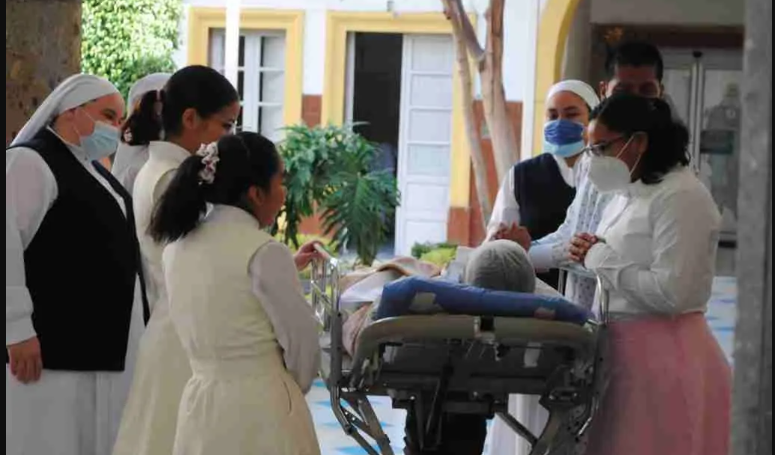
The religious sisters of the Congregation Daughters of the Sacred Heart of Jesus have concluded their presence at the facilities of the Mexican Red Cross in Guadalajara after 83 years of continuous service. The institution’s board announced that the measure is part of an internal restructuring aimed at implementing a more flexible financial model.
The congregation, founded by Saint María de Jesús Sacramentado Venegas, originally from Zapotlanejo, Jalisco, was known for its dedication to the integral care of the sick and people in vulnerable situations. The sisters joined the Red Cross in Guadalajara more than eight decades ago, in the historical context following the Mexican Revolution. Together with other congregations, they helped consolidate the former Hospital of Blessed Margarita as the headquarters of the Red Cross.
Throughout these decades, the five religious sisters assigned to the hospital in Parque Morelos carried out direct care duties for patients and accident victims. Their work included accompanying the sick and their families during emergencies, accidents, earthquakes, and health crises. In addition to their caregiving tasks, they handled administrative responsibilities, standing out for their rigorous and transparent management of financial resources and donations. According to various testimonies, this administration was based on principles of austerity and strict control, with the goal of ensuring that funds were used exclusively to support those in need.
The decision to end their participation was communicated formally. The Red Cross explained the measure as a necessary administrative adjustment to adapt to new operational conditions. No other specific reasons have been made public.
The Archdiocesan Weekly of Guadalajara has addressed the issue in its editorial. The publication notes that the departure of the sisters marks the end of an era defined by discipline, a vocation for service, and rigor in the management of resources. It questions whether the transparency and honesty that characterized their work may have caused discomfort in the face of a model seeking greater financial flexibility. It also warns of the potential risks that prioritizing economic efficiency could displace traditional ethical standards, which, in its view, could affect public trust in the institution.
The Weekly has also reflected on the legacy of the religious sisters, highlighting their contribution to strengthening values such as patience, hope, and human accompaniment in the field of healthcare. It considers that their departure represents a significant change in an institution with a humanitarian tradition.
This situation has sparked debate in sectors of Jalisco society. Among the questions raised are the following: whether a humanitarian and neutral institution can do without a group that for nearly a century embodied principles of continuous service and administrative transparency; to what extent an internal restructuring implies a shift in the founding values of the Red Cross; and whether there are other factors, beyond administrative ones, that explain the decision.
The departure of the Daughters of the Sacred Heart leaves the Red Cross of Guadalajara facing the challenge of maintaining the standards of care and trust built over decades. The institution has stated that it will continue to operate normally under its new structure. For their part, the sisters will continue their work in other areas of service in accordance with their vocation.
With information from the Guadalajara Weekly