


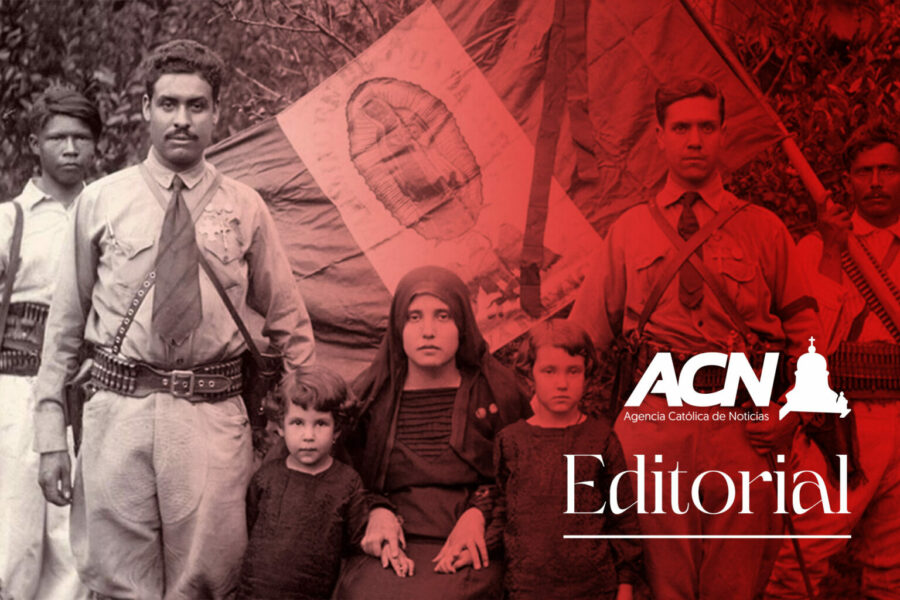
On July 31, 1926, the so-called Calles Law came into force. The next day, Mexico awoke without public Masses. The churches remained open and silent. A hundred years later, the Mexican Episcopal Conference has published a message that does not reopen wounds to feed grudges, but to heal them with the truth. That text, titled The Bells of the Churches Fell Silent, Their Blood Spoke, is the necessary starting point for any serious reflection on the religious conflict.
What happened between 1926 and 1929 was not a “sacristy quarrel.” It was a national drama in which Mexican citizens confronted other Mexican citizens. Churches were closed and desecrated, priests were shot without trial, nuns were expelled, laypeople were hanged from roadside posts, thousands died, deportations and betrayals occurred. The blood of the brother cried out from the earth, but there was also, on the Catholic side, hardness of heart, political calculations, and decisions that did not always serve the truth with the peaceful means of the Gospel. Recognizing this does not weaken the denunciation; it makes it more credible, as the bishops rightly point out.
What is being commemorated is not a war or an armed victory. It commemorates the fidelity of a people who continued to pray in their homes and baptize in secret; the witness of the martyrs who did not kill for Christ, but died for Him while forgiving; and the lesson paid for with blood: that religious freedom is not a privilege of the clergy, but the right of every human person. This is the line of the episcopal magisterium. Any attempt to instrumentalize memory for partisan projects or revenge betrays precisely what it claims to honor.
A hundred years later, Mexico has advanced. The constitutional reforms of 1992, the Law on Religious Associations and Public Worship, the reestablishment of diplomatic relations with the Holy See, and the reform of Article 24 in 2013 marked the end of the stage of open confrontation and pretense. Today there is a more respectful legal framework. However, as the bishops calmly affirm, religious freedom is still not complete. Restrictions persist on ordinary worship outside churches, the impossibility for religious associations to obtain radio and television concessions, restrictions on parents’ freedom in matters of religious education, and a residual attitude of distrust in sectors of the political class. Even more serious is the parallel government of organized crime, which nullifies human rights in entire territories and has cost the lives of priests such as the Jesuits of Cerocahui or Father Marcelo Pérez. The list of witnesses did not close in 1929.
But the deepest challenge is not only legal or security-related. It is spiritual and cultural. According to INEGI censuses, in 2010, 82.7% of the population declared itself Catholic; in 2020 that figure had dropped to 77.7%. In absolute numbers the population grew, but the percentage fell five points in a decade.
At the same time, those who declare themselves without religion or without religious affiliation increased significantly. The data is not anecdotal; it reveals a silent erosion of faith. There are already generations, especially among young people and young adults, for whom the life of faith, the liturgy, the sacraments, and the supernatural consequences of eternal life have ceased to have real weight.
Religion is reduced to cultural identity, folklore, or, at best, to a generic ethic. When faith ceases to be an answer to the ultimate question about meaning and eternal destiny, it becomes dispensable. This is the true crisis facing Mexican Catholicism a hundred years after the suspension of public worship.
In this context, the emergence of groups that, with the language of a “new Cristero War,” seek to encourage forms of armed organization or pseudo-military resistance under the guise of faith is particularly irresponsible and contrary to the spirit of the martyrs. They resort to clichés of armies of Christ, symbolic uniforms, and combat rhetoric that revive images from another era without understanding either the historical context or the nature of Christian martyrdom.
The martyr is not a combatant seeking temporal victory; he is a witness who gives his life without hatred. Turning the memory of blood into a pretext for militaristic fantasies is a betrayal of that blood. The bishops have said it clearly: we do not commemorate a war or exalt weapons; we do not call for revenge. Those who do so, even if they invoke Christ the King, place themselves outside the logic of the Gospel and the Church.
The message of the bishops of Mexico points in a concrete direction. It calls for processes of healing the collective memory, for building peace by the path of Nehemiah, not that of Babel, for the unity of the nation woven from the recognition of the other as a brother, and for a Church that awakens in the laity the awareness of living the faith in the family, work, and public life.
True fidelity to 1926 consists in being witnesses to the Truth in a time when threats to conscience come more through screens and algorithms. It consists in defending the religious freedom of all, in rejecting all forms of violence and the discarding of the person, and in proclaiming with one’s life that Christ reigns from the cross, not from the power of arms. A hundred years ago, much blood was shed and became a source of life. A hundred years ago the bells fell silent so that life, freedom, and peace might continue to speak.