


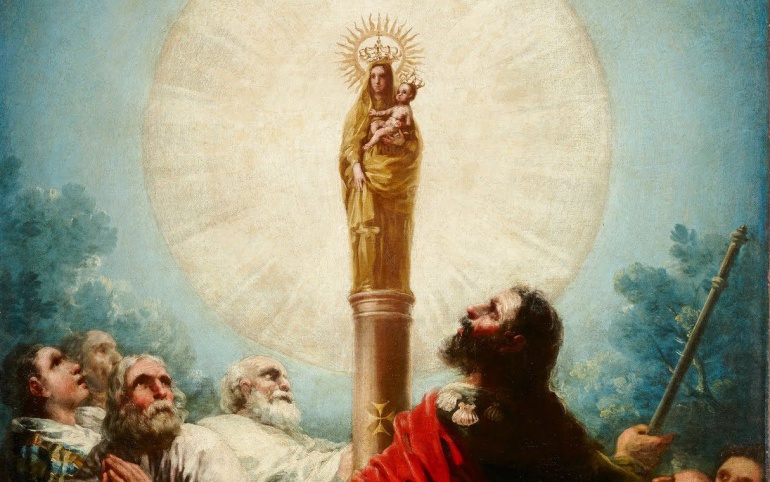
“The Lord has crowned me, he has exalted me upon the pillar” (antiphon of the responsorial psalm for the feast of the Pillar).
The Pope has a nodule in his lung and will undergo surgery this week. He announced it himself yesterday, at the end of the Angelus, in four sentences and without intermediaries. We give the entire paragraph in the official Spanish version, what he said and what he did not say, and what the Sala Stampa has not said, which is almost everything else: neither the type of procedure, nor the surgeon, nor the nature of the nodule, nor the day.
Regarding the trip to Uruguay, Argentina and Peru, scheduled from 6 to 17 November, no organ of the Holy See has said a word. The only thing that exists is a sentence from the Pope himself, in the same text and a few minutes before announcing the operation: “the pastoral visit I will make to Peru.” Everything else that has been read today about the trip is deduction, and a widely cited piece does not say what is attributed to it.
Yesterday we found groups of people praying in St. Peter’s Square in the late light from the windows of the Apostolic Palace. Rumors of Hail Marys weaving rosaries and the prayer to St. Michael. We did not leave until all the lights had gone out, after 23:15.
There are abuses too: the investigating judge in Trani ordered house arrest on Saturday against Fr. Vito Martinelli, a priest from Corato, for sexual violence aggravated by abuse of authority, and he was detained during his class at a school in the city. The victim is a young adult from his parish. And Cardinal Müller gave an interview about the televised execution scheduled for 3 December that has generated headlines that do not correspond to what he said: he did not call for desertion.
In addition, Assisi on 27 October with three hundred and eighty-four participants and not three hundred leaders of false religions; the Pope reminding the Melkites of the motu proprio that allows Eastern synods to remove their patriarch; Savino and Coming Out Day; and the pontifical secret on the appointment of bishops, which exists and has a date.
“A localized nodule has been detected in my lung”
The Pope announced it himself yesterday, from the window, at the end of the Angelus. Not in a communiqué, not through a spokesperson, and not in the Bollettino: live and last, after the beatification of Mantua, the appeal for grain from the Black Sea, the Italian day for victims of workplace accidents and, one by one, all the greetings to the groups. The entire paragraph, in the official Spanish version, is this:
“Dear friends: recently, during a check-up, the doctors detected a localized nodule in my lung. It was detected still at a very early stage and is well localized. The doctors consider it advisable to intervene. Therefore, following their advice, I have decided to undergo surgery to remove it. The operation is already scheduled for the coming days. I thank you for your spiritual closeness and commend myself to your prayers. Thank you and happy Sunday.”
What he did not say, and is as newsworthy as what he did say: he did not use the word tumor, he did not describe the nodule as benign or malignant, he gave no date beyond “the coming days” and he did not mention the trip to America in that paragraph. Four sentences, a diagnosis, a decision and a request for prayers.
A note on translation, because this blog lives on it. The original Italian says “un nodulo circoscritto al polmone” and “durante alcuni controlli,” in the plural; the official Spanish version on vatican.va translates “un nódulo localizado” and “durante una revisión,” in the singular. “Circunscrito,” a clinical term, is lost, and a single check-up is not several controls. Whoever cites the official Spanish cites correctly; whoever wants the nuance must go to the Italian. We give the official version above and note it.
And a warning about the versions circulating. At least one Roman daily published the paragraph compressed into two sentences, without “circunscrito,” without “se ha detectado en una fase muy temprana” and changing “en los próximos días”. It is not a quotation; it is a summary in quotation marks. Whoever wants the Pope’s words has them on vatican.va in seven languages. They were picked up, with greater or lesser accuracy in the quotation, by Repubblica, Vanity Fair, Fanpage, Quotidiano Nazionale, Today and Nicola Porro’s site.
What the Sala Stampa has not said
The spokesperson, Matteo Bruni, spoke afterwards, and in response to journalists’ questions, not in a written note. He said two sentences and only two: that the procedure is scheduled for the first days of this week and that the expected post-operative hospital stay is about a week. Nothing more. And yesterday’s Bollettino contains only one item, the Pope’s words at the Angelus: there is no statement from the director of the Sala Stampa, no medical note, no communiqué on the schedule. Everything known through the spokesperson lives outside the bulletin.
Hence the need to sort out who says what. The Policlinico Gemelli was not said by Bruni. It is attributed to “Vatican sources” by the Italian bishops’ agency and Rai, and Vatican News states it in its own narrative without attributing it to anyone. Two outlets, however, put it in the spokesperson’s mouth, and one of them contradicts itself: it attributes it to Bruni in the summary and to “what is known” in the body of the article. Tuesday as the day of admission is also from the press, with “probably” in front in all versions; no one has given a day officially.
The list of what is not known is long and it is better to publish it than to fill it in. The type of procedure is not known: no source, official or journalistic, has said thoracoscopy, lobectomy or resection. Who will operate is not known: no surgeon or team has been named. The nature of the nodule is not known. And the service pieces that have come out today explaining what a pulmonary nodule is, with pulmonologists on the news and percentages of benignity, are clinical generalities: none of those doctors has seen the patient’s history.
The one who is in the file is Luigi Carbone, director of the Directorate of Health and Hygiene of the Governatorate since 1 August last year, previously deputy director of the same office for years, trained in the Gemelli environment and a specialist in emergency medicine. He was Pope Francis’s referring physician and accompanied him in his illness; he coordinates the medical staff that assists the Pontiff and travels with him. He does not hold the ancient title of archiatra, which no one has formally conferred on him, and nothing indicates that he will operate: he coordinates. If someone writes that Carbone will operate on the Pope, they are making it up. ANSA adds the detail of the site: since the time of Wojtyła there has been a wing reserved for Popes on the tenth floor of the Gemelli, a kind of mini-apartment with a chapel, which he jokingly called the “third Vatican.” And a fact that closes the historical series well: the last operation performed inside the pontifical apartment of which there is news is that of Paul VI, almost sixty years ago.
One more warning, of those that seem minor and are not. That “about a week” does not mean the same in all versions: ANSA and Il Messaggero give it as hospital admission time, Silere non possum also, and La Nuova Bussola attributes it to the Sala Stampa but referring to post-operative recovery, which is another thing. The same with the day: Il Messaggero writes “perhaps already on Tuesday” in the body and states it firmly in its sidebars; La Nuova Bussola says “probably between tomorrow and the day after.”
And the trip
The question everyone is asking is whether the trip to Uruguay, Argentina and Peru will be cancelled. The itinerary has been official since 5 August, when the Press Office announced the trip from 6 to 17 November to the three countries, with the program “to be made known in due course.” And since the announcement of the illness, no organ of the Holy See has said another word about it: not the Sala Stampa, not Bruni, not the Bollettino, not Vatican News. The trip remains on the calendar because no one has touched it, not because anyone has reconfirmed it.
The only thing from the Pope himself is in the same text yesterday, a few minutes before the announcement of the operation, when greeting the Brotherhood of the Lord of Miracles: “I thank you for your prayers for the pastoral visit I will make to Peru”. Future indicative, without conditional and without reservation. It is the most solid piece of data that exists, and it is worth measuring exactly how much it weighs: he said it before speaking of the operation and did not link the two things. It is not a confirmation of the post-operative schedule.
Around that void, everyone deduces. The Uruguayan bishops are the only ones who have spoken in institutional terms: “The agenda remains. No changes are foreseen,” with a “for now” added by themselves, and Cardinal Sturla asks to continue the preparation “with greater spirit.” The Argentine and Peruvian bishops have published prayer communiqués that do not mention the trip. A Peruvian minister, the Minister of Labor, assures that the program continues without changes. And some “Vatican sources” cited by a Lima radio station say it will be evaluated according to post-operative evolution, taking into account the intercontinental flight, airplane air conditioning and temperature changes.
And this morning appears the voice closest to the Pope heard so far, with a headline that needs to be dismantled. Repubblica interviews Alejandro Moral Antón and headlines, in quotation marks, “the trip to Peru will not be delayed.” First, who he is: a Spanish Augustinian, born in La Vid y Barrios, Burgos, in 1955; he was Prevost’s number two for twelve years and then his successor at the head of the Order of St. Augustine, from 2013 to 2025, when the American Joseph Farrell replaced him. He is not, therefore, the current prior general, and the newspaper itself presents him only as “the Augustinian friend.” He does not speak for the Holy See or for the Order.
Second, what he says. In the accessible fragment, this: “I think he wants to have this operation now so as not to cancel the visits he has in November.” And he adds that the Pope “is a very, very calm person.” That is a supposition about the reason for advancing the operation, not information about the schedule, and the interviewee himself formulates it with an “I think.” The “has no doubts” with which the newspaper presents it belongs to the writer and clashes with the quotation. The phrase in the headline is not in the part we have been able to read, so we give it as Repubblica’s headline and not as a verified quotation. The new and concrete piece of data is another: Moral Antón expects the Pope in November in Argentina.
A clarification on a piece that has circulated widely. Infobae Perú does not state that the Pope will postpone the trip: it asks. The headline is interrogative and the first paragraph of the article says the opposite of what many have read: that there is no official information confirming suspension or postponement. The link without question marks has done the rest. If someone has read somewhere that a Peruvian outlet takes the trip as postponed, they have not read the article.
No one says who is in charge
We have read a dozen articles on the Pope’s illness and in none, neither the official ones nor those from interested parties, does the institutional question appear: who handles affairs while the Pope is hospitalized. There is no announced delegation, no mention of the heads of dicasteries, not a line about the Secretary of State. It is a unanimous silence, and in a pontificate that is a year and a half old it is more striking than any medical part.
What does fall is the week. Silere non possum maintains that the schedule included numerous private audiences, a Mass and the closing address of the meeting for the tenth anniversary of Amoris laetitia, an event to which, it says, he had particular affection. It does not accredit it and we have not been able to confirm it, but it fits: the meeting closes on Wednesday the 14th and the Pope opened its work on 7 October. If he enters the Gemelli on Tuesday, he misses the closing of his own convocation. The Pope shared the news only with those closest to him and with the doctors, and wanted to make it public as soon as possible to avoid “uncontrolled voices and fanciful reconstructions.”
A century of silence, and two Popes who spoke
Three Italian dailies have published the same piece of history today, Rai with the most documentation, Affaritaliani with the best dates and Il Fatto in a short version, the latter with a slip: it calls Alberto what was Albino Luciani. The common thesis is that the twentieth century was the passage from the reserve of the pontifical apartments to public communication, and it holds up well if looked at with dates.
Pius XI died in February 1939 and among his doctors was Francesco Petacci, father of Claretta, which for decades fueled the hypothesis of poisoning ordered by Mussolini, never proven. That is not a case of communication; it is a case of absence of communication: without accessible clinical information, separating fact from conjecture was impossible. Pius XII died in Castel Gandolfo in October 1958 and his archiatra, Riccardo Galeazzi-Lisi, photographed the dying Pope and sold the images to the newspapers; he was dismissed on the spot. Reserve without rules did not protect the patient: it protected whoever exploited him.
John XXIII is the case of proper concealment. He suffered from a stomach tumor diagnosed at an advanced stage, which worsened in 1962, and its nature was not initially communicated to public opinion. According to the account of his secretary, Msgr. Loris Capovilla, the Pope asked the doctors to speak to him frankly and not to hide the truth from him: he asked it for himself and it was not given to others. He was not operated on, because of the clinical picture and the risks, and he died in June 1963, in the middle of the Council. The first institutional milestone is Paul VI: on 4 November 1967 he was operated on for prostate in an operating room set up in the pontifical apartments themselves, without leaving the Vatican, and it was then that the Sala Stampa began to issue bulletins on the post-operative course.
And here a correction must be made, because we have heard it told wrongly several times today. What John Paul II announced at the Angelus on 12 July 1992 was not an operation: it was tests. His words: “I would now like to make a confidence to you. This afternoon I will go to the Policlinico Gemelli to undergo some diagnostic tests. I ask for your prayers.” The procedure came later. That is why yesterday’s gesture is not the same gesture: Leo XIV has not announced that he is going to have tests; he has announced a diagnosis already made and a surgical decision already taken. It is one more step in the same direction, not a repetition of 1992. Francis had announced in the first person lesser things, cataracts in the Regina Coeli prison in March 2018 and the knee at the end of an audience in May 2022.
The historian Alberto Melloni sums up yesterday in two messages, and the second is the one that interests whoever reads this page: “The first is how a Christian faces illness; the second, that in the pontifical court there is no room for the gossip that would fatally have arisen if there had been an attempt to keep a secret.” In other words: the announcement from the window is also a measure of governance. Whoever has followed the last two pontificates knows what an information vacuum weighs in the Sacred Palaces. Lucio Brunelli tells it today in Repubblica with the saying that sums up the whole century: “A pope is well until he dies.” It was, he writes, the motto that could be heard with a smile on the lips of elderly curial monsignori until a few decades ago. And Adnkronos reviews the same series, adding that John Paul I died without an autopsy and attributing to Benedict XVI a heart operation in 2012 performed in secret, a widely cited datum that that outlet does not document and that we do not take as good.
Gym three times a week, tennis and the Castel Gandolfo pool
Franca Giansoldati publishes in Il Messaggero a piece on the Pope’s sporting habits that has named sources, and that is why we include it. As a cardinal he frequented a gym near St. Peter’s Square, up to three times a week, and his former personal trainer, Valerio Masella, describes him as a methodical client who arrived asking: “Today I have twenty minutes, what can we do?” He has played tennis for years and continues to do so when commitments allow. Nothing, especially in the summers of Castel Gandolfo, and of that his brother Luis speaks, who has told of swims in the pool and tennis matches. He wears a White Sox cap, although the images with sneakers under the white habit that circulate are from when he was prior general.
The thesis of the article is the contrast: until Saturday nothing foreshadowed an operation. And what seems citable from the newspaper itself is its brake, because not everyone has put it: “He did not speak of a benign tumor, nor did he provide sufficient elements to establish its nature. The decision to proceed with removal, taken on the advice of the physicians, does not by itself allow a diagnosis to be formulated.” That said, the same newspaper publishes in another piece a pulmonologist unrelated to the case opining on which nodules are operated on and which are not. Both things, the same day and in the same house.
The reactions, and an absentee
Mattarella sent a message to the Holy Father, and the text is longer and more careful than usual: it says the announcement “has been received with participation and emotion by the entire Italian people,” and that the Pope will be able to count, “in addition to the prayers of the Catholic faithful, on the solidary thought of countless people, in Italy as in all parts of the world, whether believers or non-believers.” He wishes him “a serene convalescence and a prompt and complete recovery.” Cardinal Zuppi, on behalf of the Italian Episcopal Conference, thanked the Pope “for the simplicity and trust with which he has made us partakers of this trial” and closed with the phrase that has run everywhere: “We are a family: Holy Father, you are not alone.”
Afterwards, in order of appearance: Meloni, La Russa, Tajani, Gualtieri and Cardinal Reina for the diocese of Rome. From America, prayer communiqués from the Argentine, Peruvian and Uruguayan episcopal conferences, and a Mass by Cardinal Castillo in Lima. And from the United States, Archbishop Coakley, president of the Episcopal Conference and these days in Rome for the meeting on the family, who asked that “the hand of the Pope’s surgeons be guided by Jesus Christ, the divine physician.” That quotation we have retranslated from the Italian and we have not located the original English, so it goes with the warning.
From the other shore also came Cardinal Burke, prefect emeritus of the Apostolic Signatura, who asked the pilgrims of the Shrine of Our Lady of Guadalupe in La Crosse to pray for the Pope’s health and “that the Holy Spirit guide the hands of the surgeons in their care.” Of Cardinal Parolin there is no statement on record, and we say it that way, which is not the same as saying he has been silent: it is that we have not found it. Of foreign heads of state, neither, although being Sunday night it is reasonable that they arrive today.
Müller did not say “desert”
Cardinal Gerhard Müller gave an interview about the televised execution the Pentagon is preparing for 3 December, and from it have come headlines that do not correspond to what he said. Open collects it and summarizes in its subhead that it invites soldiers to desert, and its own link carries that word. Müller did not use it. He used three others: disobey, not obey and refuse.
What he said, in the quotations that outlet reproduces: that the broadcast is “an act of pure barbarity,” “not only against the doctrine of the Catholic Church, but against every law of modern humanism”; that “these immoral orders cannot be obeyed”; that “a Catholic soldier should not participate in this cruel spectacle” and that “I think he could even refuse to be part of the firing squad,” because “Catholic soldiers would have the right to disobey an immoral order.” The difference between that and calling for desertion is not one of nuance: refusing to carry out a specific order considered illicit is a classic figure of moral theology and military law, and leaving the army is another thing. The outlet’s own headline, by the way, is better than its subhead.
About Trump he says he was not given “a blank check,” that “he has exceeded the limits, and we must say it, criticize him,” and maintains the contrast with Biden on abortion. He considers “a worrying sign” the change of name of the Ministry of Defense to Ministry of War. And about the vice-president Vance’s refusal to watch the execution he says “it seems to me a demonstration of conscience.” He does not cite the Catechism, nor a paragraph number, nor a document: he speaks generically of doctrine and moral theology.
It remains to say where all this comes from. The original interview is not from that outlet: it is from Corriere della Sera of the same Sunday, and whoever collects it says so. We have not been able to open the original, paywalled and unindexed, so we do not know who signed the interview and the quotations reach us second-hand. And a clarification of office, which matters to the cardinal: he is prefect emeritus of the Congregation for the Doctrine of the Faith, which he headed from 2012 to 2017; the dicastery was renamed as such in 2022, after his mandate, and backdating the name to him is an error that is read daily.
Assisi: three hundred and eighty-four, not three hundred
On 27 October the Pope will go to Assisi, and it is worth knowing for what. The meeting is called “Pace disarmata e disarmante,” runs from 25 to 27 October and is convened by the Community of Sant’Egidio for the fortieth anniversary of the World Day of Prayer for Peace that John Paul II convened on 27 October 1986. It was presented on 6 October by its president, Marco Impagliazzo, at the Dicastery for Communication, with the support of the bishop of Assisi, Felice Accrocca. It is not an act of the Holy See: the Pope participates as a guest on the final day, at 16:15, presiding over the Christian prayer in the Lower Basilica of St. Francis with a meditation of his own and of Patriarch Bartholomew, and afterwards a message of peace in the lower square.
The official figures are 384 representatives of religions, cultures and institutions, from 53 countries, with 155 speakers, 24 thematic forums, 13 simultaneous places of prayer and more than five thousand attendees expected. An Italian traditionalist blog has headlined that Leo XIV will join more than three hundred leaders of false religions, and the headline fails on both sides: the figure is not three hundred but three hundred and eighty-four, and they are not all religious leaders, because among the participants there are lay institutions and foundations. The very text that blog translates, which is from LifeSite, notes that the thirteen separate sites exist precisely to avoid “any appearance of religious syncretism,” and quotes Impagliazzo: “No syncretism: each according to his own tradition.”
To the Melkites, with the motu proprio in hand
On Saturday the Pope received the bishops of the Greek-Melkite Church, gathered in their annual Synod with Patriarch Youssef Absi, and the speech has more substance than it seems. He told them “I am with you. The whole Catholic Church is with you,” announced scholarships for the faithful of Syria, Lebanon and Iraq, and warned against those who seek “power instead of service, benefit instead of transparency and honesty.”
The key is that he expressly cited his apostolic letter Mutua concordia, the motu proprio of 29 August this year that modified canons 106 and 126 of the Code of Canons of the Eastern Churches and empowered Eastern synods to remove their own patriarch, with the Pope’s final assent. Silere non possum stresses that saying it in front of the Melkites carries weight, and is right: that Church lived between 2016 and 2017 an open clash between its bishops and the then patriarch Gregory III Laham. Recalling the new norm before the synod that went through that is a way of saying something without saying it.
The family meeting closes on Wednesday
The meeting for the tenth anniversary of Amoris laetitia ends on Wednesday the 14th with the document drafted by the commission of eleven presided over by Farrell. From the presentations of these days a controversy has arisen, and it must be undone before telling it. LifeSiteNews headlines that a “Vatican theologian” calls for “new ways of being family” at the meeting. He is neither a Vatican theologian nor a theologian, as has been written around: it is Vincenzo Rosito, a layman, vice-dean and director of studies at the Pontifical Theological Institute John Paul II for Marriage and Family Sciences, and he spoke on 8 October.
What he said, according to the quotations given by that outlet: that we must “learn and imagine new ways of being family and new ways of being Church”; that “the anxieties and hopes of the multitudes are familiar to the Church” and “are a resource for the Church, family of God”; that pastoral care “is a space in which the Church understands what God says to it through families, so that the Church itself may better understand the Gospel and its proclamation”; and that families “have already lived a history of love with God.” He cites number 31 of the exhortation. In none of those phrases is there a mention of divorced and remarried persons or of communion.
That is put by the outlet, which presents his words as “a possible indirect reference” to the increase of divorced and remarried persons and reproaches him for not distinguishing between families and irregular situations. It is editorial interpretation and must be read as such. We add that the quotations are in English and we give them retranslated, because we have not located the original Italian of the presentation; and the outlet counterbalances with Bishop Schneider, who speaks of confusion and divine law. Four days of closed aula and we continue reading the meeting through the notes of those who did not enter.
Savino, Coming Out Day and the luck of the priest you get
The bishop of Cassano all’Ionio and vice-president of the Italian Episcopal Conference, Francesco Savino, spoke yesterday with Vanity Fair Italia, with the hook of Coming Out Day, which falls on 11 October. The headline phrase is good and is his: “Today the experience of a homosexual person, in the Church, depends on the luck of finding the right priest.” And the one that finishes it, better: “As long as the first step is taken by whoever risks the most, the word welcome consoles only us.” He adds that “silence is a choice.” Savino celebrated the Mass of the Jubilee of LGBTQIA+ associations in the church of the Gesù in Rome. He has been vice-president of the CEI for the South since May 2022, for five years: a little more than half a year of his mandate remains.
Corato: a priest detained in his class
The investigating judge of the Court of Trani ordered house arrest on Saturday against Fr. Vito Martinelli, a fifty-six-year-old priest, at the request of the Trani prosecutor’s office, for sexual violence aggravated by abuse of authority. He was detained by the State Police in Corato, in the province of Bari, during his class at a school in the city. The victim is a young adult, a regular at the parish; the facts are situated between the end of 2024 and the beginning of 2025, when he was already of age, and the complaint came from him. The Mobile Squad of Bari took statements from people in whom he had confided over time, and there are telephone interceptions. The accusation maintains that he made use of his position within the religious community.
We give the name because the regional daily and the local press give it with the place and the center where he was detained, and because the charge and the measure are on record. We also give what is missing: it is a precautionary measure and not a conviction, the presumption of innocence applies, and the local press itself warns of it, which in these matters does not always happen. Neither the archdiocese of Trani-Barletta-Bisceglie, to which Corato belongs, nor the priest’s defense have said anything. He directed the parish of the Sacro Cuore until last year and then moved to collaborate at the Chiesa Matrice; that he was also a teacher and chaplain of a residence in the city comes from aggregators we have not been able to verify. There is another Martinelli in the abuse archives, Gabriele Martinelli, of the Vatican pre-seminary, who is another person and another file. They are not the same.
Pizzaballa: “they seem to have decreased”
Katholisch.de headlines that there is less violence against Christians in Jerusalem and tells it in indirect style, without a single quotation. The original is an interview of Cardinal Pizzaballa with Vatican News, of 10 October, and what he says is more cautious than the German headline: “The episodes continue, although with ups and downs, but in recent months they seem to have decreased.” Seem. It is not a diagnosis; it is a statement with reservations.
The rest of what he says is harder and is not in the headline: that “in Israel one no longer speaks of peace processes nor believes that a two-peoples, two-states solution is possible”; that in Gaza “the humanitarian situation has not improved at all”; and that in the West Bank “what worries most is the total lack of law, of respect for the law.” About returning to Gaza: “surely one must go, so he plans to return.” The figures that accompany the piece are not his but from the Rossing Center: Christians are 1.9 % of the population of Israel, 36 % of those surveyed are considering leaving, and among young people aged 18 to 29 the figure rises to 48 %.
The pontifical secret exists, and has a date
Silere non possum maintains that the pontifical secret covers the appointment of bishops, and does so with written norm in hand, which is what distinguishes an argument from a complaint. The norm is the instruction Secreta continere of the Secretariat of State, approved by Paul VI on 4 February 1974, signed by Cardinal Villot, in force since 14 March of that year, published in Acta Apostolicae Sedis and never repealed. Its first article lists ten matters, and numbers 6, 7 and 8 cover the creation of cardinals, the appointment of bishops, apostolic administrators and legates “as well as the inquiries relating thereto,” and the appointment of the superior prelates of the Curia.
The fine argument is there: that the object of the bond is the information about the appointment, and that the prior inquiries come added with an “as well as,” against those who maintain that the secret covers only the instruction of the file. He adds canon 377 §3, which orders that reports be gathered “one by one and in secret,” the oath of the instruction itself, and the staff regulation that Leo XIV rewrote at the end of last year, where violation of the pontifical secret figures among the causes of dismissal. And he notes something that almost no one notes: the rescript of Francis of 17 December 2019 abolished only number 4 of that article, the one on abuses, and left numbers 6, 7 and 8 intact. What is left over from the article is the personal polemic with vaticanists by name. The normative apparatus, on the other hand, holds up.
Further reading
Repubblica Roma enters the home of Msgr. Vincenzo Paglia, in a series of domestic visits, and portrays him among twenty-five thousand books and three cohabitants, Bishop Emeritus Spreafico, Fr. Mensuali and Cardinal Zuppi when he is in Rome. The body is for subscribers, so of rents and square meters there is nothing; what is striking is the genre, because Paglia’s apartment was controversial in 2023 and returns now in a kitchen key. And two positions that the chronicles drag badly: Paglia no longer presides over the Pontifical Academy for Life, where Renzo Pegoraro succeeded him in May last year, nor is he Grand Chancellor of the John Paul II Institute, where Cardinal Reina is. He is bishop emeritus of Terni-Narni-Amelia and is eighty-one years old. In Papua New Guinea, the bishop of Mendi, the Capuchin Donald Lippert, presided over a solemn Mass in the Tridentine rite in his cathedral within a diocesan year of reverence, with two clarifications that he himself makes and that the headlines skip: he did not celebrate it, “because I am still learning,” and he has not authorized it in a stable way, “for now it does not seem possible, but I hope and pray that one day it will be.” He is not German nor does he have a German diocese, although of Germany he says it is derailing. And Uccronline maintains that Christianity can be refuted and the other religions cannot, because only it puts its core, the Resurrection, as a fact subject to historical test. Classic apologetics, well built.
Good Monday, and happy feast of Our Lady of the Pillar.
“Blessed is the womb that bore you and the breasts that nursed you” (Lk 11, 27).
And we end with the usual prayer, which this week must be prayed with intensity. Here it was recalled in September that praying for the Pope is not flattering him.
“Oremus pro Pontifice nostro Leone. Dominus conservet eum, et vivificet eum, et beatum faciat eum in terra, et non tradat eum in animam inimicorum eius.”