


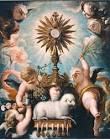
Sunday of the transferred celebration of the Solemnity of Corpus Christi in many places where Thursday is not a public holiday. Pope Leo XIV is in Spain, in Madrid, and in a short while he will celebrate Mass and the procession with the Blessed Sacrament, so popular and massive in Spain.
Pope Leo XIV’s trip to Spain.
The fourth apostolic journey of Pope Leo XIV is to Spain. Upon leaving Italian soil, following the custom observed by every Pontiff, the Holy Father sent a telegram of greeting to the President of the Italian Republic: As I begin my apostolic journey to Spain, under the maternal gaze of the Virgin Mary, who welcomes us and guides us toward God, the source of unity and hope for all peoples, I am pleased to extend to you, Mr. President, my cordial greeting, accompanied by fervent prayers for the good and prosperity of the entire Italian nation. Leo PP. XIV». While flying over French airspace, Leo XIV addressed a telegram to Macron: «I send a cordial greeting to Your Excellency and to your fellow citizens as I fly over French airspace on my apostolic journey to Spain. Recalling with pleasure your recent visit to the Vatican, I invoke the blessings of Almighty God upon the nation, especially His gifts of peace and joy. Leo PP. XIV!
Upon his arrival, Pope Leo XIV, wearing the mozzetta and surplice, was received at the foot of the plane by Their Majesties King Felipe VI and Queen Letizia of Spain. It is a first part that is too civil, in which Pope Leo seemed captivated by a Spanish political class living immersed in criminality. Seeing the Pope in choir dress at such a civil event is nonetheless a way of speaking when words cannot do so, because the arrangements had evidently been agreed upon. At the Royal Palace, a courtesy visit to Their Majesties and a meeting with the Authorities, Civil Society, and the Diplomatic Corps.
Interview on the flight.
On the Airbus bound for Madrid. On board, in addition to the Vatican delegation, eighty-four journalists took their seats to cover the fourth international apostolic journey of Leo XIV. This is the ninth visit of a Pontiff to the Iberian Peninsula, fifteen years after the last visit of Benedict XVI. The Pope walked down the aisle to greet the journalists one by one. The Pope condemned global conflicts from his flight, issuing an energetic warning against the conflicts that are bloodying the planet. He expressed his deep sorrow over the international situation, stating that too many people are dying in Kiev and declaring that the war in Iran is not just.
First Pope in the Royal Palace Chapel.
The Royal Chapel of the Royal Palace of Madrid has been the scene of an unprecedented event in the history of Spain and the Church. The King and Queen, accompanied by the Princess of Asturias, Leonor, and Infanta Sofía, have held a meeting of extraordinary institutional and spiritual significance with His Holiness Pope Leo XIV. Attendees were able to enjoy a sublime musical performance by the prestigious Escolanía del Escorial, with the interpretation of two masterpieces of sacred music: «Ave Maria» by Franz Biel and «Tu es Petrus» by Giovanni da Palestrina.
The absent Pope Francis.
He never wanted to visit Spain. He rejected invitations from the King of Spain, from its prime ministers, and even from a Spanish journalist who tempted him with a gift: soil from each region of the country. Pope Francis said he would go “when there is peace.” Pope Leo XIV began yesterday a week-long visit to Spain, his first major European destination since becoming pontiff in May 2025. Francis never clarified what he meant by “peace,” whether he was referring to tensions in the country or in the Church, or simply to organizational chaos. In the negotiated political speech at the Royal Palace, Pope Leo called for “deeper reconciliation and cooperation” in Spain, but expressed his gratitude for its “fidelity to international law and multilateralism, which translates into an active commitment to peace.” The visit highlights the balances of Leo’s young pontificate; he is a conciliator with conservatives and with countries that felt the coldness of Pope Francis. He is expected to emphasize unity in the first speech by a pope before the Spanish Parliament in Madrid.
Catholicism in Spain, which, despite the sharp decline in the number of Catholics who identify as such over the past 15 years, is experiencing a resurgence of spirituality. There is a temptation for all political parties to try to use Pope Leo’s words; it is evident that this will happen. It is likely that the Pope will speak about issues that anger the left, such as the Church’s opposition to abortion, among other topics that progressive Catholics have called “pelvic issues,” on which the Church has long been obsessed. Some far-left legislators have even said they will boycott the Pope’s speech.
In private, Leo has told the Spanish bishops that he opposes people politicizing the faith. In a meeting held in November at the Vatican, Leo expressed concern about the ideological forces in Spain that exploit Catholic voters for their own political benefit. “We are concerned that they want to approach the Catholic sphere to gain votes.” Luis Argüello, who attended the meeting, confirmed that “they spoke about the situation of polarization and confrontation in Spain.” Leo, according to him, commented on his experience of polarization in the United States and “spoke about the risk of faith being used by ideologies.”
Vigil with young people.
«If young people are faced with the question: ‘Do you want to go see Bad Bunny or the Pope?’, I think many will go see Bad Bunny,» said Leo XIV to the journalists on board the papal plane, «but I think there will also be some who come to see the Pope.»
A wonderful night in Madrid, the media speak of more than six hundred thousand people, kneeling before the Blessed Sacrament in prayer with the Pope. «Greetings to all. Thank you for being here and thank you for sharing the faith with all of Madrid and with all of Spain.»
When asked about the saints who accompanied him in his Christian growth, Leo XIV first mentioned Saint Augustine, an essential figure for him, along with Saint John Chrysostom, whose eloquence earned him the nickname “golden mouth.” The Pope praised Augustine above all for his courage, because he was not afraid to speak before the Emperor in the name of justice. He then recalled two Spanish saints: Saint Thomas of Villanova, an Augustinian and bishop of Valencia, still known today as “the bishop of the poor,” and Saint Turibius of Mogrovejo, a missionary in Peru who combined an intense life of prayer with his commitment to fighting the abuses and corruption of his time. «If they succeeded, why not me?»
When asked how to recognize the voice of God among so many, the Pope pointed to silence. Too often, he observed, we go around with headphones, with music, with distractions, and we no longer know how to keep silence; yet it is precisely in silence that the Lord can speak. Hence the passionate invitation to always seek the truth: “God is truth. If it leads you away from God, it is not truth.” He then assured the young people that God knows their voice well, that He listens to them and answers, and recalled the importance of the Word and Eucharistic adoration as a place to free the heart and present oneself before the Lord. “Never be afraid to consider a vocation to the priesthood, to religious life, or to other services in the Church!”
Leo XIV affirmed the freedom of the disciple: contemporary of his time, never a prisoner of it, free in Christ from fashions and open to the future because he is certain that history culminates in eternal communion with God. He exhorted the young people to be the salt of the earth and the light of the world, entrusting them with a mandate that he repeated with force: be human, men and women of flesh and blood, trustworthy faces, people thirsty for justice and an honest life. Then, addressing the engaged couples present, after greeting a young man named Fernando, who was about to be married, he reiterated that marriage is also a vocation, that it should not be feared. He encouraged them not to be afraid to consider priestly and religious vocations. “You can change history. Do it with love.”
Polarization during the visit to Spain.
“Be people who seek justice, because they long for it, like daily bread; people who desire an honest and upright life.” “I invite everyone to abandon divisive and polarizing narratives and to move from sterile simplifications to an appreciation of complexity. I see here a specific vocation for Europe, of which Spain is an original and fundamental protagonist.”
Overcoming polarizations “is the gift that the Old Continent can offer the world if it wants to remain young, just like those who feel they have a future: to appreciate complexity, not to deny it.” “We must avoid those identity-based approaches that seem to clarify everything, but that populate the world with ghosts and enemies.”
We all see that an enormous social change is taking place and that it does not come from above but from the social base and from the youngest. This makes a ruling class that took for granted that everything was tied up and well tied up very nervous.
Bishop José Mazuelos Pérez, bishop of a diocese in the Canary Islands: “The Spanish far right wants to imitate the American far right.” “They want to declare war on the bishops over the issue of migration.” The harshest critics accuse the Church of embracing causes of the political left, and Spain is now a microcosm of the deep division over migration and other hot-button issues. It is already clear that Pope Leo will address the issue of polarization in a much-anticipated speech before the deadlocked Spanish Parliament on Monday, which some interpret as a key papal message to the Western world. The central theme of his seven-day visit is the role of the church as a lifeline and political defender of undocumented migrants and asylum seekers, an explosive issue as European governments adopt stricter immigration rules in response to public fatigue. The reality indicates that more and more young people are looking for something to believe in: “something that is based on the question of why we are here and what we are doing here, and that search often leads them to religion.”
Things like the statements of the Vice President of the Spanish Government, Yolanda Díaz, to the Washington Post do not do Pope Leo much favor: “The alignment of the left with Pope Francis was immediate: he defended the Spanish labor reform, and the Episcopal Conference also supported it, something that would have seemed unthinkable 20 years ago; with Leo XIV, that alignment deepens.” Santiago Abascal, president of Vox, has harshly criticized the Church in recent months for remaining “silent” on the liberal policies of the government led by the socialists, including one of the most radical transgender rights laws in the world.
Archbishop Luis Argüello , president of the Spanish Episcopal Conference, stated that while the Church may appear closer to the left-wing government on migration issues, “in other areas we disagree, such as the individual understanding of the right to life, the regulation of abortion, and euthanasia.”
Bishop murdered in Mozambique.
This is Osório Citora Afonso, bishop of Quelimane and apostolic administrator of Beira. His body was found on the morning of June 6, 2026, in his episcopal residence in Quelimane, shot dead, one of the bullets striking him in the chest. Leo XIV expressed his deep dismay at this “grave act of violence,” asking the Lord to console the afflicted faithful, to protect them with His love, and to “stay the hand of the violent.” “Don Osorio,” Bishop Citora was a member of the Consolata Missionary Institute, served in the Dicastery for Evangelization in Rome from 2017 to 2023, before being appointed bishop of Quelimane in August 2025.
Finding sound doctrine in the Vatican.
On June 3, at the Association of Catholic Colleges and Universities of the United States, Leo XIV said: “I hope that students will always find in their institutions the sound doctrine (cf. 2 Tim 4:3) entrusted to the Church.” The “sound doctrine” is needed above all in the Vatican, starting with the Dicasteries that drafted the encyclical Magnifica Humanitas. How is it possible, in fact, that the word “soul,” whose theological and philosophical meaning is fundamental to Catholic doctrine, has been “set aside”? It does not appear among the 40,000 words of the encyclical. There is a quote from Acts of the Apostles 4:32 (“The company of believers was of one heart and one soul”) and another from the Magnificat (“my soul glorifies the Lord”).
Its absence is surprising, not because there is an obligation to always use this word, but because the soul itself, in its profound meaning, is the formidable Catholic response to the problems that, according to the encyclical, AI poses. Magnifica Humanitas, in fact, focuses on the relationship and diversity between human intelligence and AI. What, then, is the true difference that exists (and will always exist) between humans and AI? AI “lacks a rational and spiritual soul, the intrinsic principle of intellectual operations. The encyclical, on the other hand, formulates the distinction between humans and AI in purely phenomenological terms, on the level of experience, affectivity, and relationality, forgetting or ignoring that the decisive distinction is ontological.” If the Church spoke of an immortal soul, a substantial form of the body, seat of knowledge and morality, it would be giving a response that is above all rational (in fact, Greek philosophy had already arrived at this) and that opens the way to Christian Revelation. It seems that in the Dicastery of Czerny, where the encyclical was drafted, there is not only a lack of “sound Catholic doctrine,” but also the culture necessary to understand that speaking of a “soul” is not the mark of fanatics, quite the contrary.
Petition to Pope Leo to resolve Guadalupe.
A new petition, withdrawn from the internet after being launched by concerned faithful in Guadalupe, urged Pope Leo XIV to remove the rector of the Basilica of Our Lady of Guadalupe for his alleged links to organized crime. The petition, titled “Holy Father Leo XIV, we beg you to restore legality to the Basilica of Guadalupe and to remove the illegal rector who is under canonical investigation,” which was shared with LifeSiteNews, asked the Supreme Pontiff to intervene in the recent reinstatement of Father Efraín Hernández Díaz as rector, alleging that Cardinal Carlos Aguiar Retes, Archbishop of Mexico City and Primate of Mexico, who reinstated the priest, has largely ignored their concerns.
“We, the undersigned, write to implore your immediate intervention to put an end to the arbitrary actions and irregularities that have recently occurred under the leadership of Rector Reverend Efraín Hernández Díaz at the Insigne and National Basilica of Guadalupe Catholic Shrine in Mexico City.” “On November 26, 2023, he assumed the position of Rector of the Basilica of Guadalupe; from that moment on, irregularities in the handling of funds, mistreatment of staff, and the commercialization of private visits to the chamber where the sacred original image of Our Most Holy Mother is kept began to occur.” “Unfortunately, since Father Efraín took charge of the Basilica of Guadalupe, a series of irregularities and acts that could be classified as criminal offenses and violations of canon and civil law have occurred on its premises.”
The petition was withdrawn but «if the accusations turn out to be true and there is a legitimate campaign focused on religious freedom or accountability, CitizenGo would be ‘happy to re-examine it’.» Meanwhile, LifeSiteNews has launched its own petition for the removal of the rector of the Basilica, embroiled in numerous scandals
- Tantum ergo Sacraméntum,
- Venerémur cérnui:
- Et antíquum documentum
- Novo cedat rítui;
- Præstet fides suppleméntum
- Sénsuum deféctui.
- Genitori Genitóque,
- Laus et iubilátio;
- Salus, honor, virtus quoque,
- Sit et benedíctio;
- Procedénti ab utróque
- Compar sit laudátio.
- Amen.
«…whoever eats this bread will live forever.»
Good reading.