


It is Wednesday, there is no audience in Rome today, the Vatican is experiencing a day of strange tranquility; when the Pope is away, the emptiness is noticeable. He is still in Spain, today in Barcelona. Everything is being prepared at the Apostolic Palace of Castelgandolfo, which will once again welcome the Pope in a few weeks. And he will no longer reside in Villa Barberini, normally used by the Secretariat of State, he will return to the Apostolic Palace, which Pope Francis turned into a museum. It seems that part of it will remain open to visitors and that it will be possible to return in August. Let’s move on to another day.
The trip to Spain.
In Madrid, among the crowd that overflowed on Corpus Christi Sunday, estimated at 1.2 million people, after a night of vigil in Plaza de Lima. Answering the young people’s questions, the Pope pointed out the way to them: “I want to entrust all of you with a mission: to be human. Yes, to be human! Men and women of flesh and blood. Not appearances, but trustworthy faces. People who seek justice because they long for it, like daily bread. People who desire an honest and upright life, because they willingly treat others as they would like to be treated themselves. Be human like Christ, the perfect man, the Risen One who shares history with us, in every age. In cultivating this commitment, look to the Apostles, to the first Christians, inhabitants of a pagan world. Following their example, be missionaries of the Gospel in the face of the material and spiritual poverty of our time, knowing well that our faith is a way of life, realized in charity. This, dear young people, is the virtue that, more than any other, changes history. You can change history! Do it with love! Thank you.”
On Sunday, in his homily during the Corpus Christi Mass , he built a bridge between the past, the present, and the future. He recalled that the feast is not “a nostalgic memory,” a kind of monument to the past. The Eucharist is the living, beating heart of Jesus’ message to the world, always. Here, then, is a message for Spain today and tomorrow: may the religiosity that has animated this country for centuries not be a museum of the past to be visited, but a school of faith from which we can draw nourishment even today. A school that teaches us to kneel before God and before our neighbor, because no one can kneel before the Lord and despise his brother; a school that teaches us the gratuity of selfless love, so that it may circulate among us and break the chains of all selfishness; a school from which we learn that God is a real presence and that we too are called to be present in the situations and challenges of society, not to flee, but to commit ourselves personally to building the common good.
At the meeting with the Diplomatic Corps and civil authorities he focused on freedom of religion and conscience, which must always be protected. A strong and clear message for all of Europe, for the West, for the whole world: “Today, the temptation to gain popularity by fueling polarization seems to be growing, rather than diminishing; human dignity continues to be violated. Therefore, we need culture, introspection, free and quality education, and transcendence. Yet, from these dark nights, men and women faithful to the truth have been driven to move from place to place until, in conscience, justice and peace embrace. It is from their freedom that we learn to be free. The Catholic Church satisfies this thirst of the human heart. Not through imposition, but with the evangelical witness sustained by a multitude of martyrs and saints, and today it is ready to place itself at the service of the future of a people seeking reconciliation and peace.
In the speech delivered before Parliament on Monday, June 8 in the morning, undoubtedly the best of those given these days, he listed the principles of the Catholic moral vision: the defense of human life, the common good, the defense of the family, and, above all, a Europe capable of fostering a vision of peace. “As the motto of the European Union reminds us, ‘In varietate concordia,’ true unity does not make us uniform, but creates cohesion in diversity, turning cultures, sensibilities, and traditions into an opportunity for mutual enrichment.”
The presenter from the Bernabéu.
The presenter has explained how she felt after presenting the historic event in honor of Pope Leo XIV before 80,000 people at the Santiago Bernabéu. Patricia Pardo and Christian Gálvez were chosen to host the massive event held at the stadium. The journalist, visibly moved by her encounter with the Holy Father, broke down and said she was in shock and could not believe everything she had experienced: “I haven’t even landed. I have a massive hangover and I’m going to need some time to cry at home and let it all out. If I say that yesterday was special, I’m underselling it—a day on the level of the birth of my daughters.” The journalist recalled the Pope’s arrival before a crowd of 80,000 people, fully committed and chanting “With you, Leo, one single heart,” with the official hymn of the visit, ‘Alzad la mirada,’ performed by David Bustamante, Daniel Diges, and Diana Navarro. “That moment, I couldn’t hold it together.” “It was so beautiful… Chris kept telling me to hold on, but for me that performance of the hymn by those artists and the arrival was something overwhelming, something magical.”
Patricia Pardo also shared an anecdote, not to criticize, but to highlight the strong and “necessary” security measures in place at the Santiago Bernabéu stadium. Due to nerves, both she and Christian Gálvez left their presenter credentials in the dressing room. “When we came out through the players’ tunnel, they wouldn’t let us through because we weren’t wearing the double accreditation.”
David Bustamante also starred in one of the most moving moments of Pope Leo XIV’s visit to Madrid by performing a spectacular Hymn of Joy at the Santiago Bernabéu stadium.
Bad Bunny with Leo XIV.
Much highlighted in the media was the informal audience with Bad Bunny at the Santiago Bernabéu stadium, together with his family. Bad Bunny has always declared himself Catholic, though not practicing, due to the deep religiosity of his family. He himself had requested the opportunity to meet the Pope before his trip to Spain. Pope Leo joked about the coincidence in Madrid: “Between Bad Bunny and me, many young people today choose him.”
Leo XIV with the pilots.
During the flight from Madrid to Barcelona, Pope Leo XIV went to the cockpit of the Iberia Airbus A320 carrying the Vatican delegation. For part of the journey, the plane was escorted by a Spanish Air Force fighter jet . During the approach to Barcelona, he also flew over the Sagrada Família , where the Pope will inaugurate the new Tower of Jesus. During the trip, he also greeted Cristina Villegas , an Iberia flight attendant and an acquaintance of his from his time as bishop of Chiclayo, Peru.
Pope Leo in Barcelona.
In the Cathedral of the Holy Cross and Saint Eulalia, before the Blessed Sacrament and just steps from the crypt housing the remains of the city’s co-patroness, where Leo XIV delivered the inaugural message focused on unity. The homily, given during the celebration of Sext, began with two images that Leo XIV drew from Sacrosanctum Concilium and the First Letter to the Corinthians. The first is that of the Church as a beloved Bride . “God wanted you here because He loves in you and in your being a unique and sacred beauty and goodness.” The Church “is the fruit of an act of love that precedes it and comes from God, and grows above all by allowing itself to be loved by Him: only those who allow themselves to be loved by God can build, with others, works of love.” The second image is that of the Body . If Christ is the Bridegroom who loved us first, He is also the Head to whom we are united as members of a single organism: “it is not a matter of style, but a physiological necessity.” “We are strong because we are united, and we are united because the same Spirit animates us.” The homily concluded with an invocation to the Virgin—“Holy Mary of Mercy, pray for us”—and with a quote from Jesus’ prayer at the Last Supper: “that they may be one, so that the world may know that you have sent me.”
Pope Leo and depression.
Pope Leo XIII spoke about the “silent illness” that is depression, addressing young people at the prayer vigil in the Olympic Stadium of Barcelona. “It is important to recognize how mental health is increasingly threatened in societies that consider themselves advanced.” “That is why we need a healthcare system that includes among its priorities this invisible and widespread malaise, which also affects young people.” “It is a sign that something is deeply wrong with a certain idea of growth that subjects people to pressures, expectations, and tensions that undermine fundamental balances.” “There are moments of darkness and suffering that our society silences, because certain cultural models always want us to be winners and perfect. Therefore, limitations, fragility, and pain must be removed, confined to the deafening silence of loneliness or even shame.” “And, in those moments, we can instinctively think that God has also abandoned us. But the cross of Jesus tells us that God does not abandon us.” “In the face of the most difficult and painful situations, when God seems absent, we must once again entrust to Him the burdens we carry in our hearts,” the Pope proposed. “We must not spiritualize pain, superficially attributing it to the will of God or some mysterious plan of His, because this risks minimizing that suffering, silencing it, and wounding people. God does not want suffering; He bears it with us and invites us to trust in Him with perseverance.”
Artificial intelligence and the Spanish bishops.
This is the anecdote the Pope told at the beginning of lunch at the nunciature with the Spanish bishops. Aciprensa cites Yago de la Cierva, coordinator of the papal trip to Spain, who described a pleasant and informative exchange during the Pope’s lunch with the Spanish bishops at the nunciature. Before blessing the meal, Leo XIV “said that before leaving on the trip , he contacted an artificial intelligence to ask it: ‘What should the Pope say to the Spanish bishops?’ And the artificial intelligence answered: ‘Pope Francis would say…’ Then he interrupted it and said: ‘I think there is another Pope.’ And then the artificial intelligence said: ‘Ah, of course, now it is Pope Leo.’” In short, the AI must have missed a conclave and was updated directly by the elect. This confirms the irreducibility of the human factor, no matter how sophisticated the tool. And if even the Pope is not always infallible in all circumstances, imagine how we must approach AI…
The speech to the Spanish parliamentarians.
In his speech to the parliamentarians, the Pope recalled Spain’s Christian history, now secularized, and pointed to three pillars to defend: life, the family, educational freedom, and religious freedom. During papal trips, speeches before the parliaments of the nations visited are moments of great importance for the Church’s social doctrine and directly concern the relationship between the Catholic faith and political life, between the Church and the world. Like the speeches of Benedict XVI in Westminster Hall in London (2010) and in the Bundestag in Berlin (2011), this speech by Leo XIV must be read with attention. In recent decades, Spain has experienced an accelerated and radical process of secularization that has led to the end of the old Christian society and, as always happens in such cases, to the overthrow of public ethics. Secularization has generated moral nihilism, especially with the introduction of laws against life and the family. Recently, the opening to a possible reduction of the inviolability of the sacramental seal of Confession has been accompanied by plans to include the right to abortion in the Constitution, as has already happened in France.
Some have noted the absence of any direct reference in the speech to the Catholic religion as the true religion , with a singular role in the purification of political reason, not motivated solely by cultural and historical reasons. When its rights are affirmed, it is done only with reference to the principle of religious freedom with a criterion valid for all religions, and using the words faith or religion in a general sense. But if Catholicism is the true religion and if, for this reason, politics needs it, its position in public life changes, both with respect to authority and to other religions. At this point, a certain difference is observed with Benedict XVI and his speeches before other parliaments.
The German oversight.
We will never tire of recalling that in Germany there are Catholics who are fed up with many of their distracted bishops and the well-paid staff of the all-powerful curias. According to a local media outlet , on June 13 the Protestant church of Pforzheim and the parish of the Sacred Heart will support the pride event. “God created us in diversity and unites us. We are firmly convinced that every person—regardless of religion, origin, social status, or sexual identity—is created by God and loved by Him. We share this concern with Christopher Street Day, which defends the dignity of queer people, seeks to make visible the diversity of people in their sexual identities, and takes to the streets to demand their rights.”
The churches will have a joint stand during the parade in Pforzheim and plan to offer “blessings” to participants. On its website , the parish of Pforzheim has a section titled “for queer people” that links to the website of the Archdiocese of Freiburg, led by Archbishop Stephan Burger. The archdiocese offers “care for queer people,” which appears to be a form of “pastoral care” that does not call sinners to repentance, but affirms them in their supposed “queer identity.” On the Archdiocese’s site: “Queer gender identities can include, for example, non-binary, gender-fluid, gender-nonconforming, or agender, which shows that gender is diverse and does not have to be limited to rigid categories.” While France is waking up strongly and in Spain we are seeing how the long-suffering people of God proudly take to the streets after fifteen years, fifteen, of papal contempt, the Germans remain distracted and the faithful are fleeing en masse.
Bishops without faith?
Schneider affirms what many of us think and what is more than evident, that a “ remarkable number of high-ranking clerics” have “lost the Catholic faith.” “They want another Church: a half-Protestant, half-worldly Church, adapted to the impression the world has of it.” They have the full version in a dialogue with Gaspers: “In the last 60 years there have been a considerable number of them. They have influence in the Church… They have promoted this with inner conviction, with the desire to really change the Catholic faith, to adapt it completely to the world and to have a new relativistic religion, a kind of syncretism.”
The period he specified points to the conclusion of the Second Vatican Council in 1965 as a turning point for the apparent orthodoxy of Catholic leaders. Schneider states that it is “difficult” to determine which members of the clergy have the attitude of “changing the Catholic faith,” but that we can declare the result, the “fruits”: “A tremendous general confusion, obfuscation, and darkness with regard to doctrine, morality, and liturgy.” Gaspers asked Schneider why Cardinal Víctor Manuel Fernández, prefect of the Dicastery for the Doctrine of the Faith (DDF), asks the Society of Saint Pius X (SSPX) to unconditionally accept the Second Vatican Council as a condition for being considered “Catholic.” The bishop pointed out that previous popes demanded the same from the founder of the SSPX, Archbishop Marcel Lefebvre. Even asking him to say that the Second Vatican Council is consistent with tradition is asking him for “violence to reason” or “an exercise in mental acrobatics.” “But we see that it is a disaster. If the fruit is only confusion, ambiguity, how can ambiguity be the voice of the Holy Spirit?”
The Legion of Honor for Pizzaballa.
French President Emmanuel Macron awarded the insignia of Knight of the Legion of Honor to Cardinal Pierbattista Pizzaballa, Latin Patriarch of Jerusalem, in recognition of his commitment to interreligious dialogue, justice, and peace in the Holy Land, marked by months of conflict and suffering. Macron received Pizzaballa at the Élysée Palace, where the award ceremony took place. Macron: “An untiring apostle of interreligious dialogue, justice, and peace.” “Civilian populations, including Christians in the Holy Land, are being ravaged by war.” Macron also reaffirmed France’s historic commitment to supporting Christian communities in the region and its “unwavering adherence” to respect for the status quo of the Holy Places in Jerusalem. He stressed that the Christian presence in the Holy Land “must be preserved at all costs,” as it represents an essential component of the history and religious balance of the Middle East. The Patriarch also met with the French Minister of Foreign Affairs, Jean-Noël Barrot. The visit, which began on Monday at the initiative of L’Œuvre d’Orient, includes meetings with the faithful, representatives of the Eastern Churches, and ecclesiastical, cultural, and institutional leaders. The program will culminate in the coming days with the Cardinal’s participation in the celebrations of the Sacred Heart at the sanctuary of Paray-le-Monial, where he will preside over religious events until Sunday.
The Angel of Peace.
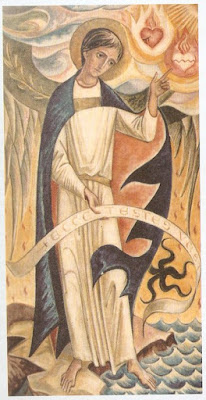
In Portugal, the “Angel of Portugal” is celebrated on June 10, which is also Portugal Day. The Angel of Portugal, also known as the “Angel of Peace,” appeared to the three little shepherds of Fatima before the apparitions of the Virgin Mary. This tradition originates from the Fatima apparitions in 1917, where the angel prepared the children Lucia, Francisco, and Jacinta for the visit of the Virgin. The angel taught the children to pray with fervor and prepared them for the apparitions of the Virgin. Today, our friends in Portugal remind us that the national children’s pilgrimage to the Sanctuary of Fatima is taking place. A good day to remember that children are capable of approaching God with greatness and of praying as well as anyone.
“… whoever keeps them and teaches them, he will be called great in the kingdom of heaven.”
Enjoy your reading.