


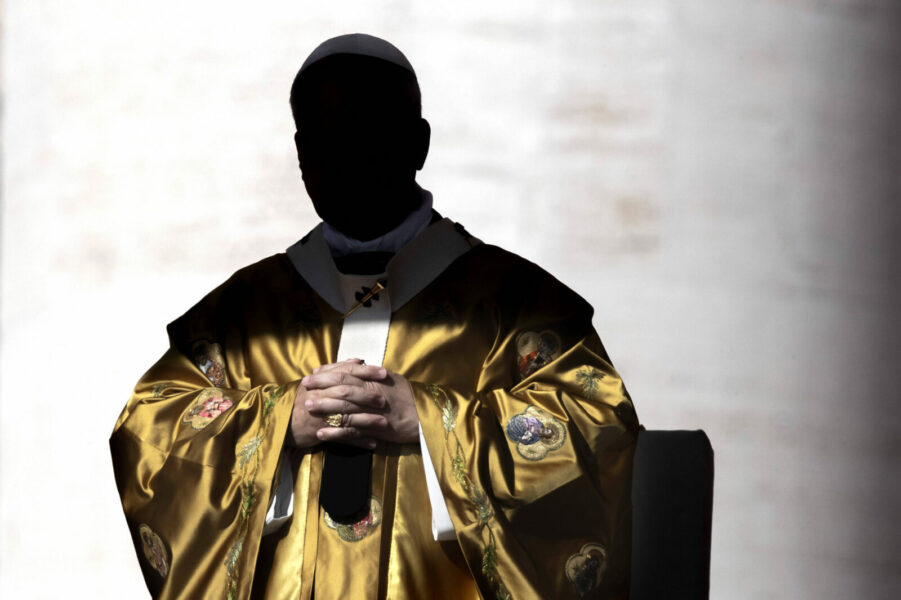
Mid-September, time flies, we start the week and the information doesn’t let up. Having celebrated the Holy Cross, today we do it with the Sorrows of the Virgin.
Pope Leo XIV recalled the new martyrs 25 years after the celebration presided over by St. John Paul II, in memory of those who bear witness to their faith without ever resorting to force or violence, but embracing the weak and gentle force of the Gospel; representatives of other Churches and Christian Communions accompanied him. In his homily he spoke of the meaning of «martyria»: «We are convinced that martyrdom unto death is ‘the truest communion that exists with Christ, who shed his blood and, in this sacrifice, draws near those who were once far away’. Even today we can affirm with John Paul II that, where hatred seemed to impregnate all aspects of life, these courageous servants of the Gospel and martyrs of the faith clearly demonstrated that ‘love is stronger than death'». He concluded his homily with a quote from a Pakistani child, which opens us to the courage of faith: «May the blood of so many witnesses bring closer the blessed day when we will drink from the same cup of salvation. Dear ones, a Pakistani child, Abish Masih, murdered in an attack on the Catholic Church, had written in his notebook: «Make the world a better place». May the dream of this child urge us to give courageous witness to our faith, so that together we may be leaven for a peaceful and fraternal humanity».
The book ‘Leo XIV. Citizen of the world, missionary of the 21st century’ which collects the complete interview with the Pope will go on sale from next Thursday in Peru, before any other country, while in Spain it will be available from September 23, published by Debate. «I have always tried to keep up with the news, but the role of Pope is certainly new to me. I am learning a lot and feel challenged, but not overwhelmed».
We continue with articles that focus on what we are learning about the book-interview of Pope Leo XIV on the occasion of his 70th birthday. The Pope urges us to «find ways to be Church together «. What does this mean? Leo XIV explains it with a striking comparison: «It is not about trying to transform the Church into a kind of democratic government», because » if we look at many countries in the current world, democracy is not necessarily the perfect solution for everything «. The goal must be «to respect and understand the life of the Church as it is and say: ‘We must do this together'».
The Pope expresses his understanding for those in the Church who have had doubts about the direction of the synodal process during the years of the late Pope Francis. For him, synodality is “an attitude, an openness, a disposition to understand” and refers to the Church : “it consists in each of its members having a voice and a role to play” , recognizing that “some have felt threatened by this”, although this is not “the purpose of synodality” , which, on the contrary, serves to find “a way to describe how we can unite, be a community and seek communion as Church” . For Prevost, synodality must help us understand that the Church’s main focus is not to be “an institutional hierarchy, but rather a sense of ‘we together’”.
American or Peruvian? «I think the answer is both. Obviously, I am American and I feel very American, but I also love Peru very much», Half of my ministerial life «I spent in Peru, so the Latin American perspective is very valuable to me ».
Referring to the war in Ukraine, he spoke of «senseless murders for years, by both sides», and stated that he believes «people need to wake up in some way and say: there is another way to do it». The Pope states that he is «perfectly aware of the implications of considering the Vatican as a mediator», quoting «the two times we offered to host negotiation meetings between Ukraine and Russia , both in the Vatican and in other Church properties» and the «totally neutral» posture adopted by the Holy See. However, he also pointed out that «various actors» should » exert enough pressure « for the parties involved to say «enough !» .
First birthday of Pope Leo XIV on the throne of Peter. Over the last four months, he has reviewed and recalibrated the themes of Francis and has given signs of détente on the liturgical front, but appointments and governmental actions that indicate the direction he intends to take are slow to arrive. Since the time of John Paul II, no pope has celebrated his seventieth birthday. At that time, on May 18, 1990, Wojtyla was returning from his 47th apostolic journey to Mexico and Curaçao. It has been a summer of trial for the new pope , who continues to benefit from popular enthusiasm for his election and has demonstrated his reluctance to rush, temporarily freezing appointments and other more urgent decisions.
Leo XIV has dedicated himself to (re)writing his first papal document, dedicated to care for the poor and inherited from his predecessor. He wanted to turn it into an apostolic exhortation, which was to be published in a few days, but which will be postponed until the first week of October for its final review in all languages. The new Pope addresses the themes according to his own sensitivity and in a much less ambiguous way than his predecessor.
On environmental crises in pastoral care, Prevost made it clear that the music has changed: «The Church will be present», but without mixing other themes contrary to Christian anthropology. «Let no one irresponsibly destroy the natural goods that speak of the goodness and beauty of the Creator, nor, much less, submit to them as a slave or worshiper of nature, since these goods have been given to us to achieve our goal of praising God and thus obtaining the salvation of our souls»; it is time to end Pachamama and various indigenous sentiments.
The future of the Church in the papacy of Leo XIV will not be without challenges . There are internal wounds to heal: ideological divisions, reforms to eliminate and others to resolve, a sometimes authoritarian laity and a clergy increasingly tired and fed up with so much nonsense led by discredited and low-level bishops. It will be necessary to restore balance, return dignity to monastic life and attention to vocations, and address the abuse of power by some recently appointed bishops who are pushing many priests to leave their dioceses. To these internal tensions are added the calls from the international community to global conflicts, the difficulty of preserving faith in a secularized world and the fragmentation that often tears the ecclesial Body. Leo XIV does not seem to want to respond with the language of complaint or with hasty and authoritarian decisions. Seventy is not an age for sudden adventures, but for wisdom. An «orderly transition» was needed to stabilize the Church after the turbulent pontificate of the late Pope Francis.
The sky over St. Peter’s Basilica lit up yesterday with the spectacular choreography of more than 3,000 drones: the Pietà, Pope Francis, the Salus Populi and many other images appeared over the Dome, including the Creation of Adam, from the Sistine Chapel. The light show was made possible thanks to 3,000 drones provided by Kimbal Musk, brother of Elon Musk, executive director and founder of the company Nova Sky Stories . «We worked with the Italian and Vatican authorities». «Specialized pilots are in charge of launching the drones. Various technologies ensure that the images form several meters away from the public watching the show». «Our drones take off with a system patented by Intel, from a distance of two and a half centimeters and separate two meters thanks to an algorithm. There are different levels of geofencing. There is the «showbox», the area in which the drones must move. If a drone leaves that area, the «return to base» order is activated. Then there is another line, a «red line»: if a drone crosses it, the engines shut down and the drone descends immediately. All the Musks were present last night, except Elon, with Mrs. Maye, the mother of Elon and Kimbal.
Meanwhile, Pope Leo, we assume oblivious to the financing of the party being offered in his house, in an interview published by El Comercio and Crux, emphasizes «the ever-widening gap between the income levels of the working class and those of the richest. For example, executives who sixty years ago might have earned between four and six times more than workers today, according to the latest data I have seen, earn six hundred times more than the average worker». Perhaps it is a desire to balance in the public imagination the pomp of last night’s event and the hospitality given to the Musks, especially on a day that celebrates his 70th birthday, which is also an opportunity to reflect on the meaning of Catholicism and the Church in the world: «I read the news that Elon Musk will become the world’s first billionaire. What does that mean and what is it about? If that’s the only thing of value today, then we’re in trouble».
Drones from Elon Musk’s brother in St. Peter’s Square as a message of peace? «Did I like it? I still don’t know. I have nothing to say about the concert, but the constant presence of drones at various events leaves me speechless». During the performance of “Amazing Grace” by Andrea Bocelli and Teddy Swims, we witnessed a highly innovative technological choreography. “Music can undoubtedly act as a bridge between different cultures and traditions” But the drones? They are impressive, but the impression that too much technology fills the voids left by critical thinking. Are the luminous drones supposed to be a message of peace? For now, they are a spectacle, an exceptional showcase for the company that organized them, owned by the great and powerful Musk family.
«The Excommunication» is now available, about the abuses in the Church during the papacy of the late Pope Francis. The central theme was the case of the influential Jesuit Marko Rupnik, artist and intellectual close to at least three popes, excommunicated and subsequently rehabilitated despite decades of abuses, rapes and violence. This investigation was carried out by Giorgio Meletti and Federica Tourn, who played a decisive role in clarifying the Rupnik scandal and therefore participated in the making of an important film for the global market, presented recently at the Toronto Film Festival.
«Here you have your mother»
Good reading.