


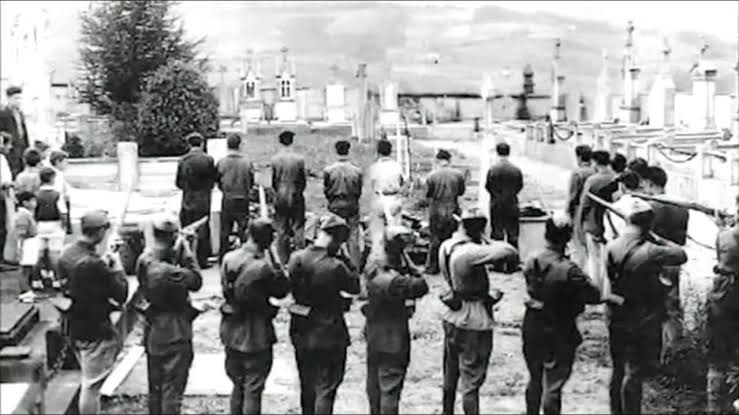
Nine seminarians between the ages of 18 and 24, the priest-uncle of one of them and the father of another have been beatified since this Saturday. At midday, in the Almudena Cathedral, Cardinal Marcello Semeraro, Prefect of the Dicastery for the Causes of Saints, read in Latin the apostolic letter by which Leo XIV declares them blessed and calls them “courageous witnesses of the Gospel to the shedding of their blood.” They were killed in Madrid and its province between August 1936 and September 1937, during the religious persecution unleashed in the Republican zone, and almost all for the same reason: they were preparing to become priests. Ninety years later, what remains of them—some verses, some letters, a tombstone in the chapel of a seminary and the memory their families have kept—does not tell of defeat. It tells a story of hope with names and surnames.
They were called Ignacio Aláez Vaquero, who gives the cause its name, Ángel Trapero Sánchez-Real, Antonio Moralejo Fernández-Shaw, Cástor Zarco García, Jesús Sánchez Fernández-Yáñez, Miguel Talavera Sevilla, Pablo Chomón Pardo, Mariano Arrizabalaga Español and Ramón Ruiz Pérez. Seven were studying at the Conciliar Seminary of Madrid; Mariano was training for the diocese of Barbastro and Ramón for the archdiocese of Toledo. With them were also beatified Julio Pardo Pernía, a 63-year-old priest from Burgos and uncle of Pablo, and Liberato Moralejo Juan, a career soldier and father of Antonio, the only layman in the group. They are nine young men and two men who accompanied them to the end: a nephew with his uncle and a son with his father.
Beatification is the step prior to canonization, and the two should not be confused. By beatifying, the Church declares that someone already enjoys God and allows public veneration, although with a cult limited to certain dioceses or a specific community. Canonization, if it comes, extends that cult to the whole Church and inscribes the blessed in the catalogue of saints. With martyrs the path has a particularity: to beatify them no miracle is needed, because having given one’s life for Christ is in itself the proof. What must be demonstrated is that they were killed out of hatred for the faith, in odium fidei, and that they accepted death without renouncing it.
That is what the decree recognized that Leo XIV authorized on 18 December 2025, the feast of Our Lady of Hope. The cause began to take shape in 2006, when the seminarians of Madrid went out to gather testimonies on the occasion of the centenary of the Seminary; the diocesan phase lasted from 2010 to 2014 and since then the file has been in Rome. The apostolic letter read this Saturday is dated 18 October. The feast of the new blessed will be celebrated each 6 November, the day on which the Church in Spain remembers its martyrs of the twentieth century. The Church insists that these beatifications are not a settling of scores: they do not judge one side, they recognize witnesses of the faith.
In the cathedral there were about two thousand people, and many more outside, in front of a screen. The flowers and the chasubles were red, the liturgical color of martyrs. After the penitential act, the Archbishop of Madrid, Cardinal José Cobo, formally requested the beatification, and the postulator of the cause, María Victoria Hernández, read a brief profile of each of the eleven. When Semeraro finished reading the apostolic letter, two seminarians slowly released the cloth that covered a 3.3 by 4.8 meter canvas hanging in the central arch of the presbytery, beneath the Pantocrator. It reproduces a painting by the artist Nati Cañada: the eleven, with halos, gathered around Santa María la Real de la Almudena, with the Seminary building in the background. The cathedral applauded.
Afterwards, a deacon walked down the central nave with a relic of Ángel Trapero, the only one of the eleven whose body could be identified and recovered. He was escorted by eleven palms, the symbol of martyrs since the first centuries, and those who carried them had been chosen on purpose: nine students from the seminaries of Madrid, Alcalá and Getafe, a priest-uncle of a Madrid seminarian and the father of another seminarian. The same composition as the group of martyrs. Nine decades later, the Church of Madrid once again had nine seminarians, a priest-uncle and a father walking together, this time toward the altar.
In the front pews sat relatives of the new blessed, and among the faithful there was a large group that had come from Socuéllamos, the village of Cástor Zarco. Among the concelebrants were, among others, the bishops of Alcalá and Getafe, Antonio Prieto and Ginés García; the Archbishop of Burgos, Mario Iceta, and the Bishop of Jaén, Sebastián Chico, from whose lands three of the martyrs came, and Cardinals Antonio María Rouco Varela and Carlos Osoro, emeritus archbishops of Madrid. The script of the celebration entrusted one of the readings to a parishioner of Navalcarnero, the village of Ángel Trapero, and the offertory to his relatives and to representatives of the Hospital Sisters of Ciempozuelos, of whom Julio Pardo was chaplain.
In the homily, Semeraro dwelt on what most catches the attention of the group: almost all were seminarians. He recalled Saint John of Ávila, patron of the Spanish secular clergy, and his instruction that “a fire of love for God and zeal for souls must burn in the heart of the ecclesiastic,” and said that those young men had made their youth an offering to God. He quoted a phrase written by one of them, Jesús Sánchez: “love and trust in God the host, who is in the Sacrament.” And he brought to the cathedral the words that Leo XIV addressed in June to hundreds of thousands of young people at the vigil in Plaza de Lima, in Madrid: “If you burn with faith, you will transmit its living fire.” He warned that martyrdom is not a distant possibility nor a vocation reserved for a few, because fidelity is prepared each day, and he summed it up this way: not all of us are asked to shed blood, but “we are all called not to spare anything in love.” At the end he asked for prayers for the young, so that they would not be afraid to give their lives to Christ.
For after Communion, the program reserved a new hymn, “Contigo y como tú,” composed by four Madrid seminarians, José Ríos, Juan Martín, Pablo Herrera and Miguel Ángel Leranca, on a poem by Ignacio Aláez entitled “Auras de mi Sagrario.” The seminarians of 2026 have set to music the verses of a seminarian of 1936.
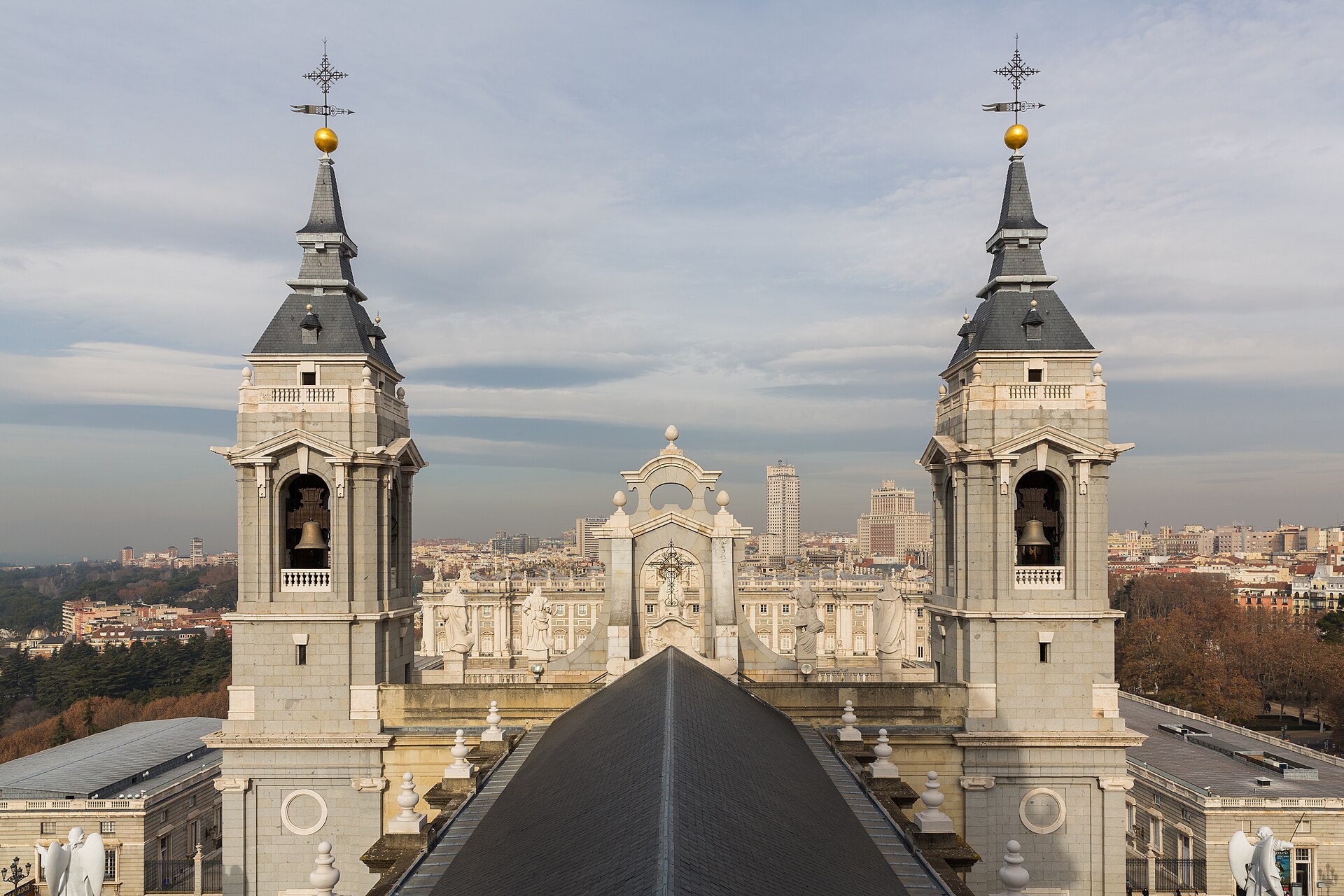
The story of most of them begins in the same place and on the same day. The Conciliar Seminary of the Immaculate and of Saint Damasus has occupied since 1906 a large brick building on Calle de San Buenaventura, next to San Francisco el Grande, a few minutes’ walk from the cathedral where they were beatified this Saturday. In July 1936 it had 215 seminarians. Most were on vacation, but on Saturday the 18th a retreat was being held in the house that a few were attending. It was preached by Hermógenes Vicente, parish priest of San Sebastián, in Carabanchel Bajo, who would also be assassinated, and present in the seminary were the rector, Rafael García Tuñón, and the spiritual director, José María García Lahiguera, who years later would become Archbishop of Valencia and is now venerable, with his cause of beatification underway.
At mealtime, the porter sounded the alarm: a group of militiamen was coming to storm the building. Those inside went to the chapel and consumed the consecrated hosts so they would not be profaned, hid a picture of the Immaculate and left dressed as civilians through a back door. Antonio Moralejo escaped through the garden door.
They saved their lives that afternoon, but the students’ files, with their addresses, remained in the building, and the militiamen used them as a directory. The seminary became a checa and later a prison, and in the following months they went to look for the seminarians at their homes, one by one. Checa was the name given in Madrid in 1936 to the detention, interrogation and torture centers set up by parties, unions and militias; they copied it from the Soviet political police, the Cheka. From many of them one left for a “walk,” the euphemism used to designate murder in a ditch or against a cemetery wall.

What happened to them was not an exception. The historian and priest Miguel Vivancos, author of two of the three volumes of the Martirologio matritense, calculates that between July and December 1936, 425 diocesan priests and seminarians, 661 religious, 107 nuns and one bishop, the one from Jaén, who will be discussed later, were murdered in Madrid, in addition to an impossible-to-specify number of laypeople. Throughout Spain, the number of murdered clergy is around seven thousand. According to data updated by the Episcopal Conference in October, the blessed of that persecution now number 2,404, counting the approved causes awaiting their ceremony; the saints, 11, and another 3,040 martyrs have their process open. The pastoral letter published by the bishops of Madrid, Getafe and Alcalá for this beatification raises to 110 the number of seminarians killed in that persecution, and recalls that the Church has officially recognized the martyrdom of 34.
The priests who survived were given another task. When, after the war, the diocese asked them what they had done since 18 July, the most repeated answer fit in three words: “He exercised the ministry.” Vivancos speaks, without exaggeration, of a heroic Church.
The first of the eleven to die were an uncle and a nephew. Julio Pardo Pernía had been born on 14 January 1873 in Pampliega, in the province of Burgos, in a family of merchants. To ordain him at 22 years of age a dispensation from Leo XIII was needed, because he did not yet have the age required by canon law, and he received the priesthood in Burgos on 8 June 1895. One Pope Leo opened the door of the priesthood for him ahead of time; another Leo, one hundred and thirty-one years later, has declared him blessed. He was parish priest in several villages of Burgos and dedicated himself to forming young men with a vocation. One of them was his nephew Pablo Chomón Pardo, born on 25 September 1914 in Quintanilla de Escalada, who began to study at the school run by his uncle.
Because of problems in his parents’ marriage, Pablo’s mother took him to Madrid with his brother Lorenzo, and they lived with Uncle Julio. Pablo entered the Conciliar Seminary, was an outstanding student and by July 1936 had already received the acolyte, one of the minor orders that then preceded the priesthood. That summer, uncle, nephew and mother went to Ciempozuelos, south of Madrid, where Don Julio was chaplain and confessor of the Hospital Sisters of the Sacred Heart of Jesus, the congregation that Saint Benito Menni founded there in 1881 to care for mentally ill women.
Upon arrival they found the village in the hands of a revolutionary committee that was detaining nuns and priests. The first days they were spared. Pablo took refuge with three priests in the house of the Hospital Sisters, where the Blessed Sacrament was exposed and adored for hours, and before they came for him he received Communion with other faithful. They were arrested at the mother’s house, locked in an improvised prison in the parish and on 7 August 1936 taken to the outskirts of Valdemoro, where they were killed. Don Julio was 63 years old and Pablo, 21.
Of neither of the two is a single image preserved. Of Don Julio, however, there remains a portrait made by his own executioners, who came to say to a nun: “You have a saint for a confessor.” They were buried in a common grave, and their remains now rest in the Basilica of Santa Cruz del Valle de los Caídos.

Five days later Ramón Ruiz Pérez died. He had been born in 1912 in a village in the province of Jaén that then belonged to the archdiocese of Toledo, and as a child he alternated school with work in the fields. At 13 he wanted to enter the seminary of Toledo. He first studied four courses at the minor seminary of San Felipe Neri, in Baeza, and then obtained the transfer. A classmate remembered him as a “very likeable” boy and very devoted to the Virgin, who did not stand out in his studies. In 1936 he had already received the four minor orders and was spending his vacation in his homeland when he was arrested together with the parish priest of his village. They were taken to the cathedral of Jaén, converted into a prison, where nearly a thousand prisoners were crowded together, including the bishop, Manuel Basulto. They ate little and badly. The priests maintained worship as best they could and prayed the breviary in secret.
In August many of them were put on a train, theoretically bound for Alcalá de Henares, which history has given a proper name: the train of death. On 12 August 1936, upon arriving at El Pozo del Tío Raimundo, on the outskirts of Madrid, they were taken off, handed over to the militiamen waiting there and murdered beside the tracks, beginning with the bishop. Manuel Basulto, now also blessed, is the bishop who appears in Vivancos’s count. Ramón was 24 years old. The remains of the victims of that train were transferred after the war to the chapel of the Tabernacle of the cathedral of Jaén, the same one that had served them as a prison. His village now belongs to the diocese of Jaén, whose bishop concelebrated this Saturday in the Almudena.

Jesús Sánchez Fernández-Yáñez was from Cózar, in the Campo de Montiel, in Ciudad Real. His family was humble and very religious, and he had to leave the village to look for work. He had wanted to be a priest since childhood. In the seminary he got excellent grades in almost all subjects, and the early death of a brother marked him forever. He wrote simple verses, of a seminarian who prays. These he addressed to Jesus:
De sus méritos nos llene
de gracias y bendiga,
que nuestra alma mendiga
de amores ansias tiene.
It is probable that he was at the retreat of 18 July. After the assault he hid in the family home, in Madrid, and there he endured weeks of threats from a neighbor. An argument with another family in the neighborhood precipitated the end. A neighbor denounced him with the cry of “¡curita!”, they took him to the checa on Calle de Fomento, one of the most feared in the city, and during the transfer they dedicated another insult to him: “curita del demonio.” They killed him without trial on 21 September 1936. His body appeared in the La China neighborhood, and his father recorded the wound: a shot in the back. He was buried in the Cementerio del Este and in 1961 his remains were moved to the crypts of the chapel of the Blessed Sacrament of the Basilica of the Valle de los Caídos. He was 21 years old. His niece Mercedes was in the cathedral this Saturday.

The youngest of the eleven was 18 years old. Miguel Talavera Sevilla was born in 1918 in Boadilla del Monte, the eldest of three children of a family of farmers of deep faith. He made his First Communion and stayed in the parish as an altar server. He grew up in a small village that had several priests and two cloistered monasteries, and his parish priest prepared him to enter the Seminary of Madrid in 1929. He spent seven courses there. In October 1936 he was again in Boadilla, where the parish and a convent had been destroyed and two priests murdered. The militiamen found his data in the seminary files and on 7 October went to arrest him at his house. The reason recorded admits no interpretations: “for having been a seminarian.” It is not known where they took him or exactly when they killed him. It is believed to have been around 9 October, near Aravaca or in the Monte de Boadilla, perhaps on the Cuesta de las Perdices. His body has never been found. In the Almudena this Saturday was his niece Felisa.

Antonio Moralejo Fernández-Shaw was born in Madrid on 14 April 1917. At the age of 12 he told his parents he wanted to be a priest, and spent six years in the seminary. His father, Liberato Moralejo Juan, born in Valencia in 1875, was a career soldier and had been posted all over half of Spain until settling in Madrid. In 1931 he promised fidelity to the Republic to remain in the Army, as was then required of officers who wished to continue in the ranks, and worked for the Republican government until 1935 when frictions began. When the war broke out, the government asked the military for a signature of adhesion against the rebels. Liberato refused, probably because of the anti-religious turn things were taking.
Antonio was sought for another reason. After escaping from the seminary through the garden door, he had defended the church of El Carmen, next to Calle de Preciados, when the militiamen tried to storm it. They came to his house and took father and son. In the file the reason for the arrest is recorded as “keeping letters in which the religious and patriotic character is revealed.” Family tradition recounts that Liberato, very close to his son, decided to accompany him wherever they took him. They locked them in the Modelo prison, which was next to their house, on the site of Moncloa where the General Headquarters of the Air Force now stands. They spent a month there in very harsh conditions.
At the beginning of November 1936 Franco’s troops were at the gates of Madrid and it was decided to empty the prisons. Thus began the great November round-ups: lists of prisoners who were taken out at night, theoretically to be transferred, and who ended up shot en masse in Paracuellos del Jarama and in Torrejón de Ardoz. Antonio and Liberato were tied up and put on a bus, taken to the castle of Aldovea, beside the Henares, and there they were murdered. The date recorded for the father is 8 November. They are buried in one of the common graves of the Cementerio de los Mártires de Paracuellos. Antonio was 19 years old.

In one of those round-ups also went Mariano Arrizabalaga Español. He was from Barbastro, in Huesca, the diocese that in proportion suffered most in all Spain: of its 140 diocesan priests, 123 were murdered, almost nine out of ten. In his city that same August the 51 Claretian missionaries died, mostly students of his age, whom John Paul II beatified in 1992. Mariano had entered in 1929 the Pontifical Seminary of Comillas, in Cantabria, the great seminary financed by the Marquis of Comillas and directed by the Jesuits to form priests from all over Spain and Latin America. He was studying philosophy. In 1934 his family had moved to Madrid because of his father’s illness, and there he spent the summer of 1936.

In that house there was another reason for the door to be knocked on: the family was very linked to Catholic Action, the great lay association of the time, and suffered harassment for it. Two of his brothers were arrested for belonging to it, and one died of malnutrition while taking refuge in the Chilean embassy, one of the legations that gave asylum to thousands of persecuted people in wartime Madrid. On 5 October, during a search, they took Mariano with another brother and a brother-in-law. He passed through the checa of Fomento and on 9 October entered the Modelo, where he remained until the November round-ups.
They took him by bus to Aldovea and shot him with hundreds of detainees. According to testimonies of those days, the prisoners shouted “¡Viva Cristo Rey!” before falling. The bodies remained almost unburied, covered with a little earth, until 1939. In December of that year his could be identified, and it ended up in one of the common graves of Paracuellos. The Seminary of Madrid preserves two relics of his. He was 21 years old.

Two of the eleven died on the same day, 9 November 1936, the feast of the Virgin of the Almudena, patroness of Madrid. Ángel Trapero Sánchez-Real had been born in June 1916 in Navalcarnero, in a well-to-do family, got excellent grades and was studying theology. On 11 October the militiamen appeared at the family home, with his name taken from the seminary archives, and took him away for being a seminarian. He spent two days in the checa of García Atadell, one of the best known in wartime Madrid, and was then placed at the disposal of the Dirección General de Seguridad. On 17 October he entered, without any judicial order, the prison of Porlier, installed in an old school of the Piarists. On 9 November his name appeared on a round-up list. He was shot beside the wall of the Cementerio del Este, which today is called, precisely, the Cementerio de la Almudena. He was 20 years old.
His family was able to identify the body thanks to some photographs, and that is why he is the only one of the eleven whose remains are preserved; they buried him in the family pantheon in Navalcarnero. On 7 December 2017, the eve of the Immaculate Conception, patroness of the Seminary, they were transferred to the chapel of the Conciliar Seminary, beneath the altar of Saint Damasus. From there came the relic that this Saturday walked the nave of the Almudena.
The tombstone says the essential: “Ángel Trapero Sánchez-Real. 20 years old, seminarian. 9 November 1936.” It also bears a phrase from the letter that Pope Saint Clement wrote to the Corinthians at the end of the first century: “Look at the athletes nearby.” Clement was referring to Peter and Paul, the martyrs closest to his time. In that chapel today young people the age of Ángel pray. One of them, the seminarian Guillermo García, told El Debate this week the impact the tombstone caused him every time he prayed there last year: that young man had been killed at his same age.

That same 9 November Ignacio Aláez Vaquero died, the one who gives the cause its name. He had been born in Madrid on 1 February 1914, the day on which the Church then celebrated Saint Ignatius of Antioch, the bishop whom at the beginning of the second century they took to Rome to be devoured by wild beasts. From there, most probably, his name came. His father, Evelio, was a barber and belonged to the Nocturnal Adoration, the association of men who take turns at night to keep vigil before the Blessed Sacrament. His mother was called Marina. His parish was San Millán and San Cayetano, on Calle de Embajadores, one of the churches that burned in 1936, like the collegiate church of San Isidro, which then served as a cathedral, or the basilica of Atocha.
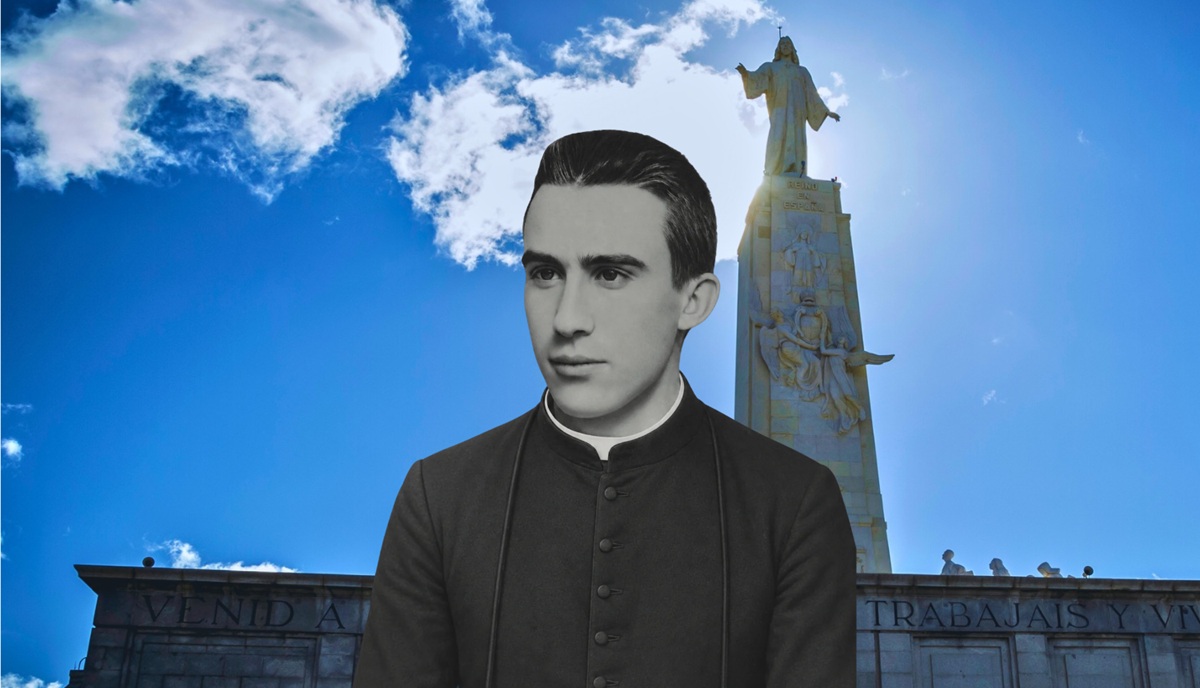
He entered the seminary in 1930 and took four years of Latin and two of philosophy. Outside class he drew, modeled, worked in repoussé and wrote verses and even a play about Saint Francis and the wolf of Gubbio; for a time he frequented a sculptor’s workshop. He visited the sick and the cloistered nuns of his neighborhood. One day on his saint’s day, in the seminary courtyard, he said to his companion Julio Navarro: “You haven’t congratulated me today.” He explained that it was the feast of his patron, the martyr of Antioch, and added: “I have asked the Lord for the grace to be a martyr, like my patron.”
It was not an idle phrase. He left written some verses that begin “Yo quisiera incendiar el orbe entero” and in which one reads: “Y morirme después martirizado.” In other verses, which Cardinal Cobo quotes in the preface of the biography published by the postulator, he wrote:
allá, en el pavimento solitario,
mi espíritu estará junto al Sagrario:
que más fuerte que la muerte es el Amor.
The bishops of Madrid, Getafe and Alcalá have titled their pastoral letter for the beatification almost with those same words: “¡Que más fuerte que muerte es el amor!”
In July 1936, when the rector closed the seminary, Ignacio returned home. A Republican soldier offered him protection and he refused it; according to the summary released by the Vatican media when the decree was approved, he refused to enlist because he wanted to continue preparing for the priesthood. He also refused to hide or deny that he was a seminarian. On 9 November, militiamen from the so-called checa of Líster searched his house, which they had reached thanks to the papers seized in the seminary, and took him away with his father and three neighbors. He did not pass through any police station or any prison, and his name does not appear in any register. Beside the walls of the Cementerio de Fuencarral they offered to save his life if he renounced his faith. He refused and died shouting “¡Viva Cristo Rey!” The next day his corpse and that of his father appeared on the road to the Quemadero, in Fuencarral. They were buried in a common grave. Ignacio was 22 years old.

The last to die was the one closest to the altar. Cástor Zarco García was born on 20 February 1913 in Socuéllamos, in the heart of La Mancha, in a family of deep Eucharistic devotion; his father was also a nocturnal adorer. He reached the seminary thanks to his schoolteacher, who paid half of his expenses, and a benefactress who paid the other half. He spent ten years at the Seminary of Madrid, won extraordinary prizes in Latin and Dogmatic Theology and kept his sense of humor. During the revolution of October 1934, the government installed in the seminary a garrison of well-equipped assault guards, because the building was, Cástor wrote to his parents, “perhaps the most strategic place in Madrid.” It did not have to be used. “We have lived the revolution in our own way: without class,” he joked. Without classes, that is.
On 6 June 1936 he received the subdiaconate in the chapel of the episcopal palace. It was then the first of the major orders, the one that committed forever to celibacy and to the daily recitation of the breviary; Paul VI suppressed it in 1972. Cástor had two steps left, the diaconate and the priesthood. When the war broke out he took refuge in his parents’ house, who to protect him took him out of the village hidden in a cart and sent him to a village in Cuenca, to the house of a friend of left-wing ideas who took him in. The war had not erased all loyalties. Later an order of mobilization came and he had to join the Republican army, first in a mobile brigade in Madrid and then in Alcalá de Henares. A fellow villager denounced him for being a seminarian.
From a prison in Alcalá, shortly before dying, he wrote to his friends a letter in which he told them: “Boys, trust in God. He, above all!” Then he suddenly stopped writing. In 1941 a death certificate appeared that sums him up in one line: he had died in Alcalá “on 18 September 1937, at 5 o’clock, murdered.” He was the only one of the eleven who died in 1937, a year after the others. He was 24 years old. His remains were transferred to the Valle de los Caídos. This Saturday about one hundred and fifty neighbors of Socuéllamos traveled to the Almudena with the priests of their parish.

What remains after a beatification like this is not a list of grievances. The bishops of Madrid, Getafe and Alcalá write it in their pastoral letter: the memory of these martyrs is a call to hope, to forgiveness and to reconciliation, and “a true force for the present.” The eleven, they say, “chose Christ and preferred to die rather than betray their Lord.” The Archbishop of Madrid translated it at the end of the Mass: they gave their lives for Christ in the Madrid of their time, and “it is up to us to make that same love present in the Madrid of today.” The diocesan delegate for the Causes of Saints, Father Alberto Fernández, prefers a more domestic image: the martyrs “are older brothers who help us in our needs.”
There are also data that allow us to look ahead without naivety, and not only in Madrid. The seminary from which they fled dressed as civilians in July 1936 began this academic year with 106 seminarians, a figure that was presented as a record. Nine students from the seminaries of the province carried the palms this Saturday, four Madrid seminarians turned a poem by Ignacio into a hymn and others pray in the chapel where Ángel is buried. In June, on Leo XIV’s first visit to Spain, hundreds of thousands of young people filled Plaza de Lima. In 1936, some militiamen searched for the seminarians of Madrid house by house, with their files in hand. In 2026, the seminarians of Madrid accompany with palms to the altar the relic of one of them.
The acts of the beatification continue. On Sunday 29 November, at 12:00, there is a Mass of thanksgiving in the Almudena; on Friday 4 December, at 20:15, in the monastery of San Bernardo in Alcalá de Henares, and on Friday 11 December, at 19:30, in the sanctuary of the Cerro de los Ángeles, in Getafe. The tomb of Ángel Trapero, in the chapel of the Conciliar Seminary, on Calle de San Buenaventura, can be visited this Saturday until 20:00 and on Sunday from 10:00 to 14:00; there the painting of the new blessed has also been unveiled. Whoever wishes to know their lives in detail has the biography by the postulator, María Victoria Hernández Rodríguez, El beato Ignacio Aláez Vaquero y compañeros de Madrid, entre los 110 seminaristas mártires del siglo XX en España, published by Encuentro.
Cástor Zarco did not become a priest. In that letter to his friends, written in a prison in Alcalá shortly before they killed him, he added a phrase that holds for Madrid in 1937 and for Spain today: “Hope and optimism are Christian.”
Read also