


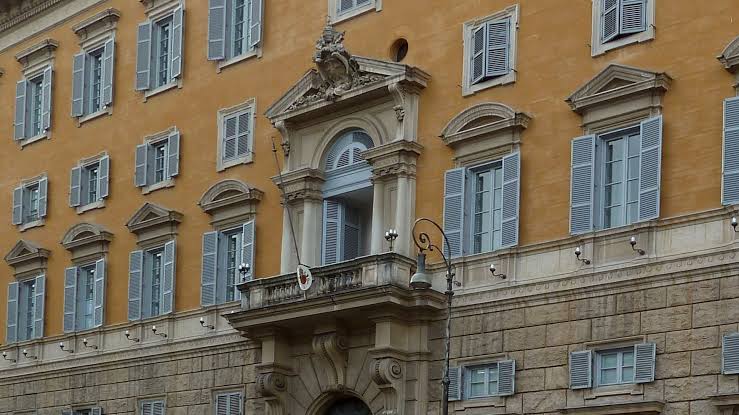
Pope Leo XIV received on Wednesday, November 25, in the Consistory Hall of the Vatican, the members of the International Theological Commission, on the occasion of the first plenary assembly of the eleventh five-year term of the body. It was the Pope’s first meeting with the Commission since he renewed its composition, and in his address he entrusted them with two matters: the apostolic Tradition and the cultural forms of transmitting the faith.
The Pontiff thanked the theologians for their contribution to the Church’s mission, which exercises the intelligence of faith in accordance with the teaching of the Second Vatican Council, and recalled his encyclical Magnifica humanitas. He then stated that the apostolic Tradition “touches the heart of the Church’s identity and mission,” and cited the constitution Dei Verbum, according to which the Church perpetuates and transmits to all generations all that she herself is and all that she believes.
“Without rupture” with previous Magisterium
The Pope maintained that, since holy Tradition is always alive, the knowledge the Church has of this reality is subject to a coherent and constant deepening. According to the text, this growth does not imply a rupture with previous Magisterium, but rather a development of the principles that animate it. As examples of this evolution in understanding, Leo XIV mentioned war, slavery, and the death penalty.
He also cited Benedict XVI, for whom Tradition is the permanent presence of the Savior who comes to meet us, and recalled that the Holy Spirit speaks to the Churches. At that point he evoked words of Saint John Paul II about the Spirit of God, who “blows where he wills” (Jn 3, 8), when speaking of the signs of the divine presence.
A “new stage” of inculturation of the faith
The second theme concerns the cultural forms by which faith is transmitted from one generation to another. Leo XIV defined inculturation as an indispensable dimension of the coherent witness of faith and added that the current historical stage calls for a new phase. To this end he drew on Paul VI, who called for evangelizing culture in depth and not merely in a decorative way, and on John Paul II, for whom a faith that does not become culture has not been fully received.
As an example he pointed to popular piety, which, citing Evangelii gaudium, allows us to see how faith, once received, becomes incarnate in a culture and continues to be transmitted. The Pope asked the Commission to examine the fundamental theological principles of inculturation and to offer practical guidelines for proclamation, catechesis, preaching, teaching, and celebration.
In conclusion, the Pontiff encouraged the members to address both questions with fidelity and competence, wisdom and creativity, with love for the people of God and trust in the Holy Spirit, and to be theologians capable of reflecting on the living Truth, who has the face of Jesus Christ. He imparted his blessing.
A Commission renewed in October
In October the Pope appointed 24 new members of the Commission for the five-year term 2026-2031. Among them is the Jesuit Michel Fédou, whom InfoVaticana recalled presented the thesis that Catholics and Reformed together form “one single Church.”