


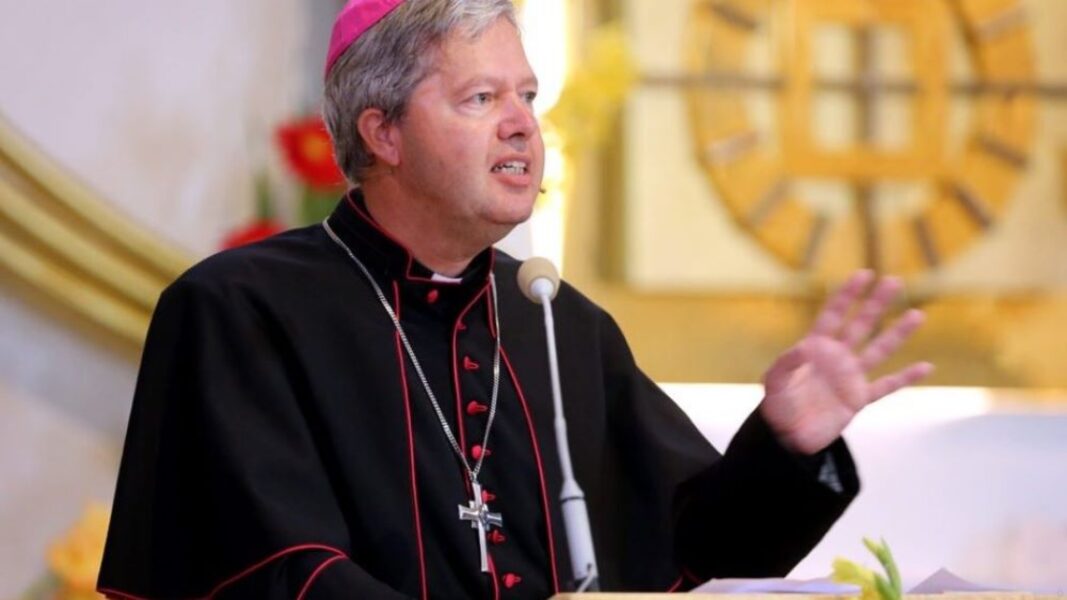
Auxiliary Bishop of ‘s-Hertogenbosch (Netherlands), Rob Mutsaerts, argues in an article published on journalist Edward Pentin’s Substack that restrictions on the Traditional Latin Mass reveal a deeper conflict: whether the Church safeguards the faith it has received or reshapes it according to the spirit of the age. The text, titled “Rome seems more afraid of its past than of its future,” reviews the transition from Summorum Pontificum to Traditionis custodes and appears just days after Leo XIV ratified Traditionis custodes.
Mutsaerts recalls that with the 2021 motu proprio, Francis largely revoked the freedom Benedict XVI had granted through Summorum Pontificum. The official argument was that the traditional liturgy caused division, undermined Vatican II, and threatened the Church’s unity. In the accompanying letter, Francis referred to a consultation with bishops and groups that would reject the liturgical reform and even the Council itself. “As has become clear, that was a blatant lie,” the bishop writes, adding that a pope who resorts to a lie to impose a measure marks “a sad low point in the history of the Church.”
Between permanent warfare and questioning doctrine
The prelate does not frame the issue as a matter of factions. He acknowledges that some traditionalists have turned their love for Tradition into permanent warfare against Rome, but he also points out that progressive Catholics openly question doctrine on marriage, the Eucharist, the priesthood, and sexual morality. In his view, the disparity in treatment is significant: the ordinary form of the Mass is not restricted because of the opinions of the latter, whereas those who wish to attend the Traditional Mass risk being treated as a threat to unity.
Mutsaerts describes those who attend this Mass as young families, students, young priests, and converts seeking silence, reverence, and mystery, and he asks what the pastoral problem with these communities might be. For the bishop, the issue is not merely liturgical but concerns what the Church is: the guardian of a revelation it must faithfully transmit or a community that redefines its identity with each age. With this idea, he cites that the Church “is not the master of Tradition, but its servant.”
Council, synodality, and development versus rupture
The article maintains that the constitution Sacrosanctum Concilium supports Latin, Gregorian chant, and organic renewal, and accuses its critics of selective reading. It distinguishes between criticizing the Council’s implementation and rejecting it, and asserts that “the Church was not founded in 1965.” It also uses the image of the oak growing from the acorn to argue that development is legitimate but does not equate to a rupture with Tradition.
Mutsaerts also addresses synodality, which he considers legitimate but problematic when listening and debating outweigh proclaiming the truth. He warns of a “silent revolution” that changes practice without explicitly altering doctrine. The bishop concludes by calling for attention to young people who kneel to receive Communion and maintains that the real problem is the loss of faith, not the stance of the faithful, because the Catholic Church has the mission of converting the world.
This is not the first time the prelate has spoken on Rome’s liturgical policy. InfoVaticana previously reported on his response to Cardinal Roche, whom he asked why every ancient liturgy is a treasure except the ancient Roman rite.