


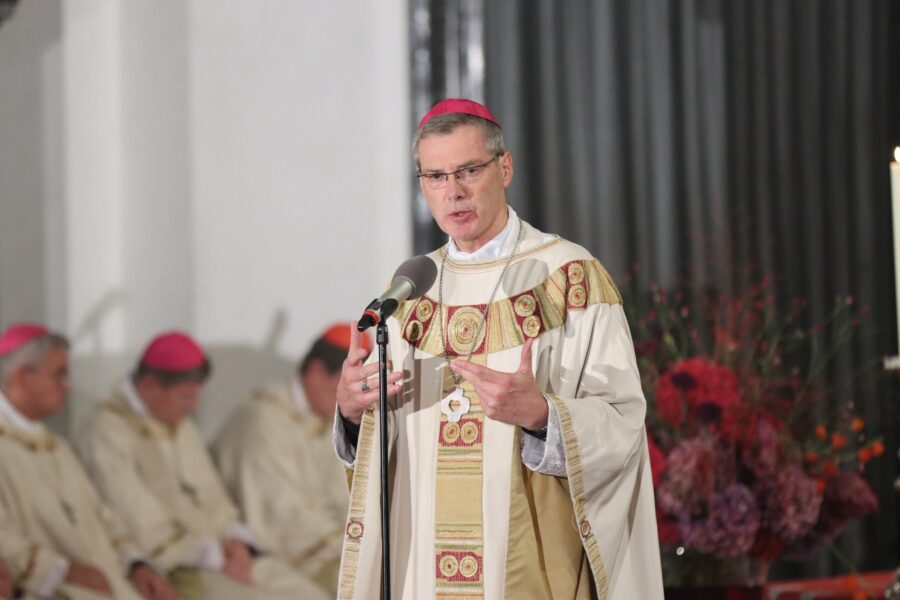
The president of the German Episcopal Conference, Heiner Wilmer, trusts that Rome will not block the Synodal Conference, the permanent body of bishops and laity that is to continue the Synodal Path, although he admits that the Holy See may introduce changes to its statutes. “I trust there will be no stop sign. That does not mean there cannot be adjustments here and there,” said the bishop of Münster in an interview with the German Catholic agency KNA, published on 19 November on katholisch.de and reported this Sunday by Vida Nueva. He added: “There will be no special German rules.”
The statutes of the Synodal Conference were approved in February by the plenary assembly of the German bishops and by the Central Committee of German Catholics (ZdK), and Wilmer himself delivered them to Rome at the end of March. Since then they have been awaiting the recognitio of the Holy See, without which they cannot be applied. Wilmer acknowledged that he himself does not know the outcome. “We are in conversation. I have heard that it is going through several dicasteries. The result is open, but I trust we will move forward,” he explained. In the same interview he maintained that the Church is already synodal and will be even more so.
The wait has already altered the calendar. The first meeting of the new body was scheduled for 6 and 7 November in Stuttgart, and in August Wilmer himself told the portal Kirche+Leben that he did not expect it to be held on that date because the matter was moving from one dicastery to another. According to that same report, the next session was set for April 2027 in Würzburg.
Asked about the participation of women, the president of the German episcopate stated that there are already many ways to involve baptized women and men in decision-making, in consultations and in the search for bishops, and summed up his criterion with a formula: “What affects everyone must be supported by everyone.”
The interview also addresses the meeting on marriage and family that Leo XIV convened in Rome in October with the presidents of the episcopal conferences, for which there is still no final document. Wilmer confessed that he was surprised by the weight given to the topic of convivenze, couples living together without being married, and defended addressing them with a different language: “We do not condemn you, but we accompany you on the path toward marriage.” Regarding the communion of divorced and remarried persons, the issue that opened chapter VIII of Amoris laetitia, he admitted that in Rome there were differing opinions and that the final text is not yet known. According to his perception, the prevailing idea was that good pastoral solutions are needed for people on the ground. He did not express his own position on access to communion for such couples and limited himself to praising pastoral agents who, he said, manage it well in parishes.
Much of the rest of the conversation focused on German politics. Regarding a possible ban on Alternative for Germany (AfD), Wilmer said it was not his place to comment and referred to the constitutional bodies. He clarified that the Church cannot dismiss a worker solely for belonging to a party, but that dismissal may be considered if someone publicly defends positions diametrically opposed to Christian conviction. He also spoke about pensions, the rise in child poverty and homelessness in Münster, and on the 1 % tax on assets over 100 million euros being debated in Germany he expressed support for considering a fairer distribution, but left the details to specialists.
Wilmer’s words extend the message he brought at the beginning of the month to Salzburg, before the Council of European Episcopal Conferences, where he assured that the German bishops do not want a path of their own that distances them from the universal Church. The decision on the statutes remains in the hands of the Roman Curia.
Read also
- Wilmer, president of the German bishops: “We do not want a specifically German path that distances us from the universal Church”
- Leo XIV returns to Rome with Germany, Amoris laetitia and the synodal reports on the table
- Marx acknowledges that in Germany one can be a bishop and support the ordination of women