


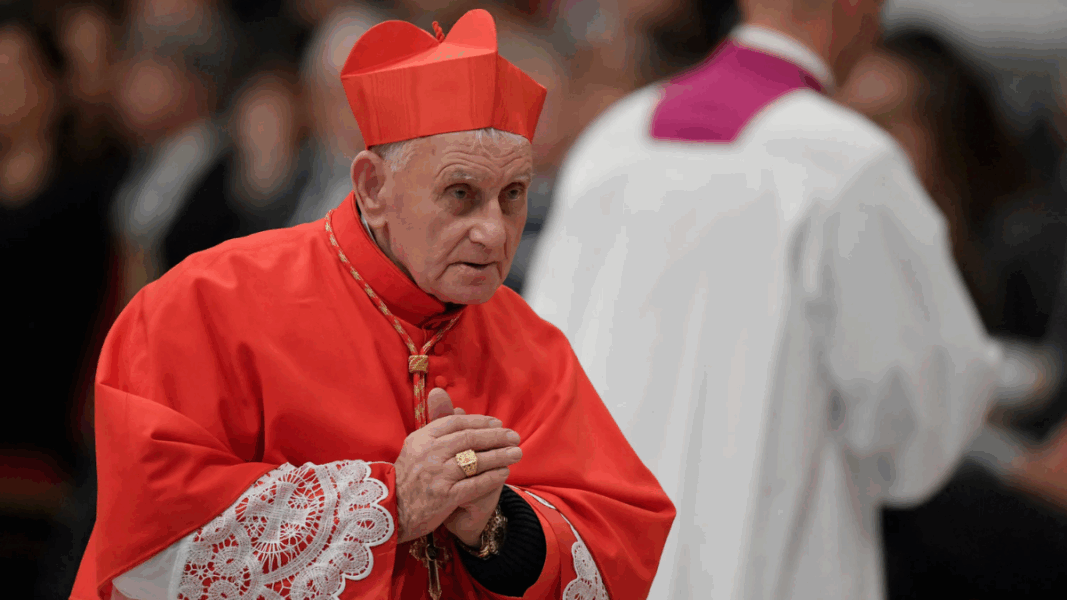
The Mass was celebrated on Tuesday, November 17 at the shrine of Saint Pio of Pietrelcina, in the Italian town of San Giovanni Rotondo (Apulia). At the conclusion of the celebration, Cardinal Ernest Simoni addressed the faithful and recited in Latin the exorcism against Satan and the apostate angels that Pope Leo XIII ordered to be published at the end of the 19th century.
The broadcast from Padre Pio TV, the Catholic channel based in San Giovanni Rotondo, captures shouts and other background sounds while the cardinal pronounces the text. According to EWTN News, the moment can be seen in the recording starting at minute 59:48. The clip has been widely shared on social media and has provoked very diverse reactions. So far, no official explanation has been provided regarding the origin of those noises.
A Prayer for Peace, the Pope, and the Authorities
Before beginning, Simoni invited those present to pray for peace in the world, for the Pope, and for the authorities. He then briefly explained the meaning of the prayer and presented it as a spiritual resource against the forces of evil. “It is the most powerful prayer for peace and for eliminating all satanic forces,” he stated, according to the EWTN News report.
The cardinal also linked the prayer to the request for protection for humanity against diseases, calamities, and wars, and recalled the role of Saint Michael the Archangel in spiritual combat. The text he recited is not the brief prayer to Saint Michael that many faithful know and that some priests recite at the end of Mass, but the considerably longer exorcism formula.
What is the Leo XIII Exorcism
The Exorcismus in Satanam et Angelos Apostaticos was published by order of Leo XIII in 1890 and later included in the Roman Ritual. It begins with an invocation to Saint Michael and, among its first formulas, includes a verse from Psalm 67 (68): “Let God arise, and let his enemies be scattered; let those who hate him flee from his presence.” The same Pontiff had added the prayer to Saint Michael in 1886 to the so-called Leonine prayers, which were recited after Low Mass.
It is a simple, deprecatory exorcism, not to be confused with the major exorcism over a possessed person. The latter, according to canon 1172 of the Code of Canon Law, may only be performed by a priest with the express permission of the diocesan bishop. In 1985, the then Congregation for the Doctrine of the Faith recalled in the letter Inde ab aliquot annis that the laity may not use this formula of Leo XIII.
Simoni has explained on other occasions that this is the prayer he usually uses. In 2018, during a course on exorcism and the prayer of deliverance at the Pontifical Athenaeum Regina Apostolorum, he recounted that he continues to use the Latin version of Leo XIII even though the ritual has been reformed since then.
Nor is this the first time he has recited it in public. On October 25, 2025, he recited it in Saint Peter’s Basilica, at the conclusion of the pontifical Mass in the traditional rite celebrated by Cardinal Raymond Burke on the occasion of the international pilgrimage Ad Petri Sedem.
The “Living Martyr” of Albania
Ernest Simoni Troshani was born in 1928 in Albania. Ordained a priest in 1956, he was arrested by the communist regime in December 1963 and sentenced to death, a sentence that was commuted to forced labor. He spent nearly two decades between prison and labor camps. After being released in 1981, he was still considered an “enemy of the people” and was forced to work in the sewers of Shkodër. Until the fall of the regime in 1990, he could only exercise his ministry in secret.
His testimony moved Pope Francis during the apostolic journey to Albania in September 2014. Two years later, the Pontiff created him a cardinal in the consistory of November 19, 2016. Since he had already turned eighty, he is not an elector in a conclave. The prayer in San Giovanni Rotondo took place two days before the tenth anniversary of his elevation to the cardinalate.