


On Thursday at 9:50, the news bulletin of «El Matí» on Ràdio Estel closed with a report on digital violence: nearly three out of ten young women have received unsolicited sexual content on social media, and one in four have received requests for intimate images they did not want. The station cited the author, the Fundació Ferrer i Guàrdia, and its conclusion: the foundation «calls for the inclusion of affective-sexual education in the digital environment from the earliest ages». Two comments were made on air. Màrius Carol, a regular Thursday contributor, said that «surely schools should do more and parents should keep a closer eye». Albert Cuesta, a technology journalist, went further: «I think the measure proposed by the entity that conducted this study is a good one». Which entity it was, no one said.
The study contains data worth knowing, and violence against young women on social media is a serious issue. It was conducted with 1,500 surveys of young people aged 18 to 35 across Spain, and nearly eight out of ten say they have suffered some form of digital violence. Among its recommendations are integrating the digital environment into affective-sexual education and addressing consent and egalitarian relationships «from an early age». What the archbishop’s radio station did not mention is who signed them.
The Fundació Francesc Ferrer i Guàrdia bears the name of the anarchist educator and freethinker who opened the Escuela Moderna in Barcelona in 1901 and was executed by firing squad in Montjuïc in October 1909, condemned as the instigator of the Tragic Week; the annulment of that sentence is today requested by the foundation itself. Ferrer was also a Freemason. He was initiated in 1883 in the Verdad lodge in Barcelona, reached the 31st degree in Paris in the Les Vrais Experts lodge, which expelled him in 1908, and after his death entered the pantheon of Masonic heroes.
The foundation has been active since 1987, and since 1987 it has been presided over by the same man: Joan Francesc Pont Clemente, professor of Financial and Tax Law at the University of Barcelona. According to his author profile on the Masonic publishing house, cited by ACI Prensa in May, Pont was initiated in 1984 in the Minerva-Lealtad No. 1 lodge of the Gran Logia Simbólica Española, served as deputy grand master of that obedience, was the founding worshipful master of the Pedra Tallada No. 70 lodge, and sovereign grand commander of the Supreme Masonic Council of Spain, a position that corresponds to the 33rd degree. That the foundation is a work of Freemasonry is maintained by historian Alberto Bárcena. What is on record is that its president has held the position since the first day and reached the highest level of his rite.
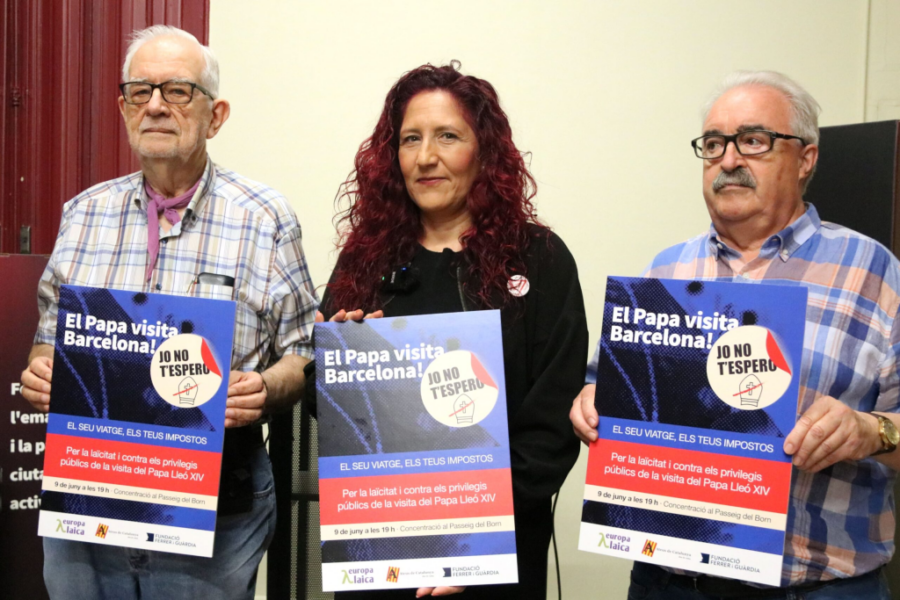
The foundation declares its commitment to «the promotion of secularism as a fundamental democratic principle», and it puts it into practice. In June, when Leo XIV came to Barcelona to bless the tower of Jesus Christ at the Sagrada Família, it led, together with Ateus de Catalunya and Europa Laica, the campaign «Jo no t’espero», I am not waiting for you. On June 9, the day of the Pope’s arrival, it called a demonstration in the Born, in front of Santa Maria del Mar, «for secularism and against the public privileges of the visit». Its director, Hungria Panadero, spoke of a «democratic anomaly»; the organisers called on the Government to repeal the agreements with the Holy See, and their manifesto, according to ACI Prensa, accused the Church of going against civil rights by opposing abortion and euthanasia. It was not the first time: in 2010 they did the same with Benedict XVI. The Pope’s host in Barcelona was Cardinal Omella, who presides over the foundation that owns Ràdio Estel.
The foundation that protested against public funding for the visit received, according to El Debate, nearly 700,000 euros in public funds in 2025 and 2.6 million since 2018. It publishes an annual report that aims to be «a yearbook of secularism», and among its recent headlines is this one: the Catholic Church «reaches a new record in public funding». Nor was it the first time it had appeared on the archbishop’s station: in 2024, according to its own website, one of its coordinators went to Ràdio Estel to speak about young people’s mental health.
The recipe endorsed by the archbishop’s radio station has doctrine against it. John Paul II wrote in Familiaris consortio that it is parents who are called to give their children «a clear and delicate sexual education»; that the school, when it collaborates, must observe «the principle of subsidiarity», «placing itself in the very spirit that animates parents»; and that education for chastity is «altogether indispensable». In the foundation’s recommendations, neither parents nor chastity appear. On the archbishop’s radio station, parents were mentioned in passing and chastity was not mentioned at all.
In June, the Fundació Ferrer i Guàrdia took to the streets to tell the Pope that it was not waiting for him. Five months later, on the archbishop’s radio station that welcomed him, it was indeed expected.
«Ràdio Estel, the archbishop’s radio station» is a daily section of InfoVaticana. We listen carefully to the radio station of the Archbishop of Barcelona and report what we find: advertising, guests, language, what is said and what is left unsaid. Ràdio Estel belongs to the Fundació Missatge Humà i Cristià, linked to the Archdiocese of Barcelona and presided over by its archbishop.
The Archbishop of Barcelona is responsible for what is broadcast on it.
Read also
- The radio station that inherits Vilà: «Vote PSC», a talk show against PP and Vox and not a word about abortion
- A report by a secularist foundation detects a rebound in practice among young Spanish Catholics
- The Supreme Council of the 33rd Degree brought its Freemasons together for three days in Poblet under Abbot Octavi Vilà