


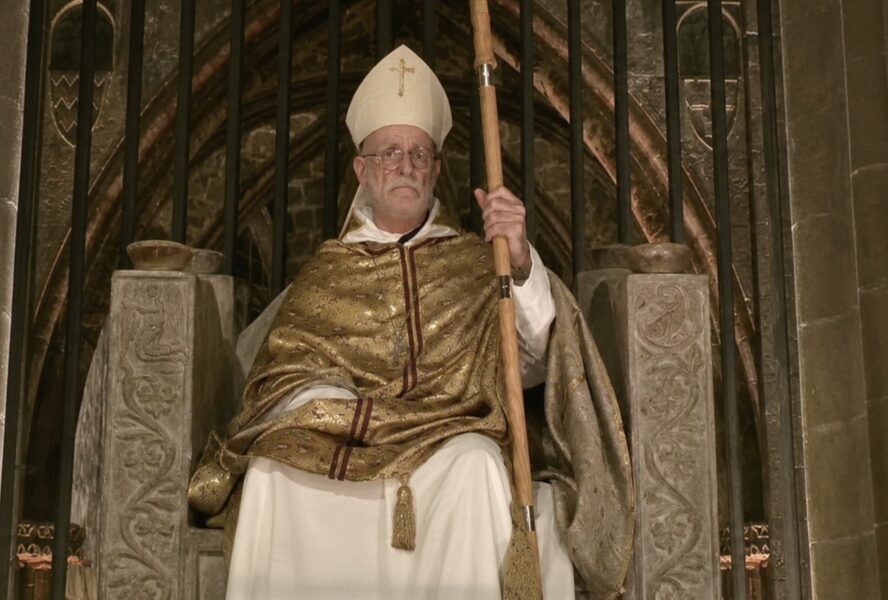
Octavi Vilà will take possession of the Archdiocese of Barcelona on December 19 and, with the see, will receive a radio station. It is called Ràdio Estel, its slogan is «Escoltant, sentiràs», listening you will hear, and we have listened to it: twenty-four hours on Wednesday, November 18, eleven days before the general elections. What follows is what was heard and what was not heard, and it is the first chapter of a section that from today will be daily.
The station belongs to the Fundació Missatge Humà i Cristià, linked to the Archdiocese of Barcelona, whose board is chaired by the archbishop, still Cardinal Omella. It has been directed since March 2025 by Òscar Martí, who also directs the weekly Catalunya Cristiana, and according to the EGM of 2025 it has around 22,000 daily listeners.
At 9:25, during the break before the morning talk show, the archbishop’s radio broadcast this: «We will not allow them to touch our pensions or cut the minimum wage. We defend our public healthcare and the right to decent housing. We fight against climate change and shout no to war. The hour of brave people. This is our strength, the strength of the people. Vote PSC». The spot aired again at 12:39, at 14:05 and at 17:05. At least four times, and it is legal: electoral law prohibits contracting electoral advertising on public media and private television, not on a private radio station. Throughout the day we did not find the spot of any other party.
The spot asks for votes for pensions, healthcare and the climate, and is silent on everything else. PSC deputies sit in the socialist group in Congress, the same one that passed the 2021 euthanasia law and the 2023 abortion reform, and Pedro Sánchez’s government sent to the Cortes in April the constitutional reform bill to enshrine abortion. One more fact. At ten-thirty at night the station identifies itself as follows: «Ràdio Estel, amb el suport de la Generalitat de Catalunya». The Generalitat is presided over by Salvador Illa, of the PSC. We are not saying that one thing explains the other. We are saying that they sound on the same frequency.
After the break, «Les claus del dia» began. The morning host, Mercè Raga, had announced the topic before the advertising: the European Union’s deportations to Rwanda and the migration crisis, because the day before «we did hear some more marked positioning from the Partido Popular and Vox». To analyze it, two guests. Tica Font, president of the Centre Delàs d’Estudis per la Pau, founded in 1999 within Justícia i Pau, and a biweekly contributor to the house. And Gonzalo Fanjul, from the porCausa foundation and ISGlobal, whom the station presented as «activist and expert on the subject». No one else. In more than twenty-five minutes, not a single voice in favor of a more restrictive migration policy was heard on air.
Raga framed the debate as «a competition» to see who applies «the hardest hand», and Font agreed. Fanjul saw in the center of Rwanda «a further step in the deconstruction of the rule of law in the European Union» and ruled that mass returns, «the kind of returns Vox was asking for, that the Partido Popular was asking for, are simply illegal». Font went further: «from the speeches I see here from Vox or the right, the ones who bother are those who are Islamic or Black». And she attributed to «the entire right» a program against the consensuses of the last eighty years on the State, democracy and human rights. It must be said, because it is true, that Fanjul introduced a nuance: the problem is not only of the right, the center-left also collaborates, and Pedro Sánchez, with his pro-immigration speech, seemed in European meetings «an extraterrestrial». He said it as praise.
Then came the ballot boxes. Asked how far we will go, Font replied that it depends on us, «not simply on how we will vote in these elections, but on what we will support». Fanjul insisted that this «is not a question of one party or another» and immediately named two: he said he had faith that the leaders of the Partido Popular would understand that letting themselves be carried away by «the populist drift of a party like Vox» leads them «to a point of no return». And he concluded: «That is why I hope that there will indeed be a social response in the vote and in any other sphere». He conceded that the feeling that the border is out of control, after what happened in Ceuta, is «very justified», but his recipe is «to create much less fearful societies». And he left listeners a practical piece of advice: the section «Tumba a tu cuñado» on his foundation’s website, «a kind of toolbox to face Christmas dinner».
Raga also asked why immigration is identified with crime. Font: «I think it is sought after, because statistically it is not true». Police statistics, she added, will not show a higher crime rate. The INE’s Statistics of the Convicted Population, which is judicial and not police, published in July the 2025 data: 70% of those convicted are Spanish, but the rate for foreigners, 15.3 per thousand adults, is 2.5 times that of Spaniards, which is 6.1. One can discuss how much of that difference is explained by the age and sex of each group; what cannot be said is that the figure does not exist. Raga then brought up the Pope: «What Pope Leo XIV has said resonates a lot with me». No one cited the Catechism. In its number 2241 it asks the more prosperous nations to welcome the foreigner to the extent possible and, in the same number, recognizes that the authorities «may subordinate the exercise of the right of immigration to various legal conditions» and that the immigrant is obliged «to obey their laws and contribute to their burdens». On the archbishop’s radio, half of it was heard.
The house’s language completes the picture. In the campaign report at quarter past eight, the station’s voice, not a candidate’s, twice called Vox the far right: «the far-right candidate Vox» and «the agreement with the far right of Vox». No left-wing party was given an equivalent adjective throughout the day. And when a recount confirmed a Democratic seat in the United States Senate, the ten and eleven o’clock bulletins reported it as «a new slap to Donald Trump, who sees how the progressive tsunami is imposed again». News, they will say. The house’s.
And what was not heard. In twenty-four hours of broadcasting, in the middle of the campaign, we did not hear the words abortion and euthanasia even once. The Church and the 29N coincided on air, as far as we could find, twice. About twenty seconds in the press review, citing Catalunya Cristiana, to report that the bishops were preparing a statement on the elections and that Argüello had warned of «the increase in aggressiveness and political and social polarization». And thirty-five seconds in the afternoon for a document on educational policy that a Church body in education has sent to the parties. No Catalan bishop said a word on air about the elections. The Spanish bishops’ note, by the way, did not reach two-thirds in the Plenary, according to this medium, and it did not mention abortion either. The science section, on the other hand, opened with a survey according to which 70% of those surveyed are considering not voting for a politician who does not act against climate change, and the host asked the popularizer what question we should ask ourselves «now that we have the elections». Climate and immigration, as voting criteria. The life of the unborn and that of the sick, not mentioned.
This is the radio that Vilà receives. It has Mass from the cathedral, news of the Pope and prayers, and all that already fits in Ànima Estel, the house’s online channel, which is advertised with «social and religious programming 24 hours a day». The rest is what we have just recounted. Given what we have seen, almost the best thing the new archbishop can do with the station is to dismantle it. While he decides, we will listen to it every day and report the most striking. The house’s slogan promises that by listening one hears. The Lord said it before, and better: «He who has ears to hear, let him hear».
«Ràdio Estel, the archbishop’s radio» is a daily section of InfoVaticana. We listen attentively to the radio of the Archbishop of Barcelona and tell you what we find: advertising, guests, language, what is said and what is kept silent. Ràdio Estel belongs to the Fundació Missatge Humà i Cristià, linked to the Archdiocese of Barcelona and presided over by its archbishop.
The Archbishop of Barcelona is responsible for what is heard on it.
Read also