


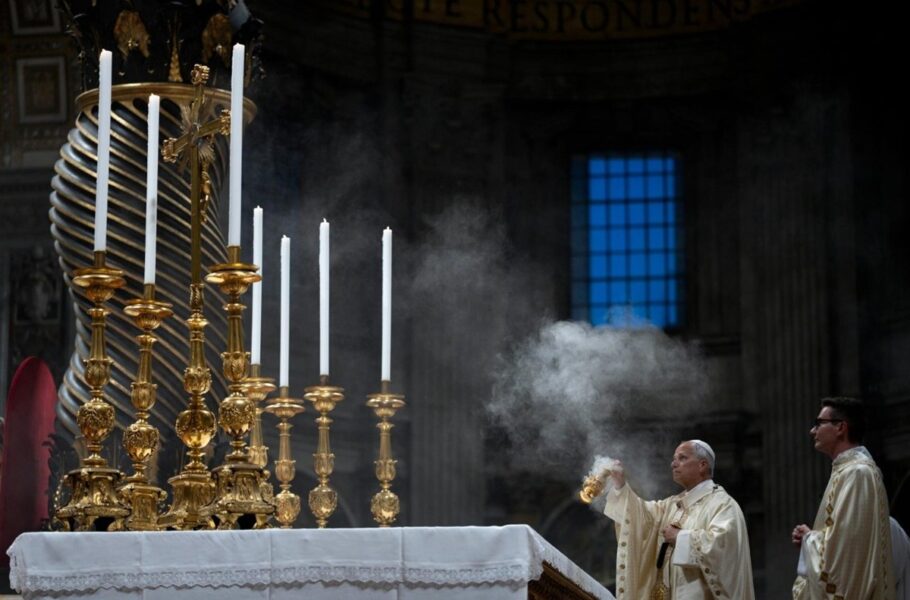
Pope Leo XIV presided this Wednesday at the Vatican Basilica over the Holy Mass for the fourth centenary of its dedication, which Pope Urban VIII carried out on November 18, 1626. The Pontiff recalled that the remains of that Pope rest “precisely here, beside the Apostle’s chair.” He opened the homily with a question to the faithful: what do they experience upon entering the temple. According to him, the awe before the art and history rests upon “a poor tomb: that of the Fisherman of Galilee, Simon son of Jonah.”
A basilica built upon Peter’s faith
The Pope began from the Gospel of Matthew proclaimed at the celebration (Mt 16:13-19) and affirmed that the entire building, “in each of its elements, is at the service of a single reality: faith. The faith of Peter, the Catholic faith, our faith.” He recalled that the phrase “You are Peter and on this rock I will build my Church” runs in Latin and Greek along the upper frieze of the basilica. He then quoted Saint Leo the Great: “As what Peter believed in Christ remains, so what Christ instituted in the person of Peter remains.”
Leo XIV linked that confession to “the constant apostolic succession, the living Tradition of the Church, which has Jesus himself as its principle and criterion.” Speaking of the Petrine ministry, he cited three predecessors: Francis (Christus vivit), Benedict XVI (Spe salvi), and Saint John Paul II, with the homily from the beginning of his pontificate on October 22, 1978.
The Eucharist, “the greatest masterpiece”
The Pontiff reviewed the history of the place: the first basilica erected by Constantine over the apostle’s tomb, the altar consecrated by Clement VIII and still used today, and the early-sixteenth-century reconstruction involving Bramante, Raphael, and Michelangelo. He stressed that the new temple arose “on the same foundation” and that its architectural history reflects that of the Church as “a living organism, the Body of Christ.” As evidence, he cited the two ecumenical councils held there, Vatican I and Vatican II, “which together give us the words of faith that must be proclaimed in every corner of the world.”
The heart of the homily was eucharistic. For the Pope, the most important event that takes place in Saint Peter’s is the celebration of Mass, and the Sacrament “is the greatest masterpiece that can be contemplated, whether in Saint Peter’s or in the smallest church in the world.” Before the consecration, he invited the faithful to fix their gaze on “the Lamb who was slain and is risen,” a gesture in which, he said, “the whole Church converges.”
Commenting on the promise that the powers of the abyss will not prevail against the Church, Leo XIV listed: “war does not prevail while we proclaim peace; misery does not predominate while we bear witness to charity; error does not triumph while we teach the truth.” He added that despair will not prevail either while salvation is proclaimed “to all in the name of Jesus.”
Change of leadership at the Basilica
In the opening part of the homily, the Pope warmly thanked Cardinal Mauro Gambetti for his service as archpriest and president of the Fabric of Saint Peter, and welcomed Monsignor Vittorio Viola. The Franciscan Vittorio Francesco Viola was appointed on October 10 as the Pope’s vicar general for Vatican City, archpriest of the basilica, and president of the Fabric of Saint Peter. With him, the period of Gambetti comes to an end, a period this medium has closely followed because of the profanations of the high altar and the tensions with the Vatican Chapter.
The homily ended with an invitation addressed to those who contemplate the portals and balconies of the temple: “Come, enter, enjoy!” In a word, “Believe!”, not because of the stones, “which time inexorably wears away,” but because of the faith that shines in them. The Pope interpreted the line of measurements of the great churches that runs across the floor of the central nave as “proof and memory of Catholic hospitality.”
The Our Father in Latin
During the Mass, Leo XIV led the thousands of faithful present in singing the Our Father in Latin, a moment that the CatholicSat network highlighted on its social media. Professor Peter Kwasniewski, for his part, wrote on X that he hopes the basilica will see “the restoration of the Roman rite, and especially of the solemn papal rite, within its venerable walls.”
InfoVaticana had already reported on the announcement of this Mass and reviewed the liturgy with which Urban VIII inaugurated the basilica four centuries ago.
We transcribe the full text of the homily:
IV CENTENARY OF THE DEDICATION OF SAINT PETER’S BASILICA
HOMILY OF THE HOLY FATHER LEO XIV
Saint Peter’s Basilica
Wednesday, 18 November 2026
________________________________________
Dear brothers and sisters:
The feast that brings us together today with joy poses a question to each one of us: What have we experienced upon entering Saint Peter’s Basilica? Visiting this majestic temple always awakens emotion: we are overcome by the awe produced by the sacredness of faith, by the power of history, by the beauty of art. Yet all of this rests upon a poor tomb: that of the Fisherman of Galilee, Simon son of Jonah. Why has this burial place become one of the most celebrated monuments in the world, at the heart of Catholicism? The Gospel of Matthew we have heard (Mt 16:13-19) answers us, recounting the faith of a man who becomes a new creature by the will of Jesus, his Master and Lord. This narrative also sets our hearts on fire today in the solemn Eucharist we celebrate for the fourth centenary of the Dedication of the Vatican Basilica, carried out on 18 November 1626 by Pope Urban VIII, whose remains rest precisely here, beside the Apostle’s chair.
That prayer transcends the centuries, clearly indicating to us the meaning and value of the work of art that welcomes us, and which the Holy See has preserved with special care, also through the work of the Fabric of Saint Peter. I gladly take this opportunity to thank His Eminence Cardinal Mauro Gambetti warmly for the service he has rendered as Archpriest and President of the Fabric, and to welcome His Excellency Monsignor Vittorio Viola.
Indeed, this entire building, in each of its elements, is at the service of a single reality: faith. The faith of Peter, the Catholic faith, our faith. Therefore, the whole Basilica evokes the question Christ asked his disciples: “But who do you say that I am?” (Mt 16:15). Listening to the words of Jesus, we who come from different countries are taken by the hand by Saint Peter to profess together the truth that saves us: Lord, “You are the Messiah, the Son of the living God!” (Mt 16:16). This is the confessio Petri, that is, the truth he witnessed together with the Roman martyrs: a confession that fertilized the soil of the Vatican hill, so that it might bear fruits of holiness throughout the centuries.
Today, dear brothers, this fruit is ourselves, living stones, a temple of the Holy Spirit built on the foundation of Christ; while, throughout the centuries, this is the constant apostolic succession, the living Tradition of the Church, which has Jesus himself as its principle and criterion. Therefore, the Lord’s words are engraved, in Latin and Greek, along the entire upper frieze of the Basilica: “You are Peter, and on this rock I will build my Church” (Mt 16:18). Meditating on them, Saint Leo the Great exclaimed: “As what Peter believed in Christ remains, so what Christ instituted in the person of Peter remains” (De Natale ipsius, III), that is, a ministry at the service of the whole Church, for the salvation of the world. Therefore, it is not simply an event of the past: like Simon of Galilee, each one of us is called to discover his own mission in dialogue with Jesus.
Continuing this same dialogue, the Lord will ask his apostle: “Do you love me?” (Jn 21:17). Do you love me? A question that beats in the heart of every Pontiff, as my Predecessors have recognized, because “the mission Peter receives to tend his sheep and lambs will always be connected with this gratuitous love, with this love of friendship” (Francis, Post-Synodal Apostolic Exhortation Christus vivit, 250). For Simon Peter, as for every disciple of Jesus, the experience of faith is inseparable from friendship with Him, recognized as true God precisely through his humanity. The new name Simon receives bears witness to how “life in its true sense is not something one has only for oneself, nor only by oneself: it is a relationship. And the whole of life is a relationship with the one who is the source of life” (Benedict XVI, Encyclical Letter Spe salvi, 27).
In this relationship with Jesus, made of listening and trust, of falling and redemption, Peter asks: “Lord, to whom shall we go? You have the words of eternal life!” (Jn 6:68). This is the faith in which we share: to recognize Jesus as Lord and Master means to find the truth about ourselves, because “Christ knows ‘what is in man.’ Only He knows it!” (Saint John Paul II, Homily at the Solemn Beginning of the Petrine Ministry, 22 October 1978). Within us, in our inner temple, Jesus pronounces the word of salvation together with our name. And the Basilica that welcomes us today is, in some way, a sign of the sacred space of conscience, in which faith vibrates, maturing in friendship with the Lord and in service to the Church, even to the point of martyrdom.
For this reason, the tomb of Saint Peter has been for all of us a place of faith and a memorial of redemption, from the time of the ancient Roman necropolis and in all subsequent ages. Indeed, the Emperor Constantine built a first basilica over the apostle’s tomb; in that temple, Pope Clement VIII consecrated the altar at which we still celebrate the divine mysteries today. At the beginning of the sixteenth century, Constantine’s building needed complete renovation. Then a project was conceived that involved the brightest minds of the time, men of talent and artists such as Bramante, Raphael, and Michelangelo. Together with them, today we remember all those who contributed to the construction of this temple, giving glory to God with their abilities, their labors, and their goods: the house we inhabit is truly an ecclesial work! The new basilica arose, therefore, on the same foundation: the architectural history of Saint Peter’s reflects the history of the faith celebrated there, that is, the history of the Church as a living organism, the Body of Christ. A special sign of this are the ecumenical councils gathered here: Vatican I and Vatican II, which together give us the words of faith that must be proclaimed in every corner of the world.
At the center and foundation of this mission is always the cornerstone: Christ crucified and risen. He is the foundation rejected by the powerful of this world, who for the peoples remains a “chosen and precious cornerstone, and whoever believes in him will not be put to shame” (1 Pt 2:6; Is 28:16). In this sense, the new name of Peter manifests the apostle’s assimilation to Christ, his communion of life with Him even to the cross. The Dedication of the Basilica, which we commemorate today, seals this correspondence: it is a solemn act that concerns us all, because the life of Jesus always dwells in this temple, precisely in the most important event that takes place here: the eucharistic celebration.
This Sacrament is the greatest masterpiece that can be contemplated, whether in Saint Peter’s or in the smallest church in the world. In the Eucharist, Jesus is always our contemporary; truly, He is Emmanuel, the Lord of history who dwells in the “House of prayer for all peoples” (Is 56:7). Shortly, at the moment of the consecration of the bread and wine, our gaze and our hearts will be centered on the Lamb who was slain and is risen: the whole Church converges in that gesture. And to bear witness to Him, the Son of the living God, this splendid Basilica was built. The Church exists and walks through history to serve Him, present in every man and woman. Against her, “the powers of the abyss will not prevail” (Mt 16:18): war does not prevail while we proclaim peace; misery does not predominate while we bear witness to charity; error does not triumph while we teach the truth. Despair will not prevail while we proclaim salvation to all in the name of Jesus.
This is our mission, the same one Saint Peter received on the shores of the Sea of Galilee and which is transmitted to his successors, until the end of time, according to a precise mandate of charity: “Feed my sheep” (Jn 21:17). To carry out this ministry, those who preceded us in the faith carved the Gospel into history, even before carving it in marble: the beauty of this apostolic work calls us all to holiness of life, to continue it with fervor.
Dear brothers, let us contemplate the wide portals, arches, balconies, and windows of the Basilica, which opens to the Square and to the world with a universal invitation: “Come, enter, enjoy!” In a word: “Believe!” Believe not because of the beautiful stones (cf. Lk 21:5), which time inexorably wears away, but because of the faith that shines in them, a reflection and reminder of the spiritual building that is the Body of Christ. The vastness of the Vatican Basilica thus reflects a perennial vocation of welcome, so that the greatest number of people may find a place in the Church. In this sense, we can interpret that line of measurements of the great churches that runs across the floor of the central nave: it is proof and memory of Catholic hospitality, which finds its synthesis here in Rome, as a sign of hope for the whole world.