


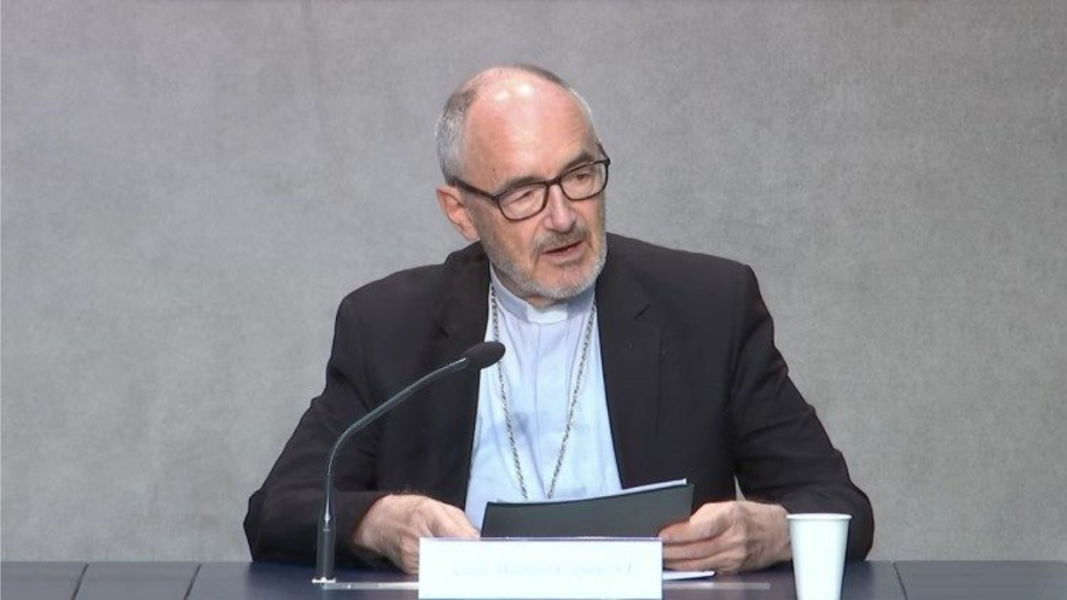
Cardinal Michael Czerny, prefecto of the Dicastery for the Service of Integral Human Development, presented the encyclical Magnifica humanitas by Leo XIV on November 17 in Sofia at an event jointly organized by the Bulgarian Academy of Sciences and the Apostolic Nunciature in Bulgaria. According to Vatican News, the cardinal focused his remarks on war and peace, explaining that the Pope considers the theory of “just war” to be outdated.
Czerny warned that the expression is frequently used loosely to justify aggression, at a time when weapons are more destructive than ever. He clarified that Leo XIV upholds the right to legitimate defense “in the strictest sense” and that, in contrast to the logic of war, he points to the path of dialogue, diplomacy, and forgiveness.
“Humans must remain responsible” for the violence unleashed by their technologies
A large part of the talk was devoted to artificial intelligence applied to armed conflicts. “Humans must remain directly responsible for all the violence and destruction unleashed by their technologies,” the cardinal stated, adding that decisions on the use of lethal force must remain in human hands and that it must always be possible to identify who made them.
Czerny also outlined the three criteria that, he explained, the Pope proposes. The first is responsibility: the chain of command, from those who design and train a system to those who authorize and use it, must be identifiable and verifiable. The second is time for judgment, because those who decide on the use of lethal force need room to assess, and speed or efficiency cannot dictate an irreversible decision. The third is the protection of civilians, who must be distinguished from combatants, as well as from the infrastructure they need to survive.
The cardinal also drew on the biblical image of two works: “The difference between Babel and Jerusalem lies in the desire that guides the act of building.” In his view, the underlying question is “what kind of world, what kind of civilization, these tools help to build.” He concluded that “the roots of both war and peace lie within” each person, so everyone must calm the aggression in their own heart.
Vatican News also published a Spanish version of the address, titled “AI does not eliminate inhumanity in armed conflicts,” which emphasizes that human responsibility cannot be transferred to the machine and warns of the “worrying return of war” and resignation in the face of the supposed inevitability of conflicts.
An open debate since the publication of the encyclical
The question of just war has been open since the document appeared in May. InfoVaticana already noted at the time that the phrase “there is no just war,” which some headlines attributed to the Pope, does not appear in the encyclical. Czerny had already said at the Vatican presentation of the text that he preferred to speak of “just defense” rather than just war.
Eight days ago, Cardinal Pietro Gallagher, secretary for Relations with States, defended the doctrine of just war against a “dangerous pacifism”. Czerny’s words in Sofia, therefore, add to a debate in which various officials of the Curia have expressed different approaches to a classic point of Catholic moral teaching.