


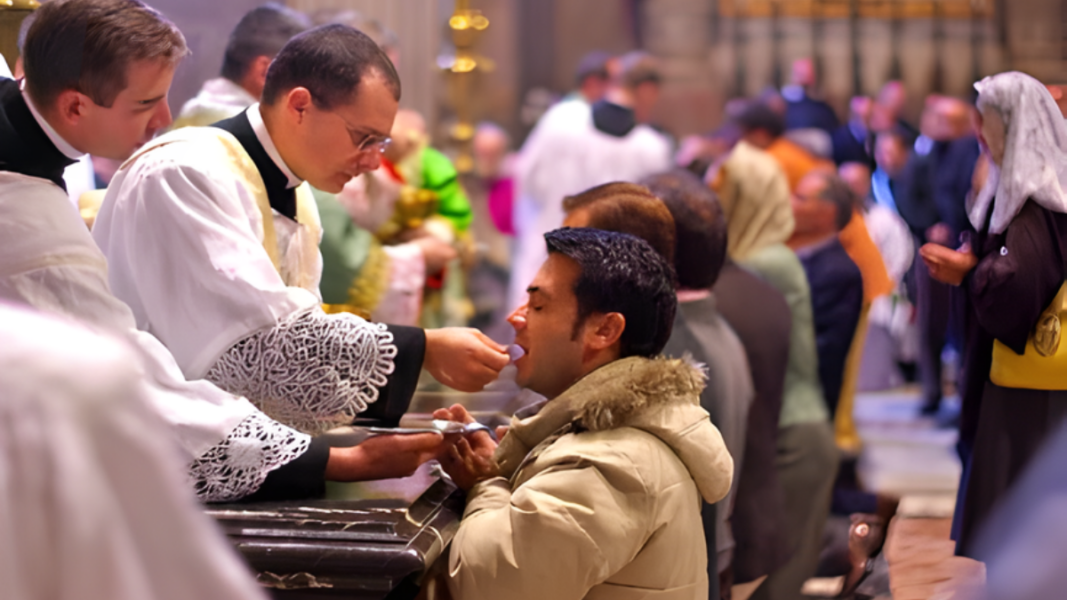
According to the portal AdVaticanum, the Dicastery for Divine Worship and the Discipline of the Sacraments has rejected a hierarchical recourse against the application of the norms issued by Bishop Michael Martin, which since January 16 prohibit the use of communion rails, kneelers, and similar structures for distributing Communion in the Diocese of Charlotte (North Carolina). The decision bears protocol number 482/26 and is dated August 3, 2026. It responds to the recourse of a faithful who denounced the “alleged repeated denial” of Holy Communion to him and his family. According to AdVaticanum, that family approached to receive Communion kneeling at the communion rail.
The three-page letter is signed by Archbishop Vittorio Francesco Viola, OFM, who at the time was secretary of the dicastery, and a head of office. On October 10, Leo XIV appointed Viola archpriest of St. Peter’s Basilica, vicar general for Vatican City, and president of the Fabric of St. Peter. To succeed him at Divine Worship, he appointed the Spaniard Aurelio García Macías.
The dicastery states that it has carefully examined the recourse, presented in accordance with canon 1737 §2, together with the documentation provided and the applicable universal and particular liturgical norms, and finds “no grounds to uphold the recourse.” The letter also recalls that Divine Worship had previously examined the provisions of the Bishop of Charlotte. According to the text, those norms neither deny the faithful access to the Eucharist nor prohibit receiving Communion kneeling, which remains permitted under the discipline currently in force in the United States.
The dicastery also rejects the petitioner’s request to suspend the diocesan provisions while the recourse was being resolved. It argues that the necessary legal conditions for such a measure have not been demonstrated.
Kneeling yes; the communion rail, no
The reasoning rests on distinguishing between the right to receive Communion and the regulation of the external manner in which it is distributed. According to the letter, the main argument of the recourse appears to be based on the assumption that the right of the faithful to receive Communion necessarily includes the right to individually determine the place and manner in which they present themselves to receive the sacrament during Mass. “Such an interpretation cannot be sustained,” the dicastery responds.
The text acknowledges that, according to canons 843 §1 and 912, sacred ministers may not deny the sacraments to those who request them opportunely, are properly disposed, and are not prohibited by law from receiving them. It adds, however, that these provisions cannot be interpreted in isolation. It recalls that the second paragraph of canon 843 provides that the faithful are to be prepared to receive the sacraments through evangelization and catechesis, in accordance with the norms of the competent ecclesiastical authority. From this it concludes that the right to receive the sacraments is exercised within the legitimately established liturgical discipline and does not confer an unlimited faculty to disregard its norms.
For this reason, the dicastery does not consider that the circumstances described constitute a denial of Holy Communion in the legal sense of canons 843 §1 and 912. According to the letter, the documentation indicates that the family could receive Communion according to the manner established in the diocese. The fact that the minister did not give it to them when they chose to present themselves “in a place or in a manner different” from that prescribed by the diocesan norms cannot be interpreted, it concludes, as an illegitimate refusal to administer the sacrament.
The letter leaves the kneeling posture intact. There would indeed be a true denial of Communion, it explains, if a faithful person who presents himself according to the established manner of distribution were denied the sacrament solely for kneeling to receive it. But it clarifies that this is not the situation raised in the recourse.
The bishop, “moderator, promoter, and custodian” of the liturgy
Viola grounds the bishop’s competence in canons 381 §1 and 838 §4, concerning the power of the diocesan bishop and his competence to issue norms in liturgical matters. The letter presents him as “moderator, promoter, and custodian” of the liturgical life entrusted to his care and affirms that regulating the use of communion rails, kneelers, and similar structures falls within his competence and pastoral responsibility.
The dicastery maintains that the discipline of the Church has consistently recognized the power of the competent authority to regulate the external manner of receiving Communion, for the sake of good order and ecclesial communion. To support this, it cites two texts. The first is number 34 of the instruction Eucharisticum Mysterium, which exhorts the faithful to willingly adopt the manner of receiving Communion indicated by their pastors, so that Communion may manifest the unity of those who gather around the Lord’s table. The second is number 42 of the General Instruction of the Roman Missal, which presents the common posture of all participants as a sign of the unity of the community gathered for the liturgy.
The conclusion is that every faithful person retains the right to receive Communion and cannot be denied the sacrament solely for receiving it kneeling, but that there is no subjective right to demand that Communion be distributed with furniture or arrangements that are not in accordance with the legitimately established discipline. The dicastery considers that the recourse has not demonstrated the violation of a protected subjective right nor that the diocesan norms or their application constitute an illegitimate denial of Communion, and rejects it.
Norms contested from the first day
Martin, a Conventual Franciscan, took possession of the see of Charlotte in May 2024. On December 17, 2025, he signed the pastoral letter with the new norms. According to AdVaticanum, the text confirmed that in the United States the usual posture is to receive Communion standing, after a bow, and provided that communion rails, kneelers, and similar structures not be used in public liturgical celebrations. Temporary or movable supports for kneeling were to be removed before the date set in January. In general, it was not necessary to remove fixed communion rails, but they could not be used to distribute Communion.
The norms met resistance from part of the diocesan clergy. In early January, 31 priests sent a series of dubia to the Dicastery for Legislative Texts asking whether the bishop had the authority to prohibit the use of communion rails and kneelers for those who wish to receive Communion kneeling.
According to AdVaticanum, the resolution comes after a formal request was addressed on June 20 to the prefect of the dicastery, Cardinal Arthur Roche. It stated that the petitioner, his wife, and their two children had repeatedly been left without receiving Communion at the parish of Our Lady of Grace in Greensboro after kneeling at the communion rail.
The avenues that remain open
With the recourse rejected, the family could, in theory, appeal to the Supreme Tribunal of the Apostolic Signatura. AdVaticanum explains that, according to article 197 of Praedicate Evangelium and the Lex propria of that tribunal, the Signatura may examine whether a dicastery has violated the law in its decision or in the procedure followed. The same source specifies that the deadline is 60 days from the formal notification of the decision, not from the date appearing on the letter.
AdVaticanum also points out a canonical difficulty. Canon 1737 regulates hierarchical recourse against a singular administrative act, and in its view it is not clear that a minister passing over a family at the communion rail constitutes such an act. Nevertheless, the dicastery examined the substance of the complaint. The source adds that, if what is really being questioned is the legality of the diocesan norms, which are a general decree, the competent body would be the Dicastery for Legislative Texts, in accordance with article 181 of Praedicate Evangelium.
For AdVaticanum, the resolution contains a possible inconsistency: if receiving Communion kneeling is legitimate, its legitimacy should not depend on whether it is done in the line or at the communion rail. In its view, restricting an established practice may aggravate the tensions about which the dicastery itself has warned.
We attach a complete and original translation of the response from Divine Worship:
DICASTERY FOR DIVINE WORSHIP AND THE DISCIPLINE OF THE SACRAMENTS
Prot. N. 482/26
Vatican City, August 3, 2026
Dear [name redacted]:
The Dicastery for Divine Worship and the Discipline of the Sacraments has carefully examined the hierarchical recourse you submitted in accordance with can. 1737 §2 of the CIC concerning the alleged repeated denial of Holy Communion in the Diocese of Charlotte.
After considering the petition together with the documentation submitted, and after carefully reviewing the applicable universal and particular liturgical norms, this Dicastery finds no grounds to uphold the recourse.
First of all, it should be recalled that this Dicastery has already examined the diocesan provisions issued by the Bishop of Charlotte regarding the reception of Holy Communion. As previously noted, those provisions neither deny the faithful access to the Sacrament of the Most Holy Eucharist nor prohibit receiving Holy Communion kneeling, which remains permitted under the universal and particular liturgical discipline currently in force in the United States of America.
The norms established by the diocesan Bishop, on the other hand, concern the regulation of the external manner in which Holy Communion is distributed within the public liturgical celebration, including the use of communion rails, kneelers, and similar structures. Such determinations fall within the competence and pastoral responsibility of the diocesan Bishop, who, as moderator, promoter, and custodian of the liturgical life entrusted to his care, is competent to regulate these matters according to law (cf. cann. 381 §1 and 838 §4 CIC).
The principal argument set forth in your recourse appears to rest on the assumption that the right of the faithful to receive Holy Communion necessarily includes the right to determine individually the place and manner in which they present themselves to receive the Sacrament during the celebration of Mass. However, such an interpretation cannot be sustained.
Certainly, canons 843 §1 and 912 establish that sacred ministers may not deny the sacraments to those who request them opportunely, are properly disposed, and are not prohibited by law from receiving them. Nevertheless, these provisions cannot be interpreted in isolation. The same canon 843 also provides, in its second paragraph, that the faithful are to be prepared to receive the sacraments through proper evangelization and catechetical instruction, in accordance with the norms given by the competent ecclesiastical authority. Therefore, the right of the faithful to receive the sacraments is exercised within the legitimately established liturgical discipline of the Church and cannot be understood as conferring an unlimited faculty to disregard the norms governing the orderly celebration of the sacred liturgy.
For this reason, this Dicastery cannot conclude that the circumstances described in your petition constitute a denial of Holy Communion in the legal sense contemplated by canons 843 §1 and 912. Rather, the documentation indicates that the possibility of receiving Holy Communion remained available according to the manner established for the liturgical celebration in the diocese. The fact that the minister did not distribute Holy Communion to you and your family when you chose to present yourselves in a place or in a manner different from that prescribed by the diocesan norms cannot be interpreted as an illegitimate refusal to administer the Sacrament.
Indeed, a true denial of Holy Communion would occur if a faithful person who presented himself according to the established manner of distribution were denied the Sacrament solely because he chose to kneel at the moment of receiving it. However, this is not the situation raised in the present recourse.
Likewise, the Dicastery recalls that the liturgical discipline of the Church has consistently recognized the power of the competent ecclesiastical authority to regulate the external manner of receiving Holy Communion for the sake of good order and ecclesial communion. As the Instruction Eucharisticum Mysterium (n. 34) states, the faithful are exhorted to willingly adopt the manner indicated by their pastors, so that Holy Communion may truly manifest the unity of those who gather around the one table of the Lord. Likewise, the General Instruction of the Roman Missal teaches that a common posture observed by all participants is in itself a sign of the unity of the Christian community gathered for the sacred liturgy (cf. GIRM, n. 42).
Consequently, while every faithful person retains the right to receive Holy Communion and cannot be denied the Sacrament solely because he receives it kneeling, there is no corresponding subjective right to demand that Holy Communion be distributed by means of certain liturgical furnishings or arrangements that are not in accordance with the legitimately established discipline of the competent ecclesiastical authority.
For these reasons, this Dicastery concludes that the recourse has not demonstrated the violation of a protected subjective right arising from the impugned acts, nor has it established that the diocesan norms or their application constitute an illegitimate denial of Holy Communion.
Likewise, the request for suspension of the diocesan provisions pending resolution of the recourse cannot be granted, since it has not been demonstrated that the legal conditions required for such a measure are met.
Therefore, the present hierarchical recourse is rejected.
With my best wishes, I remain yours,
Yours affectionately in Christ,
[Seal of the Dicastery]
[Signature] ✠ Vittorio Francesco Viola, O.F.M.
Archbishop Secretary
[Signature] Head of Office