


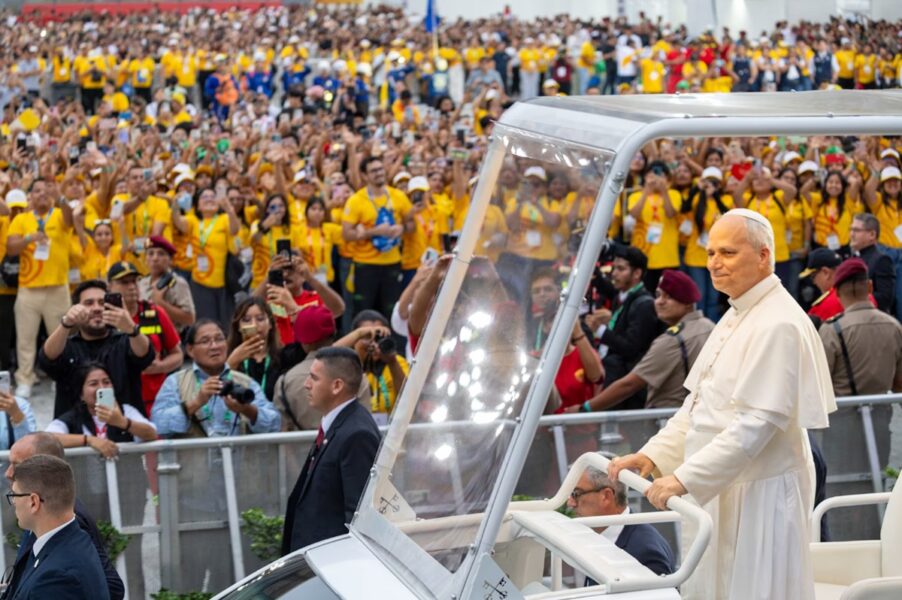
Vatican analysts Matteo Matzuzzi, from Il Foglio, and Franca Giansoldati, from Il Messaggero, have devoted their latest analyses to the crowds accompanying Leo XIV on his trip through Uruguay, Argentina, and Peru. Both agree in highlighting the Pope’s ability to draw millions of people, though each interprets it from a different angle: the religious one in Matzuzzi’s case, and the political one in Giansoldati’s.
Matzuzzi describes in Il Foglio “millions of faithful of all ages in the streets to see and listen to the Pope.” According to the journalist, amid tears, songs, and shouts, “Leo the missionary wins over the crowds by speaking of Christ,” and he sums it up with a phrase that gives the title to his analysis: “It is the program of the pontificate.”
A popular force that no political leader can match
For her part, Giansoldati writes in Il Messaggero a chronicle from Chiclayo, titled “Leo XIV and the oceanic crowds, a popular force that no political leader can match.” The Vatican analyst argues that the ability to mobilize the masses is becoming one of the most significant elements of the pontificate, also on the international level, and that it is a phenomenon governments are watching closely. In her text, she also recounts that Peruvian television follows the Pope as if it were a World Cup final and that, the day before, at the meeting with young people in the Lima stadium, Leo XIV was moved to tears.
A twelve-day trip nearing its end
The trip, the longest of the pontificate, began on November 6 in Montevideo and will continue until November 17, with stops in Uruguay, Argentina, and Peru. In Peru, the Pope returns to a country where he lived for more than twenty years, first as a missionary and later as bishop of Chiclayo, and to which he arrived saying: “I also return to my homeland,” as reported by InfoVaticana.
Attendance has been one of the hallmarks of the trip from the beginning, and InfoVaticana already reported on the balance of the Argentine stage in Leo XIV bids farewell to Argentina with record numbers and unanswered requests: Traditional Mass, Tucho, and victims, which detailed the attendance figures and the requests left unanswered by the trip. The two readings, Matzuzzi’s and Giansoldati’s, thus portray the same phenomenon from two perspectives: for the former, the reason for the gathering is the proclamation of Christ; for the latter, the result is a popular force that no political leader can match and that governments are following closely.