


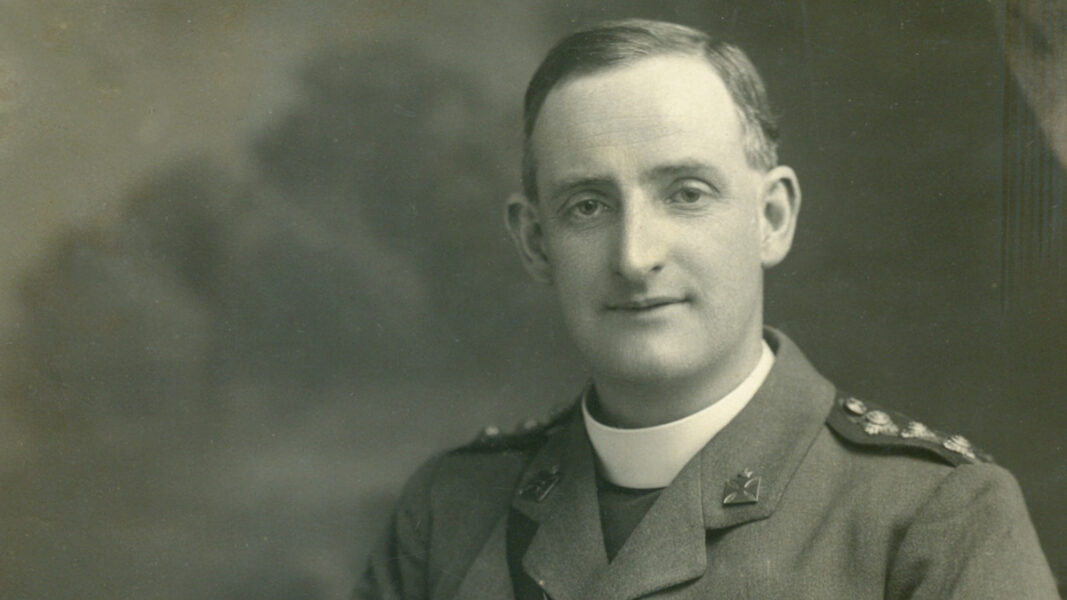
The cause of canonization of the Servant of God Willie Doyle, Jesuit priest and military chaplain killed in the First World War, has officially entered its Roman phase, after the documentation gathered during the diocesan stage was formally presented to the Dicastery for the Causes of Saints. The Irish diocese of Meath, which opened the process in 2022, had closed it on October 18, 2026.
According to the diocese, this is the first time in more than forty years that a cause of canonization of an Irish candidate has completed its diocesan phase in Ireland. The last one had been that of the Venerable Nano Nagle, foundress of the Sisters of the Presentation. The diocese’s page dedicated to Doyle specifies that the acts were copied in two sets, the official transcript and the public copy, which travel to Rome, while the original remains sealed in the diocesan archives.
A new postulator and a vice-postulator in Meath
With the change of phase, Jesuit Pascual Cebollada, general postulator of the Society of Jesus, will assume the role of postulator of the cause. Father John Hogan, of the diocese of Meath, will be the vice-postulator. The Bishop of Meath, Tom Deenihan, expressed in a statement his satisfaction with the stage reached: “I am pleased that the cause has reached this important stage. I trust that it will continue to move forward and I encourage people to pray for the intercession of Father Willie Doyle.”
The prelate added that “the generosity and heroism of Father Doyle, which sprang from his religious conviction, are an example for our time.” The closing session of the diocesan phase was held in Christ the King Cathedral, Mullingar, under his presidency.
From parish missions to Passchendaele
Willie Doyle was born on March 3, 1873, in Dalkey, County Dublin, and was the youngest of seven siblings. He entered the Jesuit novitiate at Tullabeg, in the diocese of Meath, in 1891, at the age of eighteen. He devoted much of his ministry to preaching parish missions and retreats throughout Ireland, with special attention to workers.
In November 1915 he was appointed chaplain of the 8th Battalion of the Royal Irish Fusiliers, in the 16th Irish Division. Although he held the rank of captain, he shared the life of the trenches with his men. He received recognition for his conduct during a gas attack in April 1916 and the Military Cross for his actions at the Battle of the Somme.
He died on August 16, 1917, in Passchendaele, Belgium, while attending to two wounded soldiers on the front line, struck by a German shell. His body was never recovered. His private diaries, found after his death, reveal an intense life of prayer and sacrifice.
The cause had been opened on November 20, 2022, in the same cathedral of Mullingar. From now on, the dicastery will examine the documentation to determine whether Doyle practiced the virtues to a heroic degree, a step prior to a possible declaration of venerable.