


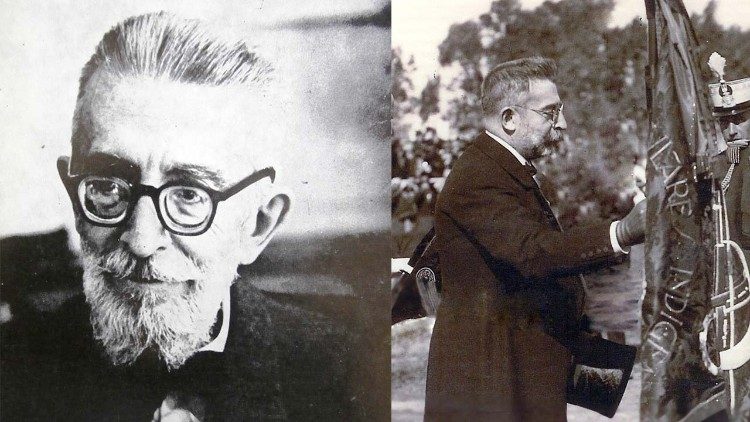
José Gálvez Ginachero (Málaga, 1866-1952) spent more than half a century caring for the poor women of his city at the Civil Hospital, was mayor of Málaga and, according to those who have studied his life, died impoverished from giving so much. His cause for beatification could make him the first gynecologist raised to the altars. The latest step was taken on October 8 and barely received attention outside Málaga: the theological consultants of the Dicastery for the Causes of Saints voted unanimously in favor of the heroism of his virtues.
None of the best-known physicians the Church has raised to the altars in the last century was a gynecologist. Giuseppe Moscati was a clinician and researcher; Gianna Beretta Molla, a pediatrician; José Gregorio Hernández, a bacteriologist and professor; Ladislao Batthyány-Strattmann, an ophthalmologist; the missionary Giuseppe Ambrosoli, a surgeon in Uganda. The Spaniards Mariano Mullerat and Pedro Sandoica, beatified as martyrs, were rural doctors. In the race for that first place, Gálvez has company. The Australian Mary Glowrey, a missionary in India who earned her doctorate in 1919 in obstetrics, gynecology and ophthalmology, has been venerable since November 2025. The Italian obstetrician Giancarlo Bertolotti, who died in 2005, closed his diocesan phase in 2021. None has yet been recognized for a miracle.
He was born on September 29, 1866 into a well-to-do family. He studied Medicine in Granada and Madrid and completed his training in Berlin and Paris. According to the postulator of his cause, Father Salvador Aguilera, he chose gynecology at the age of 22, after his mother made him see how many women died in childbirth. From Europe he brought aseptic techniques that not everyone at his hospital applied, and some colleagues, annoyed by his results, said the only difference was that he washed his hands before operating.
In 1893 he joined the Civil Hospital, the one for patients without resources, to which he remained linked until almost the end of his life and which he came to direct. He never collected his salary: he gave it to the Daughters of Charity for the needs of the patients. He treated many women free of charge and paid for their medicines, funded midwifery courses out of his own pocket and, when a patient was in serious condition, stayed overnight at the hospital, sometimes on a trunk. He is credited with more than 150,000 certified consultations, most of them to the poor. His biography recounts that in 1898 he delivered by cesarean section the daughter of a woman in labor who had just died in the hospital, and later became her godfather at baptism.
His day began at five in the morning with Mass. After lunch he prayed the rosary and, on the way home, stopped to pray at a convent. The bishop of Málaga, José Antonio Satué, recalled in April that he never entered the operating room without first pausing for a few moments in prayer. He recorded his days by hand in a notebook in which he demanded that he review “what you fail to do out of negligence, laziness or cowardice.” He was a Salesian cooperator and devotee of Mary Help of Christians, presided over the board of the Asilo de los Ángeles and supported the Ave María Schools.
Upon marrying María Moll Sampelayo, an orphan from a wealthy family, he became, according to the former diocesan postulator Francisco García Villalobos, the third wealthiest person in Málaga. He was also physician to the queen, but preferred to stay in his city, with his poor, rather than pursue a career at court. Charity ended his fortune: when he died, García Villalobos recounts, he had only one suit and no change of clothes.
He was mayor of Málaga from 1923 to 1926. He launched a sewer and sanitation plan and the construction of affordable housing for workers, and when the City Council ran out of money he paid for the works out of his own pocket. According to García Villalobos, the first councilwoman of the city, Teresa García, entered the council with him. He resigned after three years, unable to combine the mayoralty with medicine.
In August 1932 he spent three days in jail, accused of conspiring against the Government of the Republic. According to his postulator, it was the lepers he cared for who went to the civil governor to demand his release. During the Civil War he was arrested again, this time accused of being a bourgeois and of taking advantage of the poor. Before the tribunal, according to the account of the cause, he replied that many of those present had been born at dawn in his hands and that, unlike them, he had no fixed hours of rest. They set him free. One of his daughters, who was pregnant, was also detained. Even so, during the revolution he hid people in danger of death in his clinic and, after the war, testified in defense at summary trials against republicans. According to García Villalobos, that reduced many sentences and saved some from the death penalty.
He died in Málaga on April 29, 1952, shortly after receiving a visit from Bishop Ángel Herrera Oria, who presided over his funeral. A crowd bid him farewell under a downpour. His remains rest in the Basilica of La Victoria, and the city dedicated an avenue and a bust to him in the gardens of the cathedral.
Devotion to him survived. Francisco Rosas, a retired gynecologist and diocesan delegate for Health Pastoral Care, recounted in 2017 that he had seen women enter the delivery room with a photo of Dr. Gálvez, of whom their mothers were devotees. The diocesan phase of the cause closed that same year and the positio reached Rome in July 2023. After the theologians’ vote, the dossier moves to the session of cardinals and bishops of the dicastery; if it passes, Leo XIV could declare him venerable. For beatification a miracle attributed to his intercession will be needed, and his postulator is already asking for prayers that it may occur.
Read also