


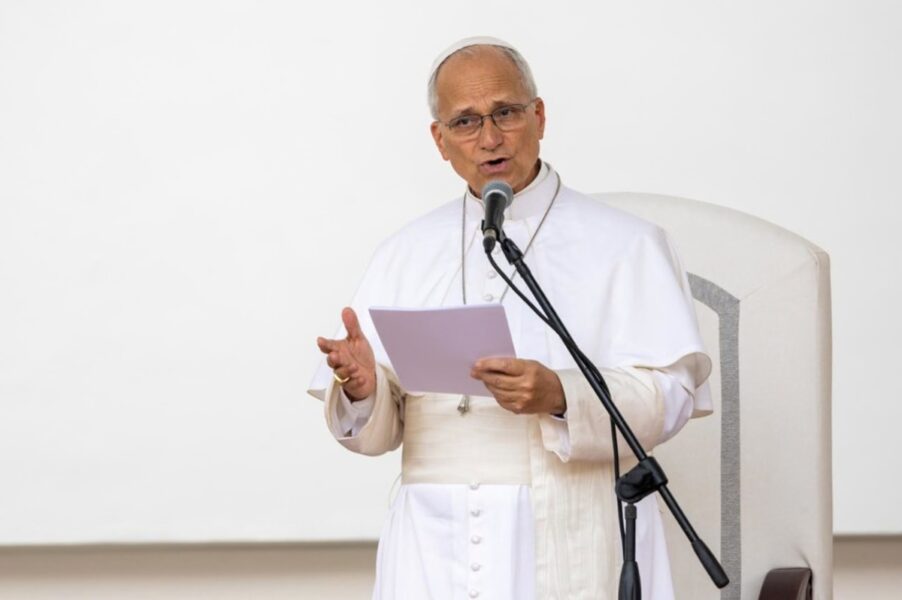
The meeting on «the challenges and hopes for the future of the Peruvian people,» scheduled for 11:30 local time, was one of the central events of the Pope’s first full day in Peru. It is the final stage of his apostolic journey through Uruguay, Argentina, and Peru, from November 6 to 17. Leo XIV greeted those present as «my dear Peruvian people.» He said he wanted to walk among them like Saint John the Baptist, «witness to the Light,» and invoked the Lord of Miracles, the most venerated devotion in the country.
The Pope structured his address around the four challenges raised by the participants: the family, cultural diversity, the world of work, and the condition of women. According to him, these are realities «in profound interdependence» that cannot be treated separately. His starting point was the social doctrine of the Church. At the center of every social, economic, and political organization must be the human person, created in the image of God and «endowed with infinite dignity.» From this derive the principles of the common good, solidarity, and subsidiarity.
The family, the «first natural society»
The longest section of the speech dealt with the family. Leo XIV recalled that human life is born from the love between a man and a woman and emphasized that the child is «the fruit of this communion, not a product.» Its beginning, «most fragile,» is entrusted to the mother’s womb, which the Pope called the «first place of welcome.»
Citing the Compendium of the Social Doctrine of the Church (n. 214), the Pontiff stated that the family «precedes any written law.» That law «must simply recognize and protect it,» and public institutions «must help it, not replace it.»
Regarding the cultural changes that have altered the roles of men and women, «sometimes in misguided ways,» the Pope cited the Aparecida Document. In the face of this situation, he maintained that it is necessary «to propose more forcefully that God created the human being male and female.» He added that «only in this union» are expressed the reciprocity and complementarity from which fatherhood, motherhood, and filiation are born. He clarified, however, that this truth does not justify inequality in domestic tasks or «the subordination of one spouse to another.»
The Pope also mentioned families wounded by emigration, poverty, gambling addiction, alcoholism, drugs, abuse, and domestic violence. He asked them not to give up and to look to the Holy Family. Regarding the digital impact, he referred to his encyclical Magnifica humanitas, where he warns that technology can supplant real coexistence.
Business, education, and cultural diversity
Regarding the world of work, Leo XIV described the company as «a community of persons» in which capital, management, and labor must be ordered toward integral human development. He called on the authorities for a just legal framework and a reasonable balance between work, rest, and family life. From the State he demanded social policies that favor families and guarantee human and intellectual formation.
On the country’s cultural plurality, the Pope cited a Creole waltz and rejected expressions that offend on the basis of appearance or origin «under the pretext of certain ‘jokes.'» He proposed meekness as a response to aggression and recalled Saint Toribio de Mogrovejo, who, he said, spread the Gospel «without impositions» among peoples of diverse languages. He cited as an example the Lima Catechism.
Call against machismo
In the final section, Leo XIV lamented the persistence of «a machista mentality.» In his view, this manifests itself in the absence of the father, abuse, and violence against women. He supported his denunciation with Benedict XVI’s inaugural address at Aparecida (2007), which affirmed the equal dignity of man and woman. He recalled the «double marginalization» suffered by poor, indigenous, and Afro-descendant women. He also issued a call: «Let us value women! Let us protect and respect girls!» As a model he proposed the Virgin Mary, citing the exhortation Marialis cultus of Saint Paul VI.
The Pontiff concluded that just structures «are necessary, but not sufficient» and that «honest hearts» are needed to overcome corruption and violence. He closed the event with the recitation of the Our Father and the blessing: «May God bless Peru!»
The full text of the speech can be read here.