


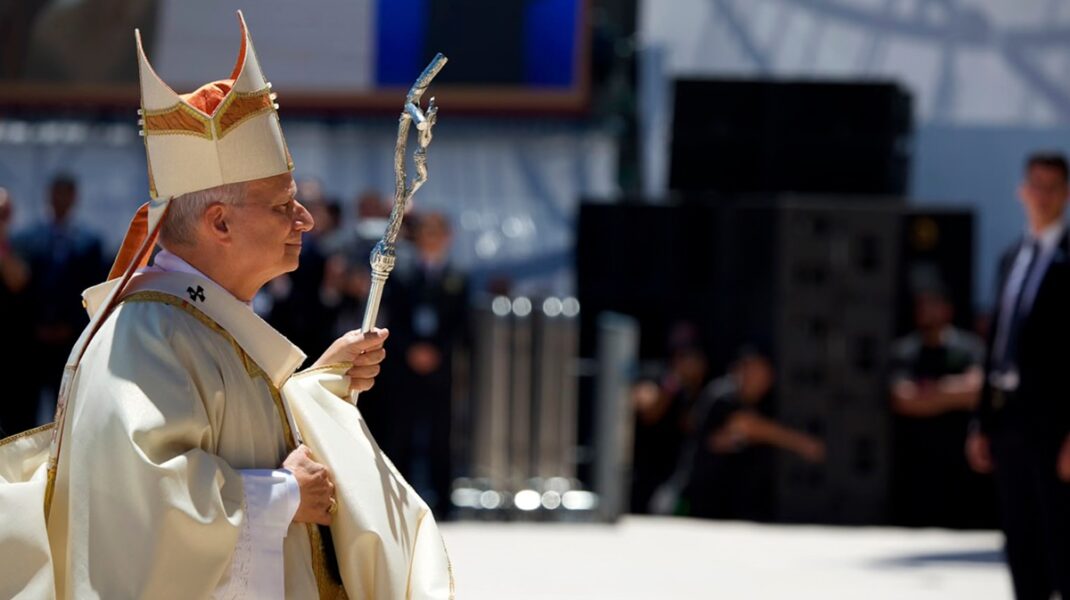
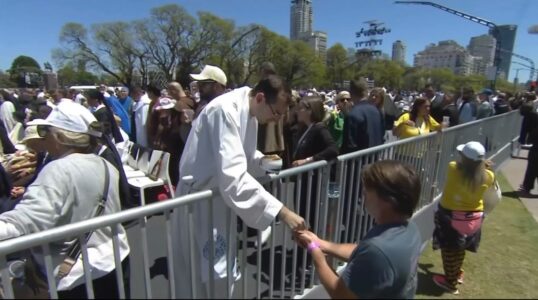
The Mass celebrated by Leo XIV this Tuesday on the grounds of the Fábrica Argentina de Aviones (FAdeA) in Córdoba drew more than half a million people, according to local television station El Doce, and offered a carefully staged image of the communion rite. The archdiocese had previously released the distribution protocol. Ministers would give the Eucharist from outside the barriers, at stations marked with black umbrellas, and with red umbrellas those suitable for celiacs.
In the video of the celebration, the faithful can be seen approaching the communion stations in orderly lines.
Palermo, under the gaze of the faithful
The day before, at the Mass for Families at the Monumento de los Españoles, the communion stations were also marked with umbrellas, according to AICA. Official sources cited by La Nación put attendance at around two and a half million people.
The difference lay in the detail with which the Córdoba archdiocese planned the distribution of the Eucharist and made it public before the celebration. Each minister had been assigned a eucharistic chapel, where they had to report at six in the morning to register, receive an identifying jacket and the final instructions. They gave communion from a fixed station beside the barriers and, when finished, returned to the same chapel to purify the ciboria and take the remaining hosts to the place of reservation. For the Palermo Mass, only the figures for the operation were released: 30 eucharistic tents, more than 2,000 ciboria and as many ministers and volunteers. No protocol of comparable precision on how the Blessed Sacrament was to be safeguarded from the tents to the faithful and back has come to light.
A reader who attended the celebration has sent this newsroom a very different account of what happened when receiving communion. According to his testimony, there were people “spread out everywhere handing out communion with no kind of order.” He claims he saw no priests administering it and that, even after the papal blessing had been given, the Eucharist was still being distributed. He adds that the Mass was preceded by a musical performance that resumed as soon as the ceremony ended. Other readers have sent images of the distribution, which accompany this report.
Journalist Mamela Fiallo summed up the contrast on X. She praised the overall organization in Buenos Aires, but considered that in Córdoba communion was better because, with so many priests present, there was no need to resort to so many extraordinary ministers. “The best way to convey the real presence is to treat it as such,” she wrote. The preliminary figures, however, point to a similar deployment in that regard: some 2,000 extraordinary ministers were also expected in Córdoba.
Not all reports agree with the complaints. EWTN News described the Palermo Mass as a moment of recollection in which many of the faithful knelt at the consecration and received communion in an orderly manner.
What the norm establishes
The instruction Redemptionis Sacramentum (2004) reserves the intervention of extraordinary ministers for when there are not enough ordinary ministers. It admits as an exception a number of faithful so large that the celebration would be unduly prolonged (nn. 157-158). The same document recalls that every faithful person has the right to receive communion on the tongue and that, if there is danger of profanation, communion should not be given in the hand (n. 92).
In large outdoor celebrations, where it is difficult to ensure that each host is consumed in the presence of the minister, safeguarding the Blessed Sacrament requires an organization that leaves nothing to improvisation. The Pope will preside over his last great Mass in the country on Wednesday, at the basilica of Luján.